
天文研究

Search documents
国际首个!我国构建→
Yang Shi Xin Wen Ke Hu Duan· 2025-09-02 01:04
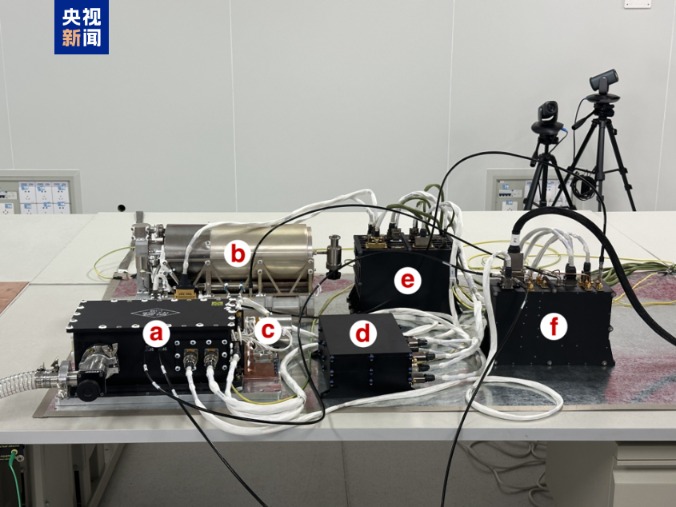
Core Insights - China's research team has successfully constructed the world's first lunar orbital VLBI (Very Long Baseline Interferometry) system, which has detected interference patterns of celestial radio emissions and spacecraft signals [1][4] - The system, known as LOVEX (Lunar Orbital VLBI Experiment), is part of China's Chang'e 7 lunar exploration program and utilizes the QiaoQiao II relay satellite platform [1][2] - LOVEX features a long baseline of approximately 380,000 kilometers and offers high spatial resolution for deep space observations and precise spacecraft tracking [4] System Details - The VLBI payload equipment was developed by the Shanghai Astronomical Observatory in collaboration with various domestic aerospace electronic technology units, including components like X-band low-temperature receivers and passive hydrogen atomic clocks [2][4] - The QiaoQiao II relay satellite was launched on March 20, 2024, and is currently in a stable orbit at a near-moon point of 300 kilometers and a far-moon point of 160,000 kilometers [2] Innovations and Capabilities - LOVEX is the first space VLBI system independently completed by a single country and is the fourth operational space VLBI project globally [4] - It boasts the longest interference baseline of about 380,000 kilometers, the widest observation bandwidth of 512 MHz, and the highest data rate of 2 Gbps among all space VLBI systems [4] - The system has achieved the first VLBI measurement test of deep space probes in the space-earth baseline and has successfully stored raw VLBI data onboard in a space mission environment [4] Future Contributions - As data collection and scientific analysis progress, LOVEX is expected to provide deeper insights into the astronomical environment and contribute significantly to future deep space exploration capabilities [6]

【科技日报】我国两台太阳系天体观测望远镜建设启动
Ke Ji Ri Bao· 2025-06-23 00:53
Core Points - The China Academy of Sciences' Purple Mountain Observatory launched two significant telescope projects aimed at enhancing the precision measurement of celestial bodies within the solar system [1][2] - The 4.2-meter ground-based dedicated celestial measurement telescope is the largest of its kind in China and is expected to be completed by 2027, focusing on high-precision measurements of faint celestial bodies [1] - The 2.5-meter multi-terminal general telescope is designed for various observational needs and is projected to be completed by 2026, serving national strategic requirements such as space safety and asset protection [2] Group 1 - The 4.2-meter telescope features large aperture, low distortion imaging, high precision positioning, and deep detection limits, supporting the autonomous construction and long-term maintenance of China's solar system celestial catalog [1] - The 2.5-meter telescope will conduct multi-band and multi-type precision measurements of both natural and artificial celestial bodies, complementing the efforts of the 4.2-meter telescope [2] - Both telescopes will work in tandem to provide comprehensive mapping of various moving celestial bodies within the solar system, with the 4.2-meter telescope focusing on distant and faint objects while the 2.5-meter telescope targets closer and faster-moving entities [2]
“中国天眼”发现罕见掩食脉冲星
Xin Hua She· 2025-05-22 18:53
Core Findings - Chinese scientists discovered a rare millisecond pulsar PSR J1928+1815 in the Milky Way using the "China Sky Eye," which is obscured by its companion star for one-sixth of its time, and the companion star's mass is significantly higher than typical companion stars of eclipsing pulsars [1][2][3] Group 1: Scientific Significance - The discovery of PSR J1928+1815 is crucial for studying stellar evolution, compact star accretion, and gravitational wave sources from binary star mergers [1][3] - The unique characteristics of this pulsar and its companion star provide valuable observational data for understanding the common envelope evolution of binary star systems [2][3] Group 2: Characteristics of the Pulsar and Companion Star - PSR J1928+1815 has a rotation period of 10.55 milliseconds and orbits its companion star with a period of 3.6 hours, with the companion star having a mass of at least one solar mass [2] - The companion star is inferred to be a high-temperature helium star, and the pulsar's signal obscuration is caused by the stellar wind material ejected from the helium star [3]

“悟空”号宇宙线研究获国际性突破
Xin Hua Ri Bao· 2025-05-20 22:56
Core Insights - The "Wukong" satellite has achieved the first precise measurement of the secondary cosmic ray boron spectrum in the TeV/n energy range, providing new observational evidence for revising cosmic ray propagation models [1][2] - The satellite's findings indicate a significant hardening structure in the boron spectrum around 200 GeV/n, suggesting that cosmic ray propagation may be slower than previously anticipated [2] Group 1: Scientific Achievements - The "Wukong" satellite, launched by China, is the first astronomical satellite dedicated to observing high-energy particles in space, with core scientific goals including dark matter particle detection and cosmic ray research [1] - The international collaboration group utilized eight years of observational data to achieve precise measurements of the boron element spectrum from 10 GeV/n to 8 TeV/n, surpassing previous space detection experiments in both measurement precision and energy limits [2] Group 2: Implications for Cosmic Ray Research - The observed hardening of the boron spectrum indicates that the particle flux at higher energies significantly exceeds classical model predictions, with the spectrum index increase being approximately twice that of primary cosmic ray protons and helium nuclei [2] - These findings are crucial for understanding the acceleration and propagation mechanisms of cosmic rays, as they provide insights into the diffusion process of cosmic rays in the universe [2]
AI“助手”加入天文研究行列
Ke Ji Ri Bao· 2025-05-10 02:21
Core Viewpoint - The exploration for extraterrestrial life is being revolutionized by the integration of artificial intelligence (AI) into astronomical research, enhancing data analysis and hypothesis generation capabilities [1][2][6]. Group 1: AI in Astrobiology - NASA's "AstroAgents" system, consisting of eight AI agents, is designed to autonomously conduct research in astrobiology, analyzing data and generating scientific hypotheses [2][3]. - The system aims to study Martian samples to identify organic molecules that may indicate past or present life [2][3]. - AI agents utilize large language models to actively participate in research, determining research content and methods, and evaluating results [2][3]. Group 2: Discovering Exoplanets - The ExoMiner project, developed by NASA scientists, has successfully identified 370 previously unknown exoplanets using machine learning techniques [4][5]. - Despite the discovery, none of the identified exoplanets have environments similar to Earth, indicating a challenging search for habitable conditions [4][5]. Group 3: SETI and Electromagnetic Signal Monitoring - The SETI program is employing AI to analyze electromagnetic signals across a wide wavelength range, enhancing the search for extraterrestrial intelligence [6][7]. - A new AI-driven software system is being developed for the Very Large Array (VLA) to process vast amounts of data, significantly improving the efficiency of signal detection [6][7]. - SETI's efforts include scanning millions of stars and hundreds of galaxies for signs of life, with AI also being used to analyze Martian rock samples for biological indicators [6][7].