AI Coding

Search documents
AI Coding 产品的陷阱:有 PMF 但还没有做到 BMPF
投资实习所· 2025-08-18 06:22
Core Insights - AI Coding has emerged as the fastest-growing category in AI applications, with companies like Cursor, Claude Code, Lovable, and Replit experiencing rapid growth and new products continuously entering the market [1] - Lovable's ARR is projected to reach $250 million by the end of the year, with a potential to exceed $1 billion in the next 12 months [1] Group 1: Growth and Challenges - Despite the rapid growth in AI Coding, many companies are struggling to achieve profitability, with Replit's CEO noting that their previous fixed pricing model led to negative profits [2] - Replit has shifted to a usage-based pricing model, achieving a gross margin of around 23%, while targeting the enterprise market where margins can reach nearly 80% [2] - Heavy users of AI Coding products may lead to significant losses, with some companies reporting profit margins as low as -300% to -500% [2] Group 2: Business Model and Market Fit - The concept of Business Model-Product Fit (BMPF) is crucial, as it ensures that the value extracted from the product can sustainably exceed the costs of delivering that value [5] - Companies like Cursor have relied on subscription models that allow "unlimited" usage, leading to variable costs that can spiral out of control without proper pricing discipline [6] - The lack of pricing discipline can lead to a downward spiral similar to failed companies like MoviePass, where rapid growth obscures underlying profitability issues [6][8] Group 3: User Expectations and Pricing - Users expect top performance from AI coding products, which ties the cost of goods sold (COGS) to the pricing set by leading AI model providers like OpenAI and Anthropic [7] - If companies lower their model quality to reduce costs, they risk losing performance-focused users, while maintaining high-quality models without raising prices can lead to unsustainable costs [7] - The challenge lies in determining whether user demand is for the product itself or merely for the subsidies provided [11] Group 4: Future Outlook - The AI infrastructure layer, positioned between models and applications, is expected to be a significant winner, with some companies in this space achieving gross margins as high as 76% [13] - Recent funding rounds have seen valuations for these infrastructure companies soar from $3 billion to $9 billion within a year, indicating strong growth potential [13]


AI 招聘 Micro1 估值 5 亿美金,又一 AI Coding 每 10 天新增 100 万美金 ARR
投资实习所· 2025-08-14 05:53
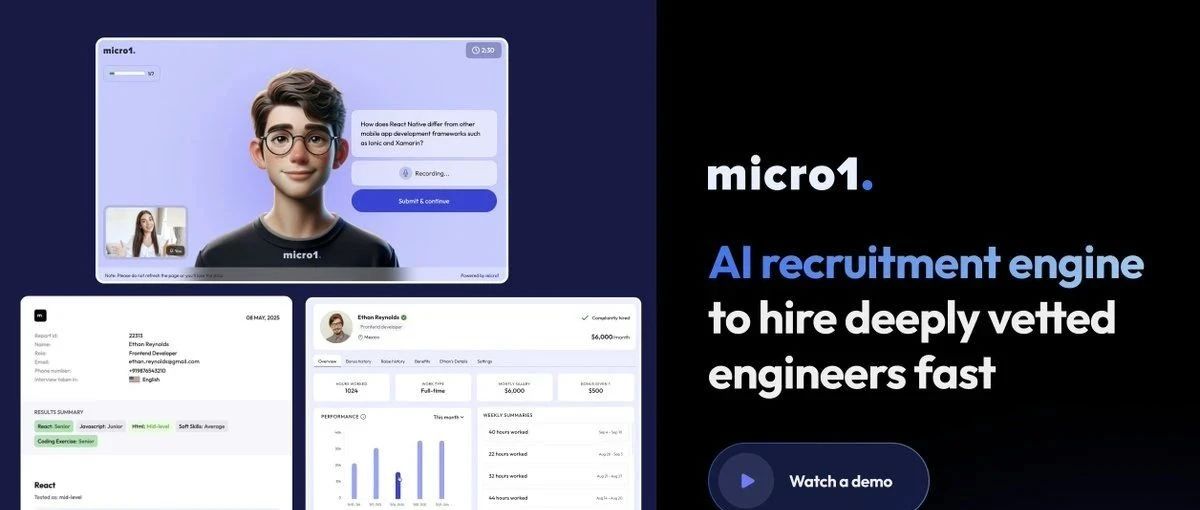
Core Insights - The rapid growth of AI recruitment products is driven by the increasing demand for talent in the AI sector, with Mercor's latest valuation reaching $10 billion [1] - Meta's investment in Scale AI has positively impacted other companies in the AI recruitment space, leading to significant growth in platforms similar to Scale AI [1][2] - Micro1, a competitor to Mercor, has also experienced rapid growth, with its valuation rising from $8 million to $500 million in a short period [1][5] Group 1: Company Developments - Mercor has gained attention for its AI voice product, raising nearly $60 million and achieving a valuation of $10 billion [1] - Micro1 positions itself as an AI recruitment platform that simplifies the hiring process by screening and matching top software engineering talent globally [2] - Micro1's annual revenue has surged from approximately $800,000 in March to over $5 million currently, indicating strong demand for its services [5] Group 2: Market Trends - The demand for training data among AI companies has led many to adopt business models similar to Scale AI and Surge, with Surge reportedly raising $1 billion at a $15 billion valuation [4] - Micro1's AI Recruiter conducts thousands of interviews daily, allowing it to build a substantial talent pool and adapt to various time zones and language barriers [4] - The AI coding sector is also witnessing rapid growth, with new products emerging and achieving significant revenue increases, such as one product that has grown its revenue 19 times this year [5]
a16z 和红杉抢投一 AI 硬件平台,Replit 估值 30 亿美金 ARR 近 1.5 亿
投资实习所· 2025-08-11 06:27
Core Insights - The competition in the AI coding sector is intensifying, with companies like Lovable and Replit achieving significant milestones in funding and annual recurring revenue (ARR) [1][5] - Replit's recent funding round raised $250 million, increasing its valuation to $3 billion, more than doubling from its previous valuation of $1.16 billion [1] - Replit's ARR reached approximately $144 million as of July, marking a rapid growth from $10 million to over $100 million in just six months [1][5] Funding and Valuation - Lovable completed a funding round at an $1.8 billion valuation, with an ARR surpassing $100 million [1] - Replit's latest funding round was led by Prysm Capital, raising $250 million and pushing its valuation to $3 billion [1] - The significant increase in Replit's valuation reflects strong investor confidence and market potential in the AI coding space [1] Product Development and Features - Replit differentiates itself by not only generating code but also building a comprehensive deployment infrastructure over several years [2] - New features introduced by Replit include a checkpoints and rollbacks system, enhancing project management and safety [2][4] - The separation of development and production environments allows developers to operate more freely without risking user experience [4] Business Model and Profitability - Replit shifted from a fixed pricing model to a usage-based billing system due to previous negative profit margins [5] - The current gross margin for Replit stands at approximately 23% [5] - Future plans for Replit focus on autonomy, with the aim for its Agent to operate for over one hour, reinforcing the sustainability of the usage-based model [6] Market Trends - The AI hardware sector is also witnessing growth, with Amazon acquiring an AI hardware product that saw a 150% increase in functionality last year [7] - New AI products are emerging, such as those integrating AI with brain interfaces to enhance user interaction [7]

AI 算命 3 个月做到月入 100 万美金,又 3 个 AI Coding 突破 1 亿美金 ARR
投资实习所· 2025-07-24 05:48
Core Insights - The AI coding industry is experiencing rapid growth, with Lovable recently announcing a $200 million funding round and achieving over $100 million in ARR within just 8 months, showcasing the speed of innovation in the AI era [1] - Lovable has introduced Lovable Agent, which reportedly reduces error rates by 91% and enhances workflow capabilities, allowing for more complex tasks such as code reading and debugging [1] - The competitive landscape is intensifying, with Lovable entering the enterprise market and Replit also making significant moves, including the acquisition of Cognition [2] Group 1: Lovable and Replit - Lovable's new Business version targets larger B2B clients by adding collaboration, security, and privacy features [2] - Replit has also shown impressive growth, with its ARR increasing from $10 million to $100 million in just 6 months, and Cognition's overall ARR estimated to be around $150 million [2] Group 2: Other Players in AI Coding - Anthropic's Claude Code is reportedly nearing $200 million in ARR, indicating strong market reception and potential for further growth [3] - Augment Code has experienced explosive growth, achieving a 5x increase in the last 3 months and securing multiple million-dollar deals with enterprise clients [3] Group 3: Newsletter and Creator Economy - Substack has raised $100 million at an $11 billion valuation, while Beehiiv has surpassed $30 million in annual revenue [4] - The platform Every has achieved over $1 million in ARR, focusing more on content compared to Substack and Beehiiv [4]

5个月狂赚4000万美金,一名“工作狂”的绝地求生
虎嗅APP· 2025-07-18 10:20
Core Viewpoint - The article discusses the rapid growth and innovative features of Bolt.new, an AI coding assistant that simplifies software development for users with no programming background, highlighting its potential in the competitive AI coding market [4][5][16]. Company Overview - Bolt.new, launched in October 2024, achieved an annual recurring revenue (ARR) of $40 million within five months and has over 300,000 registered users, making it one of the fastest-growing software products in history [5][13]. - The application allows users to create complete applications by simply describing their needs in natural language, significantly lowering the barrier to entry for software development [7][21]. Growth Metrics - Within the first week of its launch, Bolt.new's user base doubled compared to its parent company StackBlitz's total users, reaching an ARR of $400,000 in four weeks and $2 million in eight weeks [13][14]. - By March 2025, the ARR reached $40 million, with over 1 million monthly active users [14]. Market Position - The AI programming market is rapidly growing, with a projected increase from $4.29 billion in 2023 to $24.46 billion by 2031, averaging a growth rate of 24.3% annually [26]. - Bolt.new operates in a competitive landscape with other players like Lovable, Cursor, and Windsurf, each targeting different segments of the market [26][33]. Competitive Advantage - Bolt.new targets a B2C market, focusing on users with no programming experience, which differentiates it from competitors that cater to more experienced developers [16][33]. - The product's simplicity and community-driven approach have contributed to its viral growth, relying on user feedback for rapid iterations and improvements [37][38]. Business Model - Initially free, Bolt.new introduced a basic $9 subscription plan, later transitioning to a token-based pricing model to accommodate high-frequency users while maintaining accessibility for casual users [38][40]. - The subscription model allows for flexibility in pricing based on usage, which is a departure from traditional subscription models in the coding tool market [40]. Industry Challenges - The AI coding sector faces challenges such as code quality issues, dependency on advanced AI models, and competition from larger tech companies that could replicate Bolt.new's model [29][43]. - The reliance on upstream AI models for performance and service quality poses risks, particularly if there are disruptions in model development or supply [43].

Lovable 完成 2 亿美金融资,Newsletter 产品 Beehiiv 年营收突破 3000 万美金
投资实习所· 2025-07-17 13:31
Core Insights - Lovable, a product by Vibe Coding, has completed a $200 million Series A funding round, achieving a valuation of $1.8 billion, led by Accel with participation from other investors [1] - The platform targets individuals who previously lacked opportunities to build products, with a current team of 45 and 2.3 million active users, of which over 180,000 are paying customers [1] - Lovable's annual recurring revenue (ARR) is projected to reach $90 million soon, potentially becoming the second Vibe Coding product to surpass $100 million ARR after Replit [1] Group 1 - Lovable's founder mentioned that 100,000 startups are created on the platform each month, with 2.5 million websites built in June alone, accounting for over 10% of new internet sites that month [2] - The AI programming sector is experiencing intense competition, highlighted by acquisitions and talent wars, including Wix's $80 million acquisition of Base44 and the bidding war for Windsurf [2] - Major companies like Amazon and Figma are entering the AI coding space, indicating ongoing developments in this sector [3] Group 2 - Beehiiv, a newsletter product, has surpassed $20 million in ARR, with an additional $10 million from its advertising platform, totaling $30 million in annual revenue [3][4] - The founder of Beehiiv expressed optimism about future growth, noting a 64% month-over-month revenue increase in May [4] Group 3 - The article includes insights from Tyler Denk, founder of Beehiiv, on entrepreneurship, emphasizing that challenges persist regardless of the stage of the business [6] - It discusses the evolving nature of goals in entrepreneurship, the limited utility of advisors, and the importance of focusing on product development rather than investor prestige [11][12] - The significance of remote work, co-founders, and the necessity of accountability in roles are also highlighted as key factors for success [15][16][35]

速递|Cursor率先迈进百亿美元估值俱乐部,ARR66倍,海外AI编程全面开花
Z Potentials· 2025-03-09 03:44
Core Insights - Investor interest in AI programming assistants is surging, with Cursor's Anysphere product in talks to raise funds at a nearly $10 billion valuation [1] - Anysphere's previous funding round valued the company at $2.5 billion based on a $100 million ARR, indicating a significant increase in investor willingness to pay higher multiples for fast-growing companies [1] - Current ARR for Anysphere may have risen to $150 million, suggesting a potential valuation of 66 times its ARR if the new funding round is successful [1] - Codeium, the company behind the AI coding editor Windsurf, is seeking funds at a nearly $3 billion valuation, with investors valuing it at 70 times its approximately $40 million ARR [2] - The rapid adaptation of AI in coding tools is outpacing its application in other sectors such as sales, legal, and healthcare [2] - Investors are also engaging with Poolside, another AI coding company developing its own LLM [3]

Lovable:3 个月 ARR 破 1700 万美元,付费用户留存超过 ChatGPT
海外独角兽· 2025-03-06 12:28
Core Viewpoint - Lovable is rapidly emerging as a leading AI coding startup, achieving remarkable growth with an ARR increase of $1 million weekly, reaching $17 million in just three months, and boasting over 30,000 paid users, making it one of the fastest-growing startups in Europe [1][5][48]. Group 1: Lovable Overview - The software development market faces two main pain points: the difficulty for non-technical individuals to write code and the inefficiency of the software development process [3]. - 99% of the global population cannot code, creating a gap between technology and creativity, which Lovable aims to bridge by enabling users to build software using natural language [3][4]. Group 2: Product - Lovable allows users with no coding experience to create and refine web applications using natural language, significantly speeding up the development process [4][7]. - The product integrates with Supabase for backend functionalities, positioning itself as the world's first AI full-stack engineer [8][10]. - Lovable's mission is to create a tool that can reliably run AI-generated code by 2025, enhancing user experience and addressing programming pain points [7][8]. Group 3: Team - The Lovable team consists of experienced entrepreneurs and former employees from Google and Stripe, aiming to establish Lovable as a core player in European AI engineering [24][25]. - The team employs advanced AI techniques to ensure the accuracy and reliability of the code generated by Lovable, setting it apart from competitors [25][26]. Group 4: Growth - Lovable has experienced exponential growth, achieving an ARR of $17 million within three months of launch, with a user base that includes entrepreneurs, designers, and freelancers [48][49]. - The company has successfully transitioned from a free usage model to a subscription-based model, with a significant increase in paid users [33][39]. - Lovable's marketing strategies, including user engagement through social media and community building, have contributed to its rapid user acquisition [50][51]. Group 5: Market Competition and Cooperation - Lovable faces intense competition from traditional website builders like Wix and other AI coding tools, but its user-friendly approach for non-technical users is a key differentiator [50][52]. - The integration with GitHub and Supabase enhances Lovable's capabilities, but also increases its dependency on these partners [64]. Group 6: Future Impact of Lovable - Lovable is democratizing software development, allowing non-technical users to create software and potentially sparking a wave of innovation [59][60]. - The platform accelerates product iteration and fosters an experimental culture, enabling users to quickly test and adjust their ideas [61].