AI Healthcare

Search documents
Tempus AI Boosts Its Clinical AI Capabilities Through Strategic Moves
ZACKS· 2025-12-05 14:46
Core Insights - Tempus AI is transitioning into a more scalable AI-driven healthcare platform, integrating genomics, real-world data, and clinical AI, with improved financial performance and a shift from heavy investment to maturity [2][9] Financial Performance - In the past year, Tempus' shares have increased by 43.6%, significantly outperforming the industry, which saw a decline of 0.4%, while the S&P 500 composite rose by 15.6% [8] Business Segments - The genomics segment is strong, with increasing test volumes in oncology and hereditary diseases, supported by an expanding test menu that provides higher-value clinical insights [3] - The Insights and Data & Services segment is becoming a higher-margin and scalable revenue stream beyond traditional genomic testing [3] Strategic Developments - Tempus achieved notable regulatory milestones in AI-powered diagnostics during the first nine months of 2025 and is building strategic partnerships for long-term growth, including a collaboration with Whitehawk Therapeutics [4] - The acquisition of Paige has enhanced Tempus' digital pathology capabilities, adding millions of digitized, clinically annotated slides and computational-pathology expertise [5] Valuation Metrics - Tempus currently trades at a forward 12-month Price-to-Sales (P/S) ratio of 8.82X, compared to the industry average of 5.77X, indicating an expensive valuation [10] Earnings Estimates - The loss per share estimate for 2025 has narrowed by 9 cents in the past 30 days, reflecting improved expectations [11]



Why Tempus AI Stock Soared This Week
The Motley Fool· 2025-11-28 20:18
Core Insights - Tempus AI stock has shown significant performance, rising 10.9% compared to the S&P 500's 3.7% increase, indicating strong investor interest and market confidence in the company [2] - Cathie Wood's Ark Invest has increased its holdings in Tempus AI, with the Ark Innovation ETF adding 29,605 shares and the Ark Genomic Revolution ETF acquiring 9,302 shares, reflecting a bullish outlook on the stock [3] - BTIG analyst Mark Massaro has raised the price target for Tempus AI from $96 to $105, suggesting a potential upside of 38% based on the stock's recent closing price [5] Company Performance - Tempus AI's market capitalization stands at $14 billion, with a current stock price of $77.93 and a gross margin of 60.33% [4] - The stock has experienced a 52-week price range of $31.36 to $104.32, indicating volatility and growth potential [4] Market Sentiment - Despite the recent rise of nearly 11% in Tempus AI stock, analysts believe there is still considerable room for growth as the company continues to develop new AI applications for healthcare [6] - The positive sentiment from analysts and institutional investors suggests that Tempus AI is viewed as a promising investment opportunity in the healthcare sector [1][3]

「紫荆智康」获近亿元天使轮融资,加速AI医院系统开发及落地 | 早起看早期
36氪· 2025-11-11 00:10
Core Insights - "Zijing Zhikang" has completed nearly 100 million yuan in angel round financing, led by Xinglian Capital, with the funds primarily allocated for the development and iteration of the Zijing AI Hospital system [2] - The company aims to leverage advanced large model AI technology to create a virtual medical world system, enhancing smart healthcare applications in the real world [2] - The Zijing AI Hospital's core logic involves simulating real hospital facilities and processes, particularly by creating highly human-like, diverse AI patients to meet initial training data needs [2] Data and Training Challenges - High-quality data and case studies are essential for training AI doctors, but challenges such as data silos and difficulty in data acquisition persist in the real medical world [3] - Zijing Zhikang's core technology team is addressing the cold start problem by synthesizing some case data using AI, creating "evolvable intelligent agents based on simulations" [3] - The AI hospital has constructed over 500,000 AI patients covering various countries, age groups, and disease types, serving as a significant supplement for training AI doctors [3] AI Doctor Evolution - The AI doctors are designed to possess self-evolution capabilities, with a specific memory and reflection algorithm to accumulate "experience" during consultations [5] - The evolution of AI doctors is expected to be faster than that of human doctors, with experimental results indicating that the AI's capability evolution curve aligns with Scaling Law [5] - Zijing Zhikang has developed 42 AI doctors that achieved over 96% accuracy on the MedQA dataset, surpassing the average level of human doctors [5] Product Development and Features - The AI system includes three interfaces: a patient app, a doctor workstation, and a hospital system, facilitating full-cycle health management [5] - Patients can register online, engage in intelligent pre-consultation, and generate structured medical records, while doctors can access these records to save time during consultations [5] - The system is designed to manage health data over time, providing health advice and allowing patients to utilize AI for health consultations and report interpretations [5] Future Plans and Regulatory Alignment - The Zijing AI Hospital system is set to launch publicly by the end of 2025, with initial internal testing already conducted in various departments at Tsinghua University Hospital [6] - The system's development aligns with recent government initiatives aimed at promoting and regulating the application of AI in healthcare, potentially enhancing service capabilities and efficiency in grassroots medical settings [6]

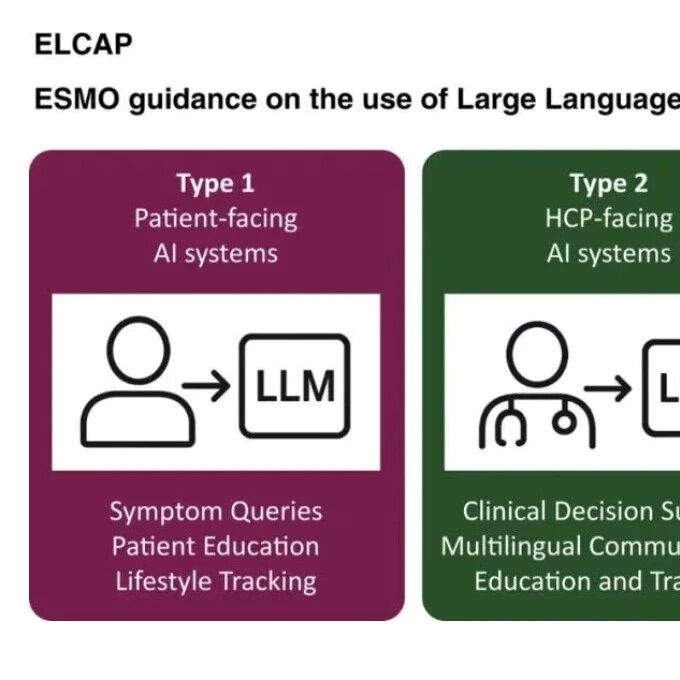
速递|全球首创!ESMO重磅发布AI医疗指南,23项共识精准回应行业难题!
GLP1减重宝典· 2025-11-10 13:34
Core Viewpoint - The article emphasizes the urgent need for guidelines on the application of AI in healthcare, particularly in oncology, as AI tools like ChatGPT become more prevalent in the medical field. The European Society for Medical Oncology (ESMO) has released the first systematic framework for the safe integration of large language models (LLMs) in oncology practice, focusing on data protection, clinical oversight, and decision support [2][3]. Group 1: AI Application Categories - ESMO categorizes AI applications into three types, each with specific safety and governance recommendations [3]. Group 2: Type 1 LLM Applications - Patient-Facing Tools - Type 1 applications include chatbots and virtual assistants that provide symptom information or treatment advice. A study involving a GPT-4-based breast cancer chatbot highlighted the importance of clear communication from patients to receive accurate information [7][8]. - Key recommendations for patients include maintaining open dialogue with healthcare providers, not treating LLMs as replacements for in-person consultations, and ensuring privacy when sharing health data [7][8][9]. Group 3: Type 2 LLM Applications - Medical Professionals - Type 2 applications are designed for oncologists and healthcare teams, focusing on decision support, documentation, and translation. These tools can assist in clinical decision-making but require strict validation and clear accountability mechanisms [10][12]. - Recommendations for healthcare professionals include verifying AI-suggested information, maintaining human oversight, and not delegating final responsibility for patient care to AI [11][12]. Group 4: Type 3 LLM Applications - Backend Systems - Type 3 applications operate in the background of healthcare institutions, focusing on tasks like data extraction from electronic health records (EHRs) and patient screening for clinical trials. The quality of AI outputs heavily relies on the accuracy and completeness of clinical documentation [13][15]. - Continuous performance monitoring and institutional governance are emphasized to ensure the reliability and safety of these AI systems [15].
民生北分战略赋能 2025京津冀创新医学转化与产业促进大赛 金融活水浇灌健康新质生产力
Bei Jing Qing Nian Bao· 2025-10-08 18:19
Core Insights - The 2025 Beijing-Tianjin-Hebei Innovation Medical Transformation and Industry Promotion Competition concluded successfully, with a focus on creating a collaborative medical industry demonstration zone and developing new productive forces in health [1] - Minsheng Bank Beijing Branch provided strategic support throughout the event, leveraging its expertise in "finance + technology" to enhance the transformation of medical innovations [1] Group 1: Event Overview - The competition attracted 405 high-quality projects from both domestic and international participants, covering four key areas: medical devices and intelligent manufacturing, innovative pharmaceuticals and biological products, AI healthcare and health management, and traditional Chinese medicine innovation [1] - After three stages of evaluation, 35 projects were awarded prizes in the final competition [1] Group 2: Minsheng Bank's Role - Minsheng Bank Beijing Branch has positioned itself as a crucial link between innovation and industry, focusing on the integration of financial power with the innovation, industry, and resource chains in the Beijing-Tianjin-Hebei region [1] - The bank has introduced measures to address the cross-border development needs of medical innovation enterprises, including automated online collection, material fee exemptions for quality enterprises, and integrated cross-border financing services [1] Group 3: Financial Services for Medical Innovation - The bank has developed a comprehensive service model that integrates settlement, financing, and technology to alleviate financial pressures faced by the pharmaceutical industry [2] - Moving forward, Minsheng Bank Beijing Branch aims to continuously optimize its medical financial service system to support high-quality development in the regional pharmaceutical and health industry [2]

Tempus AI: Is TEM Stock A 10x Growth Story?
Forbes· 2025-09-12 13:59
Core Insights - Tempus AI has received FDA approval for its upgraded Tempus Pixel platform, a cardiac imaging system utilizing advanced AI for accurate heart imaging [2] - The stock has seen significant growth, climbing over 33% in a month, with potential for even greater returns, possibly up to 10x [3] Company Overview - Tempus is likened to the "Google of healthcare data," possessing the largest library of clinical and molecular data, and applying AI for precision medicine across various fields including oncology, cardiology, and mental health [4][9] - The company transforms data into real-time insights, aiding physicians in making informed treatment decisions [5] Financial Performance - Tempus has achieved an average revenue growth rate of 50% over the past three years, with Q2 2025 revenue increasing by 90% year-over-year, and a full-year revenue outlook raised to $1.26 billion, indicating over 80% growth from the previous year [6] - The company is nearing EBITDA profitability, showcasing accelerating growth and improving margins [6] Market Potential - The AI healthcare market is projected to exceed $800 billion by 2030, with Tempus positioned as a significant player by personalizing treatments through AI [8] - Tempus has generated nearly $1 billion from pharmaceutical partnerships, indicating strong demand for its data and AI capabilities [17] Growth Drivers - Tempus benefits from a growing clinical sequencing volume and a robust database, which enhances its AI capabilities and attracts more clients, creating a "virtuous cycle" [17] - The company has multiple revenue streams, including diagnostic tests, pharma partnerships, data licensing, and custom AI models [17] - Expansion into new areas such as cardiology and mental health significantly increases its addressable market [17] Valuation Insights - If Tempus scales its revenue to $20 billion, it could achieve substantial profitability, with potential net margins of 22-25%, leading to a valuation of approximately $175 billion based on a median earnings multiple of 35 [11] - The company’s current market cap stands at $15 billion, suggesting significant upside potential if it captures a portion of the growing AI healthcare market [10][11]


AI+临床决策支持:商业化加速落地,有望助力行业提质增效
2025-09-04 14:36
Summary of Key Points from the Conference Call Industry Overview - The conference call discusses the development of AI in the healthcare sector in China, which has evolved through three main stages: electronic data, internet healthcare, and smart healthcare and innovation [1][2]. Core Insights and Arguments - **AI Applications**: AI is widely applied in medical imaging, pathology analysis, and clinical decision support, particularly in diagnostic assistance, which helps reduce diagnostic discrepancies and improve healthcare efficiency [1][4]. - **Market Growth**: The Chinese AI healthcare market has grown from 2.7 billion yuan in 2019 to 10.7 billion yuan in 2023, with a compound annual growth rate (CAGR) exceeding 40%. It is projected to approach 100 billion yuan by 2028, accounting for 15.4% of the entire AI industry [1][6]. - **Driving Factors**: Key drivers for AI healthcare development include the increasing medical demand due to an aging population, the mismatch of quality resources, and the rapid advancement of large model technologies like Deepseek [1][5]. - **Policy Support**: National policies have significantly promoted the application of AI in auxiliary diagnosis, health management, and medical insurance services, enhancing the efficiency of grassroots healthcare services [1][7]. Additional Important Content - **Clinical Decision Support Systems (CDSS)**: Specific applications of AI in CDSS include intelligent analysis of medical images and pathology, which can significantly reduce misdiagnosis rates, such as in early esophageal cancer detection [4]. - **Market Penetration**: The penetration rate of AI-assisted diagnosis in grassroots healthcare is currently only 19%, indicating substantial future growth potential [9]. - **Lessons from International Experience**: The early experiences of IBM Watson highlight the complexities of integrating AI in healthcare, including challenges in technology, data, and clinical scenarios, as well as the need for market education [10][11]. - **Investment Focus**: Investors are advised to focus on leading companies in niche sectors with rich data resources and those with model advantages, as these companies are expected to achieve rapid scale expansion and improved profitability once they cross the maturity threshold [14]. Conclusion - The AI healthcare market in China is poised for significant growth, driven by technological advancements, policy support, and increasing demand for efficient healthcare solutions. Investors should target companies with strong technological capabilities and clear commercialization paths to capitalize on this emerging opportunity [12][14].
Tempus' Key Acquisitions Strengthen Its AI Healthcare Leadership
ZACKS· 2025-08-26 13:46
Acquisitions and Growth Strategy - Tempus AI, Inc. announced the acquisition of Paige for $81.25 million, which includes nearly 7 million digitized pathology slide images and FDA-cleared AI tools, enhancing its digital pathology capabilities [1][8] - In March, Tempus acquired Deep 6 AI, expanding its access to medical records from over 30 million patients across 750 healthcare providers, thereby enhancing its healthcare platforms [2][8] - Earlier this year, Tempus completed the acquisition of Ambry Genetics for $375 million in cash and $225 million in stock, broadening its healthcare offerings into areas such as pediatrics, women's health, and rare diseases [3][8] Industry Position and Performance - Year to date, Tempus AI shares have surged 121.3%, significantly outperforming the industry growth of 27% and the S&P 500's 9.8% improvement [6] - Tempus AI currently trades at a forward 12-month Price-to-Sales (P/S) ratio of 9.04X, compared to the industry average of 5.90X, indicating a relatively expensive valuation [9] Financial Estimates - In the past 30 days, Tempus AI's loss per share estimate for 2025 has decreased by 3%, reflecting a slight adjustment in financial expectations [10] - Current loss per share estimates for the upcoming quarters and years are projected at -0.16 for the current quarter and -0.69 for the current year [11]

又一家AI医疗独角兽诞生,1/4的美国医生都在用
创业邦· 2025-04-10 00:03
Group 1 - The core viewpoint of the article highlights that OpenEvidence, an AI healthcare company, has secured $75 million in funding from Sequoia Capital, achieving a valuation of $1 billion and becoming a unicorn in the AI healthcare sector [1] - OpenEvidence was founded in 2021, with its founder Daniel Nadler initially investing $5 million of his own money to kickstart the company [1] - In 2023, OpenEvidence received additional investments from friends and family, indicating strong personal and community support for the company's growth [1]