Space Technology

Search documents
AST SpaceMobile: Delays Present A Buying Opportunity
Seeking Alpha· 2025-12-10 01:11
Core Insights - AST SpaceMobile's share price has experienced significant fluctuations due to launch delays and SpaceX's spectrum acquisition, but no developments have altered the outlook on the company's prospects [1] Company Analysis - Narweena, an asset manager led by Richard Durant, focuses on identifying market dislocations stemming from a poor understanding of long-term business prospects [1] - The firm aims to achieve excess risk-adjusted returns by targeting businesses with secular growth opportunities in markets characterized by barriers to entry [1] - Narweena's investment strategy emphasizes company and industry fundamentals to uncover unique insights, with a preference for smaller cap stocks and markets lacking obvious competitive advantages [1] Market Trends - An aging population with low growth and stagnating productivity is expected to create a different set of investment opportunities compared to historical trends [1] - Many industries may face stagnation or secular decline, which could paradoxically enhance business performance due to reduced competition [1] - Conversely, some businesses may encounter rising costs and diseconomies of scale, while economies increasingly favor asset-light business models, leading to a decline in infrastructure investment needs [1] - A large pool of capital is pursuing a limited number of investment opportunities, resulting in rising asset prices and compressed risk premia over time [1] Leadership Background - Richard Durant holds undergraduate degrees in engineering and finance from the University of Adelaide and an MBA from Nanyang Technological University, where he was on the Dean's Honors List [1] - He has successfully passed the CFA exams, indicating a strong foundation in financial analysis [1]



SpaceX reportedly planning 2026 IPO with $1.5T valuation target
Yahoo Finance· 2025-12-09 21:27
SpaceX is planning to go public in mid-to-late 2026 and is looking to raise $30 billion at a valuation of around $1.5 trillion, according to a new report from Bloomberg News citing multiple unidentified sources. That would make it the largest IPO of all time, edging out Saudi Aramco’s public listing in 2019, which brought in $29 billion. It would also be a bit of a reversal for SpaceX, which previously considered spinning off its Starlink division for an IPO, while keeping the main company private. Bloo ...
Elon Musk's SpaceX to raise over $25 billion in blockbuster 2026 IPO, source says
Yahoo Finance· 2025-12-09 20:49
Core Viewpoint - SpaceX is planning to raise over $25 billion through an IPO in 2026, potentially valuing the company at over $1 trillion [1][2]. Group 1: IPO Plans and Market Context - The IPO is driven by the rapid growth of SpaceX's Starlink satellite internet business and advancements in the Starship rocket program for lunar and Martian missions [2]. - Discussions with banks regarding the IPO are expected to begin around June or July 2026, coinciding with a resurgence in the IPO market after a three-year lull [3]. - Wall Street executives anticipate continued momentum in the IPO market into 2026, supported by a pipeline of high-profile companies preparing for public offerings [3]. Group 2: Industry Significance and Comparisons - SpaceX is viewed as a significant opportunity in the global IPO market, with space technology being a critical frontier in defense and tech infrastructure [4]. - The company is currently the second most-valuable private startup globally, following OpenAI, which is also considering an IPO [5]. - A successful IPO from SpaceX could encourage other private startups to pursue public listings [4]. Group 3: Valuation and Market Comparisons - Recent reports suggested a secondary share sale valuing SpaceX at $800 billion, although Elon Musk dismissed this as inaccurate [6]. - Saudi Aramco remains the only company to have completed an IPO with a valuation exceeding $1 trillion, debuting with a market cap of $1.7 trillion in December 2019 [6].
Rocket Lab Awarded R&D Funding from Canadian Space Agency to Develop New Reaction Wheel for Medium-Class Satellites
Globenewswire· 2025-12-09 13:30
Core Insights - Rocket Lab Corporation has been awarded funding by the Canadian Space Agency to develop a new medium-class reaction wheel aimed at supporting larger satellites in low Earth orbit and beyond [1][2] Group 1: Funding and Development - The funding is part of the CSA's Space Technology Development Program, with Rocket Lab's Canadian subsidiary receiving $999,951 CAD to accelerate the development of Canadian-designed space technologies [2] - This initiative is part of a broader $14.2 million CAD investment in Canadian space innovation, with Rocket Lab being one of 18 selected companies [2] Group 2: Product and Market Expansion - The new reaction wheel will have a minimum angular momentum capacity of 25 Nms and is designed for satellites weighing between 500kg and 1,000kg, addressing a growing market segment [1][3] - Rocket Lab currently offers a range of flight-proven reaction wheels that have been utilized in over 300 satellites, indicating a strong track record in the industry [3] Group 3: Strategic Positioning - Since acquiring Sinclair Interplanetary in 2020, Rocket Lab has expanded its presence in Canada, contributing to the satellite hardware ecosystem for over two decades [4] - The new product will enhance Rocket Lab's portfolio, providing a high-performance solution for next-generation satellite applications [3]


Parsons Corporation Celebrates TraCSS Victory with Space News Icon Award for Civil Space Achievement of the Year
Globenewswire· 2025-12-08 16:00
Core Insights - Parsons Corporation has been awarded the 2025 SpaceNews Icon Award for Civil Space Achievement for its work on the Traffic Coordination System for Space (TraCSS) program, highlighting its commitment to safe and efficient space operations [1][2] Company Achievements - The award reflects the efforts of Parsons' Space Operations Team, which successfully transitioned the TraCSS program from concept to operational capability in less than two years [2] - The development of TraCSS enhances collision avoidance measures and promotes a cooperative framework for satellite operators globally [2] Industry Context - The number of satellites in orbit has increased significantly, creating a more complex space environment that necessitates effective traffic coordination solutions [3] - Parsons, in collaboration with the Office of Space Commerce (OSC), is focused on delivering essential solutions to support safe operations in the burgeoning space industry [3]


FLY DEADLINE: Faruqi & Faruqi Reminds Firefly Aerospace Investors of the Pending Class Action Lawsuit with a Lead Plaintiff Deadline of January 12, 2026 - FLY
Newsfile· 2025-12-07 13:46
Core Viewpoint - Firefly Aerospace is facing a class action lawsuit due to allegations of misleading statements regarding its business operations and financial performance, with a lead plaintiff deadline set for January 12, 2026 [2][4]. Company Overview - Firefly Aerospace conducted its initial public offering (IPO) on August 7, 2025, selling 19.296 million shares at a price of $45.00 per share [5]. - The company reported a significant loss of $80.3 million, or $5.78 per share, for Q2 2025, which was an increase from a loss of $58.7 million, or $4.60 per share, in the same quarter of 2024 [6]. Financial Performance - Firefly's revenue for Q2 2025 was $15.55 million, falling short of analyst expectations of $17.25 million and representing a 26.2% decrease year-over-year [6]. - The Spacecraft Solutions business segment reported revenue of only $9.2 million, indicating a 49% year-over-year decline [6]. Stock Performance - Following the Q2 earnings report, Firefly's stock price dropped by $7.58, or 15.31%, closing at $41.94 on September 23, 2025 [7]. - After the announcement of a failed rocket test on September 29, 2025, the stock price fell further by $7.66, or 20.73%, closing at $29.30 on September 30, 2025 [9]. Legal Proceedings - The lawsuit alleges that Firefly and its executives violated federal securities laws by making false or misleading statements about the demand for its Spacecraft Solutions and the operational readiness of its Alpha rocket program [4]. - Investors who purchased Firefly securities during the class period from August 7, 2025, to September 29, 2025, are encouraged to discuss their legal rights with the law firm Faruqi & Faruqi [2][10].

3 Growth Stocks That Could Skyrocket in 2026 and Beyond
The Motley Fool· 2025-12-07 12:25
Core Viewpoint - The article discusses three growth stocks that have recently underperformed but are expected to improve in the upcoming year due to various catalysts and market recognition of their potential [2]. Group 1: Roblox - Roblox has experienced a 30% decline since its peak in September, primarily due to concerns over slowing growth and profitability, despite a year-over-year revenue growth of 48% [4][6]. - The company has warned of a potential slight decline in operating margin due to increased development expenses and investments in infrastructure and safety [4]. - Analysts maintain a strong buy rating for Roblox, with a consensus price target of $146.28, indicating a potential upside of over 50% from its current price [7]. Group 2: Rocket Lab - Rocket Lab's stock has been volatile, recently declining due to the postponement of the first flight of a new rocket design to early next year, which disappointed investors [8][10]. - The company is positioned to enter the medium-lift segment of the orbital launch market, which is expected to grow at an average annual rate of nearly 15% through 2034 [10]. - Approximately two-thirds of Rocket Lab's revenue comes from technology and communication solutions for satellites, which remains unaffected by the timing of its new rocket launch [11]. Group 3: MercadoLibre - MercadoLibre, often referred to as the Amazon of Latin America, is the market leader in a fragmented e-commerce industry, with significant growth potential driven by increasing broadband and smartphone penetration [12][13]. - The e-commerce industry in South America is projected to grow by 21% year-over-year, doubling in size between 2023 and 2027 [13]. - Despite a nearly 20% decline in stock price since mid-year due to unexpected expenses from a free-shipping promotion, the company reported a 38% increase in commerce revenue on a constant-currency basis [15][16].



SpaceX to offer insider shares at record-setting $800 billion valuation
Fortune· 2025-12-06 22:59
Core Viewpoint - SpaceX is preparing to sell insider shares that could value the company at up to $800 billion, potentially reclaiming its title as the world's most valuable private company [1][3]. Group 1: Share Sale and Valuation - The board of directors discussed the share sale at SpaceX's Starbase hub, with the final details subject to change based on insider interest [2]. - The price for the insider shares is reportedly over $400 each, valuing SpaceX between $750 billion and $800 billion, although the company will not raise funds through this sale [3][5]. - The share price represents a significant increase from the $212 per share valuation set in July, when SpaceX raised funds at a $400 billion valuation [5]. Group 2: IPO Considerations - SpaceX is exploring a potential initial public offering (IPO) as early as late next year, which could place it among the largest public companies [2][8]. - If SpaceX sold 5% of the company at the $800 billion valuation, it would result in a $40 billion stock sale, making it the largest IPO in history [9]. - The company has previously considered spinning off its Starlink business into a separate publicly traded entity, although this remains uncertain [11]. Group 3: Industry Position and Impact - SpaceX is a leader in the space industry, known for its Falcon 9 rocket and Starlink internet services, which utilize over 9,000 satellites [7]. - The news of SpaceX's valuation positively impacted shares of EchoStar Corp., which recently agreed to sell spectrum licenses to SpaceX for $2.6 billion [6]. - The company operates in a unique position, able to raise funds at valuations exceeding $100 billion while delaying public offerings [8].


SpaceX Share Sale Could Value Company at $500 Billion
Yahoo Finance· 2025-12-05 20:45
Core Insights - SpaceX is preparing to sell insider shares, which would result in a valuation exceeding OpenAI's record-setting $500 billion [1] Company Summary - The transaction is expected to value SpaceX at a higher amount than OpenAI's valuation, indicating strong market confidence in SpaceX's growth potential [1]
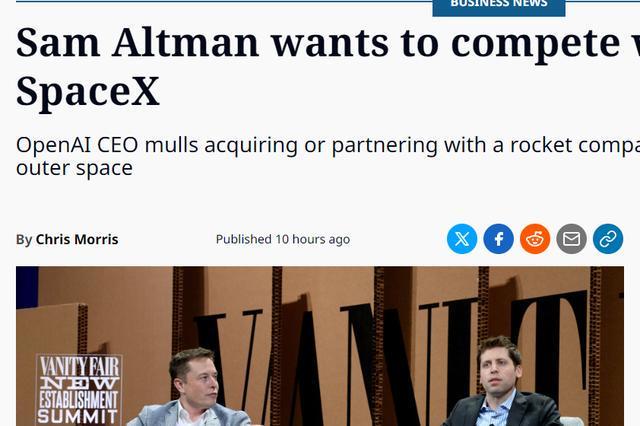
数十亿美元豪赌!OpenAI奥特曼拟收购火箭公司,硬刚马斯克SpaceX
Huan Qiu Wang Zi Xun· 2025-12-05 03:39
Group 1 - OpenAI CEO Sam Altman is planning to enter the space sector through investments or acquisitions of rocket companies to compete with Elon Musk's SpaceX, although this ambition may be temporarily shelved due to a focus on optimizing ChatGPT [1] - Altman has previously engaged with the rocket startup Stoke Space, aiming to gain a controlling stake through equity investment, with historical ties as Y Combinator, which he led, was an early investor in Stoke [1] - Negotiations with Stoke Space have currently stalled, and the competition for billions of dollars in the space sector has not yet commenced in earnest [1] Group 2 - This is not the first confrontation between Altman and Musk; after Musk's exit from OpenAI in 2018, tensions arose, culminating in Musk's attempt to acquire OpenAI this year, which was rejected [4] - Following the acquisition attempt, Musk has initiated legal action against OpenAI and established a competing AI company, while Altman has launched a startup to rival Neuralink and is developing social products to challenge Musk's X platform [4] - The space business is emerging as a new arena for competition between the two [4]