AI竞争

Search documents
罗布乐思2025年Q4财报超预期,多项指标增长强劲
Jing Ji Guan Cha Wang· 2026-02-13 21:59
Core Viewpoint - Roblox's Q4 2025 financial results exceeded expectations, with strong growth indicators, but operational adjustments and external risks remain a concern [1] Financial Performance - In Q4 2025, Roblox reported revenue of $1.415 billion, a year-over-year increase of 43%, and bookings of $2.22 billion, up 63% year-over-year. Daily active users reached 144 million, reflecting a 69% increase, all surpassing market expectations [2] Company Outlook - For Q1 2026, Roblox expects bookings between $1.69 billion and $1.74 billion, above market consensus, but anticipates a net loss potentially widening to $316 million. This guidance will be a focal point for assessing the sustainability of high growth. Starting in 2027, Roblox will shift from annual to quarterly guidance to address business volatility, which may affect investor perceptions of long-term growth [3] Business Developments - Global age verification was completed in January 2026, resulting in a short-term negative impact on user engagement (a mid-single-digit percentage decline). However, the company believes this will enhance safety and content customization capabilities in the long run. Changes in user data will be monitored closely [4] Regulatory Environment - Several Middle Eastern countries have banned the platform citing child safety concerns, leading to potential lawsuits that could create uncertainty for regional business expansion. Ongoing developments in this area will be important to watch [5] Institutional Perspectives - On February 10, 2026, institutions such as Citigroup, Piper Sandler, and UBS lowered their price targets primarily due to concerns over competition from AI platforms, though most maintained "buy" or "overweight" ratings. Changes in institutional viewpoints may influence market sentiment [6]
马斯克回应xAI联创离职潮:这是组织的进化
量子位· 2026-02-12 11:00
Core Viewpoint - The recent departures at xAI, including two co-founders, have raised questions about whether this is a normal turnover or indicative of deeper issues within the company. Elon Musk has stated that the restructuring is aimed at improving execution efficiency and is not merely a layoff [4][9][10]. Group 1: Company Restructuring - Musk emphasized that the departures are part of a necessary organizational restructuring to enhance efficiency at the current scale of the company [9][10]. - The company is still actively recruiting, indicating a focus on future growth despite the recent changes [5][12]. - The restructuring is described as a response to the company's rapid growth, suggesting that some individuals may be better suited for earlier stages of a startup rather than a more mature organization [11][14]. Group 2: Employee Departures - The recent wave of departures includes co-founders Tony Wu and Jimmy Ba, who publicly expressed intentions to pursue new opportunities, suggesting a voluntary exit rather than a forced departure [15][17]. - The narrative from departing employees contrasts with Musk's framing of the situation, leading to speculation about the true nature of these departures [20][21]. - A significant number of core team members have left xAI since February, indicating a potential trend of increasing turnover within the organization [27][38]. Group 3: External Factors - xAI was recently acquired by SpaceX in an all-stock deal, which is expected to influence the company's operational focus and priorities moving forward [38]. - The company is facing external regulatory scrutiny, particularly related to its AI products, which may contribute to internal pressures and the recent departures [40][42]. - The competitive landscape in AI, with major players like OpenAI and Google ramping up efforts, raises concerns about the potential impact of talent turnover on xAI's future capabilities [43][44].


Roblox财报超预期但遭投行下调目标价,股价波动加剧
Jing Ji Guan Cha Wang· 2026-02-11 14:09
Core Viewpoint - Several Wall Street investment banks have lowered their target prices for Roblox, citing concerns over competition from AI platforms while maintaining varying ratings [1] Financial Report Analysis - Roblox reported Q4 2025 earnings on February 5, 2026, with revenue of $1.415 billion, a 43% year-over-year increase - The bookings reached $2.22 billion, up 63% year-over-year, exceeding market expectations - Daily Active Users (DAU) were 144 million, a 69% increase year-over-year - The company expects Q1 2026 bookings to be between $1.689 billion and $1.740 billion, above market consensus - However, net loss widened to $316 million, and the company announced it will no longer provide annual guidance starting in 2027, shifting focus to quarterly guidance [2] Recent Stock Performance - The stock price has shown significant volatility influenced by the earnings report and actions from investment banks - Closing price on February 5 was $60.57, down 3.96% for the day; it rose to $66.42 on February 6, an increase of 9.66% - On February 9, the price further increased to $73.45, up 10.58%, before dropping to $71.94 on February 10, down 2.06% - Over the past five days, the stock has cumulatively risen by 10.00%, with a price range fluctuation of 26.18% and trading volume exceeding $4.9 billion, indicating high market activity [3] Recent Events - Key events include the release of Q4 2025 earnings on February 5 and the completion of global age verification promotion, which has had a short-term negative impact on user engagement but is viewed as a long-term strategic opportunity - Additionally, several Middle Eastern countries have banned the platform citing child safety concerns, leading to related lawsuits against the company [4]
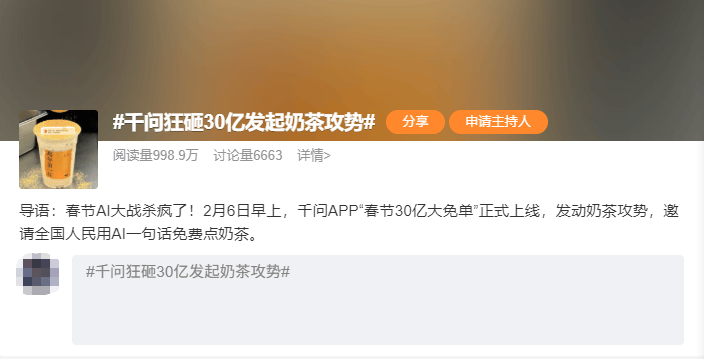
突破1000万单!千问把奶茶店搞瘫痪,跪求大家明天再来
Sou Hu Cai Jing· 2026-02-10 12:08
Group 1 - The core point of the article highlights the intense competition in the AI sector, particularly during the Spring Festival, with Alibaba's Qianwen launching a significant promotional campaign involving free milk tea to attract users [1][29] - Qianwen's campaign offered a 25 yuan no-threshold coupon for milk tea, leading to a rapid surge in orders, exceeding 1 million within 3 hours and 10 million within 9 hours [3][8] - The promotional strategy resulted in a notable increase in stock prices for milk tea brands, with Cha Baidao rising by 6% and Gu Ming by over 3% [11] Group 2 - The overwhelming demand caused significant operational challenges for milk tea shop employees, who faced extreme workloads and supply shortages, leading to some stores temporarily closing for restocking [17][20] - The rapid influx of users overwhelmed Qianwen's servers, causing service disruptions and user frustrations, prompting the company to extend the validity of the coupons to February 23 [12][26] - The article discusses the broader context of AI applications competing for user acquisition during the Spring Festival, with major players like Baidu and Tencent also investing heavily in user engagement strategies [29][31] Group 3 - Despite the initial excitement, the article notes that users attracted by promotional offers may not remain engaged long-term, as many uninstall the app after redeeming their rewards [33] - The competition in the AI space is expected to focus on delivering real value and enhancing user experience, as transient user acquisition strategies may not sustain long-term growth [40]

Space X投资人:今年的IPO将是“史上最大造富事件”,马斯克仍被严重低估
华尔街见闻· 2026-02-02 07:57
Core Viewpoint - The upcoming SpaceX IPO is anticipated to be "the healthiest wealth creation event in history," with its valuation soaring from $36 billion in 2019 to $800 billion [2][15]. Group 1: Investment Insights - Shaun Maguire, a partner at Sequoia Capital, believes the market still undervalues Elon Musk's contributions, particularly highlighting the potential of SpaceX's excess rocket capacity to create a space data center, which he considers one of the largest market opportunities [2][4]. - Sequoia Capital invested approximately $1.2 billion in SpaceX since 2019, which is now valued at around $12 billion, achieving a tenfold return [6]. - The investment decision in 2019 was seen as unconventional, as SpaceX was primarily viewed as a limited growth rocket launch company, with its valuation considered to have little upside potential [9]. Group 2: Business Model and Growth - SpaceX's valuation increase is attributed to four waves of evolution in the Starlink business: consumer network reaching 9.2 million subscribers, enterprise market penetration with airlines, government defense services through the Starshield product line, and the Direct-to-Cell satellite service expected to have 6 million users by the end of 2024 [6][11][12]. - The Direct-to-Cell technology, which allows mobile phones to connect directly to satellites without additional equipment, is projected to become a major revenue source, potentially surpassing consumer network revenues by 2028 [12][14]. - The anticipated reliable production of Starship by 2026 will lead to excess launch capacity, prompting SpaceX to explore the space data center market to address the limitations faced by terrestrial AI data centers [4][13]. Group 3: Market Dynamics and Future Outlook - Maguire emphasizes that the future of AI competition will be constrained by physical resources such as power and hardware, which SpaceX, through its collaborations with xAI and Tesla Energy, is well-positioned to leverage [4][14]. - The IPO is expected to differ significantly from past tech IPOs, as SpaceX employees are driven by mission rather than financial gain, fostering a culture that prioritizes long-term goals over immediate wealth [15]. - The next five years are critical for SpaceX, with milestones including the operational normalization of Starship, large-scale deployment of Direct-to-Cell, initiation of the space data center, and preparations for Mars missions [15][16].

理想调整研发架构,智驾部门将被重组
Xin Lang Cai Jing· 2026-01-28 16:00
Core Viewpoint - Li Auto is undergoing a restructuring of its R&D system to enhance its competitiveness in the AI sector, particularly in autonomous driving and intelligent robotics [1] Group 1: Organizational Changes - Li Auto will reorganize its R&D into three main teams: Base Model Team, Software Entity Team, and Hardware Entity Team, with a significant focus on the restructuring of the autonomous driving team [1] - The former Senior Vice President of Autonomous Driving, Lang Xianpeng, will lead the Hardware Entity Team, focusing on robotics development and reporting to President Ma Donghui [1] - The autonomous driving team will be integrated into the Software Entity Team, led by Guo Xiaofei, who will also oversee the development of intelligent cockpit and intelligent driving [1] Group 2: Leadership and Reporting Structure - Guo Xiaofei will report to Ma Donghui, while Zhan Kun will lead the Base Model Team, responsible for integrating VLA and self-developed chips, reporting to CTO Xie Yan [1] - This restructuring aligns with Li Auto's strategic vision as articulated by CEO Li Xiang, emphasizing the importance of R&D adjustments to meet new AI competition [1] Group 3: Strategic Vision - Li Xiang indicated that the next decade will see embodied intelligence become a core capability for Li Auto, marking the beginning of a new era for automotive robotics [1] - The company anticipates that the revenue potential from this sector could reach trillions, indicating significant growth opportunities ahead [1]

独家丨理想调整研发架构,智驾部门将被重组
雷峰网· 2026-01-28 15:41
Core Viewpoint - Li Auto is undergoing a significant organizational restructuring to enhance its R&D capabilities, particularly in response to the competitive landscape of AI technology [2][4]. Group 1: Organizational Changes - Li Auto will reorganize its R&D structure into three main teams: Base Model Team, Software Entity Team, and Hardware Entity Team, with a focus on splitting the autonomous driving team [2]. - Lang Xianpeng, the former Senior Vice President of Autonomous Driving, will now lead the Hardware Entity Team, focusing on robot development and reporting to President Ma Donghui [2]. - The autonomous driving team will be integrated into the Software Entity Team, which will be overseen by Gou Xiaofei, who will also manage smart cockpit and smart driving R&D [2]. Group 2: Leadership and Responsibilities - Zhan Kun will lead the Base Model Team, responsible for integrating VLA and self-developed chips, reporting to CTO Xie Yan [3]. - Gou Xiaofei's new role emphasizes the integration of smart driving and smart cockpit technologies, indicating a strategic shift in focus within the company [2][3]. Group 3: Strategic Direction - Li Xiang, the founder and CEO of Li Auto, indicated that the restructuring is a proactive measure to address the new wave of AI competition [4]. - The company aims to position itself at the forefront of embodied intelligence, with Li Xiang stating that the era of automotive robots has begun, projecting significant revenue potential in the future [5][6].

用电量屡创新高 我国电力保供底气从何而来?
Yang Shi Wang· 2026-01-26 00:07
Core Insights - The article discusses the challenges and strategies for ensuring stable electricity supply during winter, highlighting record electricity loads and the need for tailored solutions across provinces [1][2][3][4][5] Group 1: Winter Electricity Supply Challenges - In 2026, national electricity load reached a winter peak of 1.417 billion kilowatts, marking the first time it surpassed 1.4 billion kilowatts [1] - Winter electricity supply faces unique challenges compared to summer, including lower water storage for hydropower, adverse weather affecting wind and solar energy, and natural disasters like freezing conditions [1] Group 2: Provincial Strategies for Electricity Supply - Due to the vast geographical differences and varying energy resources across provinces, a "one province, one policy" approach is necessary for effective electricity supply management [2] Group 3: Confidence in Electricity Supply - The confidence in electricity supply stems from significant advancements in power generation capacity, a robust high-voltage transmission network, and improved local distribution networks [3] Group 4: Changes in Energy Structure - Coal power remains a dominant energy source in the short to medium term, despite a gradual decrease in its share, with projections indicating it will still account for over 60% of electricity generation for the foreseeable future [4] Group 5: Role of Electricity in AI Development - The importance of electricity is underscored in the context of AI development, as sufficient power supply is crucial for supporting AI technologies, especially in comparison to the current state of the U.S. power grid [5]
用电量屡创新高 我国电力保供的底气从何而来
Yang Shi Xin Wen Ke Hu Duan· 2026-01-22 02:00
Group 1: Electricity Supply Challenges - In 2026, national electricity load reached a winter peak of 1.417 billion kilowatts, marking the first time it surpassed 1.4 billion kilowatts [1] - Winter electricity supply faces unique challenges compared to summer, including water scarcity affecting hydropower, weather impacts on wind and solar energy, and natural disasters like freezing conditions [1] - Despite a lower winter peak load compared to summer, the pressure for stable electricity supply remains significant [1] Group 2: Regional Supply Strategies - Due to the vast geographical differences and varying energy resources across provinces, tailored electricity supply strategies are necessary, leading to the implementation of "one province, one policy" measures [1] Group 3: Electricity Supply Confidence - The confidence in electricity supply stems from significant advancements in power generation capacity and a robust grid infrastructure, including ultra-high voltage transmission systems [2] - Continuous improvements in local distribution networks and the rapid development of microgrids contribute to the reliability of electricity supply [2] Group 4: Energy Structure Trends - Coal power remains a dominant energy source in the short to medium term, despite a gradual decrease in its proportion, supported by the growth of wind and solar energy [3] - The utilization hours of coal power are projected to decrease from 5,500 hours to around 4,400 hours by 2024, with wind and solar contributing approximately 18% of electricity generation [3] Group 5: Role of Electricity in AI Development - The importance of electricity is underscored in the context of AI development, as sufficient energy supply is crucial for supporting AI technologies [4] - The U.S. faces challenges in electricity manufacturing and grid infrastructure, while other countries leverage their manufacturing advantages and robust energy supply to support AI applications [4]
1 天净赚 9.6 亿!字节火速给全员涨薪
程序员的那些事· 2025-12-21 02:23
Core Viewpoint - ByteDance has reported significant financial growth, with a projected profit of $50 billion for the year, leading to a company-wide salary increase and a restructuring of its job level system to attract and retain talent in a competitive AI landscape [5][7][15]. Financial Performance - ByteDance's profit for the first three quarters has exceeded $40 billion, with an average daily profit of approximately $9.64 million [5]. - The company's revenue is expected to reach $186 billion this year, marking a 20% increase from the previous year, resulting in a net profit margin of 26.9% [7]. - The company's valuation has risen, with reports indicating a valuation of $330 billion in September, later increasing to $480 billion following stock buybacks and investment interest [8]. Salary Increase and Job Level Restructuring - ByteDance announced a salary increase of 1.5 times the previous cycle's adjustment, with a focus on increasing cash compensation and modifying the distribution of stock options [10][20]. - The new compensation structure will see a higher cash component and a reduction in the proportion of stock options, with performance incentives also increasing by 35% [10][20]. - The job level system will transition from a 10-tier structure to a new L1-L10 system, effective January 2026, allowing for greater salary flexibility and potential for salary increases [12][23]. Strategic Rationale - The company aims to enhance its talent acquisition and retention strategies in response to emerging opportunities and challenges in the AI sector, indicating a shift in focus from top-tier talent to a broader employee base [15][16]. - The restructuring of salary and job levels is designed to provide employees with more significant salary growth potential and to ensure competitive compensation across various markets [19][23].