
Software Development

Search documents
九江思特尔科技有限公司成立 注册资本10万人民币
Sou Hu Cai Jing· 2025-12-13 01:46
Company Overview - Jiujiang Sitel Technology Co., Ltd. has been recently established with a registered capital of 100,000 RMB [1] - The legal representative of the company is Liao Heyue [1] Business Scope - The company’s business scope includes software development, information technology consulting services, and technology intermediary services [1] - It also engages in conference and exhibition services, software sales, software outsourcing services, and the development of basic software for artificial intelligence [1] - Additional activities include retail of daily household appliances, property management, landscaping engineering construction, and sales of office supplies [1] - The company is involved in the wholesale and retail of kitchenware and daily miscellaneous goods, security equipment sales, and labor services (excluding labor dispatch) [1] - Information system operation and maintenance services, information system integration services, electrical equipment repair, and home services such as professional cleaning, disinfection, and home appliance installation are also part of its offerings [1]
黑龙江维铭泰达科技发展有限公司成立 注册资本100万人民币
Sou Hu Cai Jing· 2025-12-12 22:12
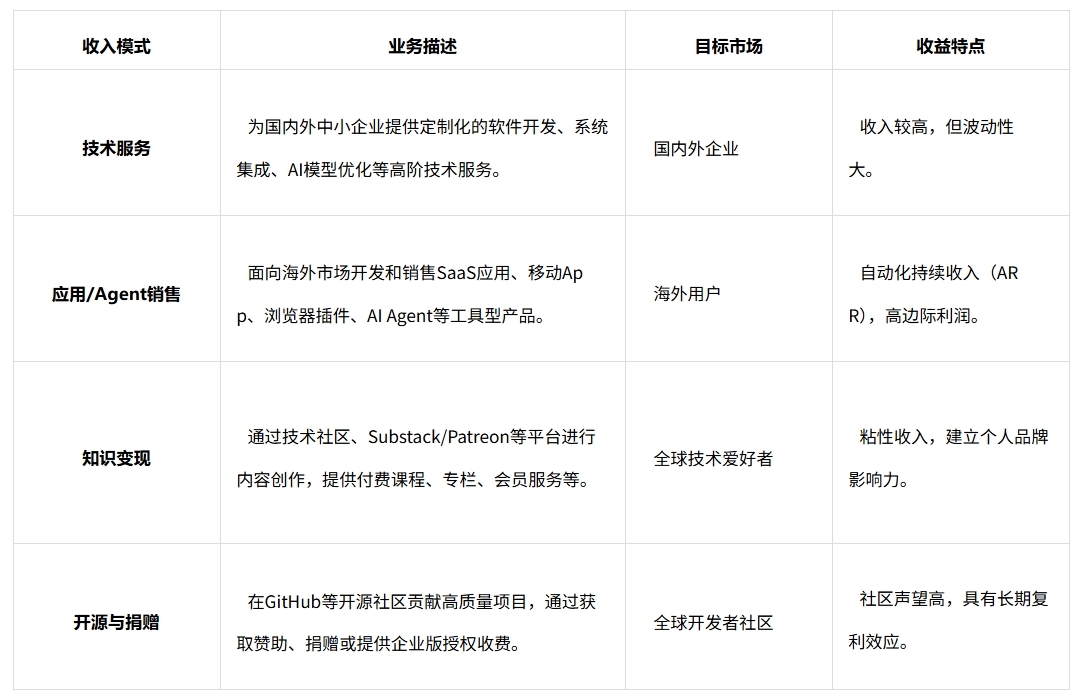
天眼查App显示,近日,黑龙江维铭泰达科技发展有限公司成立,法定代表人为胡炳利,注册资本100 万人民币,经营范围为一般项目:软件开发;信息系统集成服务;人工智能基础资源与技术平台;交通 及公共管理用金属标牌制造;交通及公共管理用标牌销售;电子、机械设备维护(不含特种设备);光 通信设备制造;劳务服务(不含劳务派遣);通信设备制造;机械设备租赁;电子产品销售;园林绿化 工程施工。许可项目:建设工程施工。 ...
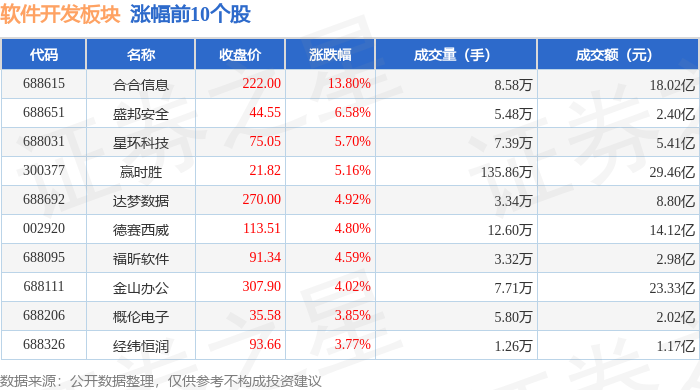
软件开发板块12月12日涨1.4%,合合信息领涨,主力资金净流入3.2亿元
Zheng Xing Xing Ye Ri Bao· 2025-12-12 09:12
Core Viewpoint - The software development sector experienced a 1.4% increase on December 12, with Hehe Information leading the gains [1] Group 1: Market Performance - The Shanghai Composite Index closed at 3889.35, up 0.41% [1] - The Shenzhen Component Index closed at 13258.33, up 0.84% [1] Group 2: Individual Stock Performance - Hehe Information (688615) closed at 222.00, up 13.80% with a trading volume of 85,800 shares and a transaction value of 1.802 billion [1] - Shengbang Security (688651) closed at 44.55, up 6.58% with a trading volume of 54,800 shares [1] - Xinghuan Technology (688031) closed at 75.05, up 5.70% with a trading volume of 73,900 shares and a transaction value of 541 million [1] - Yingshisheng (300377) closed at 21.82, up 5.16% with a trading volume of 1,358,600 shares and a transaction value of 2.946 billion [1] - Dameng Data (688692) closed at 270.00, up 4.92% with a trading volume of 33,400 shares and a transaction value of 880 million [1] - Desay SV (002920) closed at 113.51, up 4.80% with a trading volume of 126,000 shares and a transaction value of 1.412 billion [1] - Foxit Software (688095) closed at 91.34, up 4.59% with a trading volume of 33,200 shares [1] - Kingsoft Office (688111) closed at 307.90, up 4.02% with a trading volume of 77,100 shares and a transaction value of 2.333 billion [1] - Gallen Electronics (688206) closed at 35.58, up 3.85% with a trading volume of 58,000 shares [1] - Jingwei Hengrun (688326) closed at 93.66, up 3.77% with a trading volume of 12,600 shares [1] Group 3: Capital Flow - The software development sector saw a net inflow of 320 million from main funds, while retail funds experienced a net outflow of 119 million [1] - Speculative funds had a net outflow of 201 million [1]




四川省麓熵智能科技有限公司成立 注册资本50万人民币
Sou Hu Cai Jing· 2025-12-12 06:12
Group 1 - Sichuan Lushang Intelligent Technology Co., Ltd. has been established with a registered capital of 500,000 RMB [1] - The legal representative of the company is Li Chao [1] - The company's business scope includes software development, sales of display devices, electronic products, and audio equipment, among other services [1] Group 2 - The company is involved in various technical services such as technology development, consulting, and transfer [1] - It also engages in manufacturing audio equipment and display devices, as well as sales of new energy power equipment and electronic components [1] - The company is permitted to conduct construction engineering and electrical installation services, subject to relevant approvals [1]
安徽诚意智能科技有限公司成立 注册资本1000万人民币
Sou Hu Cai Jing· 2025-12-12 00:44
Group 1 - A new company, Anhui Chengyi Intelligent Technology Co., Ltd., has been established with a registered capital of 10 million RMB [1] - The legal representative of the company is Wei Xueyuan [1] - The company's business scope includes technology services, development, consulting, and various manufacturing and sales activities related to plastic products, electronic components, and software [1] Group 2 - The company is involved in general projects such as technical transfer, promotion, and information technology consulting services [1] - It also engages in the manufacturing and sales of paper products, artificial boards, and wooden containers [1] - The company has a license for printing packaging and decorative printing, as well as road freight transportation (excluding hazardous goods) [1]
上海算道科技有限公司成立,注册资本1000万人民币
Sou Hu Cai Jing· 2025-12-11 17:09
天眼查显示,近日,上海算道科技有限公司成立,法定代表人为吕松涛,注册资本1000万人民币,由上 海江村市隐投资发展有限公司全资持股。 序号股东名称持股比例1上海江村市隐投资发展有限公司100% 经营范围含技术服务、技术开发、技术咨询、技术交流、技术转让、技术推广;软件开发。(除依法须 经批准的项目外,凭营业执照依法自主开展经营活动)自主展示(特色)项目:信息系统集成服务;信 息技术咨询服务;网络与信息安全软件开发;集成电路芯片设计及服务;计算机软硬件及辅助设备批 发;人工智能应用软件开发;计算机软硬件及辅助设备零售;数据处理和存储支持服务;人工智能基础 软件开发;网络设备销售;人工智能理论与算法软件开发;计算机系统服务。 企业名称上海算道科技有限公司法定代表人吕松涛注册资本1000万人民币国标行业信息传输、软件和信 息技术服务业>软件和信息技术服务业>软件开发地址中国(上海)自由贸易试验区牛顿路393.421号6幢 102部位122室企业类型有限责任公司(自然人投资或控股的法人独资)营业期限2025-12-11至无固定期 限登记机关自由贸易试验区市场监管局 来源:市场资讯 ...
Empat Launches Empat School to Train Next-Gen Full-Stack & Flutter Developers
Newsfile· 2025-12-11 12:30
Core Insights - Empat has launched Empat School, an online program aimed at training aspiring full-stack and Flutter developers, starting on January 5, 2026 [1][4] - The program is complimentary and targets students in their 2nd year or higher in IT-related fields, combining expert-led lectures, hands-on assignments, and mentorship [3][4] - Top-performing students will have the opportunity to secure trainee positions at Empat, creating a direct link between education and employment [5] Program Structure - Empat School's curriculum includes backend architecture, database management, responsive frontend design, and mobile app development with Flutter [4] - The program emphasizes real-world tasks typically handled by professional development teams, providing practical experience [3][4] Company Background - Empat is a leading custom software and mobile app development agency with successful projects across 17 countries [6] - The company focuses on transforming ideas into impactful digital products through deep research and empathy-driven design [6]


独立开发者的AGI焦虑,何处有解?
3 6 Ke· 2025-12-11 11:05
Core Insights - The article highlights the contrasting experiences of independent developers in the AGI era, showcasing both the struggles of many and the successes of a few [2][11]. Group 1: Independent Developer Landscape - Independent developers are defined as individuals or small teams creating software, applications, games, or other digital products without affiliation to large companies [4]. - The emergence of AGI is reshaping the competitive landscape, lowering the technical barriers for becoming a full-stack developer [3]. - Approximately 13.7% of Chinese developers are active as independent developers, indicating a growing trend towards independent creation [2]. Group 2: Revenue Models and Challenges - Independent developers have diversified their income sources, moving away from traditional employment to flexible revenue streams [6]. - The primary revenue sources for independent developers include technical services, application sales, knowledge monetization, and open-source contributions [7]. - Despite the potential for diverse income, the reality is harsh, with only about 20% of independent developers achieving stable income levels comparable to urban salaries [10]. Group 3: Market Dynamics and Income Disparities - The market for independent developers is highly polarized, with the top 10% capturing 90% of the funding, leading to a "winner-takes-all" scenario [17]. - A significant portion of new games released on platforms like Steam earn less than $100, reflecting a challenging environment for many developers [15]. - In 2025, 40% of over 15,000 new games on Steam generated total revenues below $100, indicating a decline in profitability for independent developers [15]. Group 4: Support Systems and Community Building - There is a growing desire among independent developers for connection and support systems to navigate the challenges they face [20]. - Initiatives like the AI OPC service plan and physical community spaces are emerging to support independent developers and foster collaboration [22]. - The upcoming AGI era international digital nomad development seminar aims to address the needs of independent developers and promote community building [22].
“996 是常态、你自愿加班且没申请、我也没验收结果,为什么要给加班费?”
程序员的那些事· 2025-12-11 07:53
以下文章来源于伯乐在线 ,作者伯小乐 伯乐在线 . 伯乐在线分享IT互联网职场和精选干货文章(原域名已不再维护)。组织维护10万+star的开源技术资源 库,包括:Python, Java, C/C++, Go, JS, CSS, Node.js, PHP, .NET 等 工作群言论引投诉,程序员突遭开除 2018 年 11 月,李勤带着多年的编程经验,入职了天道公司,成了一名 PHP 高级工程师。本以为能在 这家公司好好打拼,没想到两年后,一场突如其来的离职风波,让他和公司闹上了法庭。 时间拉到 2020 年 8 月 19 日,这天对李勤来说格外刺眼。公司直接递过来两份文件:《职工违纪处罚 单》和《解除劳动合同通知书》。上面写得明明白白,说他在工作群里发了不当言论,不仅引来了合作方 投诉,还损害了公司名誉,已经构成了《职工手册》里的"特别重大违纪",所以要解除劳动合同。 事已至此,李勤当天就签了《离职交接表》,按流程办完了交接。 但越想越觉得委屈,他觉得自己没犯啥足以被开除的错,而且在职期间经常加班,公司也没给过合理的加 班费。思前想后,李勤决定维权。 仲裁败诉不气馁,起诉法院讨公道 他先向劳动争议仲裁委员 ...

深圳市艾森娜信息技术有限公司成立 注册资本1000万人民币
Sou Hu Cai Jing· 2025-12-11 05:41
Core Viewpoint - Shenzhen Aisenna Information Technology Co., Ltd. has been established with a registered capital of 10 million RMB, focusing on various technology and artificial intelligence services [1] Company Overview - The legal representative of the company is Xu Haiping [1] - The registered capital is 10 million RMB [1] Business Scope - The company engages in general business activities including technology services, development, consulting, exchange, transfer, and promotion [1] - It specializes in artificial intelligence software development, including foundational, application, and algorithm software [1] - The company also focuses on software development, sales of intelligent manufacturing equipment, and various intelligent systems [1] - Additional services include digital technology services, smart home device manufacturing, and information system integration [1] - The company does not have any licensed business projects [1]