
独立游戏

Search documents
AI掀起内存涨价潮 PC与主机游戏成本飙升
Shang Wu Bu Wang Zhan· 2026-01-07 16:19
Core Viewpoint - The surge in demand for artificial intelligence data centers is causing a significant increase in global memory semiconductor prices, particularly DRAM and SSD, which is raising the overall costs for PCs and console gaming [1] Group 1: Impact on Memory Prices - The demand for memory semiconductors is tightening supply, leading to substantial price hikes for DRAM and SSD [1] - The price increases are affecting the development of GPUs and next-generation consoles, such as the PS6 and Xbox, which may face delays [1] Group 2: Industry Response - The ongoing memory price increases are likely to continue in the short term, prompting a shift towards cloud gaming as an alternative solution [1] - Subscription-based cloud gaming services are gaining renewed attention as they lower hardware requirements for consumers [1] - There is an expected growth in demand for cross-platform games designed for low-spec devices and independent games that focus on innovative concepts [1]
独立游戏路演,如何为创意与资本“搭桥铺路”?
Guan Cha Zhe Wang· 2025-12-16 02:23
Core Insights - The 2025 BGM Game Exhibition recently concluded in Shanghai, showcasing new independent games and facilitating connections between developers and industry resources through events like the "BUFF Roadshow" [1][3] - A growing trend in the Chinese gaming industry is the emergence of a model focused on bridging independent games with market opportunities, reflecting a significant evolution and demand within the independent game ecosystem [3] Industry Trends - Independent games are currently experiencing an unprecedented "golden age," driven by a growing player base and decreasing development barriers, indicating a broad market potential [4] - The sales revenue of independent games on the Steam platform reached nearly $4 billion in the first nine months of 2024, accounting for 48% of Steam's total game sales revenue of $8.3 billion [5] - Sales of independent games on major platforms like Steam and Epic Games Store have seen a growth rate of 30% [7] Challenges and Opportunities - The independent game development sector faces two core challenges: the arduous creative process and unstable income, leading to a high exit rate of 85% to 90% among creators after completing a game [7] - The advent of AI technology has significantly transformed the independent game creation landscape, enabling explosive growth in production capacity and drastically reducing costs, thus allowing for more flexible and diverse participation in the industry [7][8] Strategic Shifts - The content strategy of independent game developers is undergoing profound changes, with many games evolving from small-scale projects to more polished and larger productions, challenging the previous notion of "small and refined" [8] - The definition of independent games is expanding, as they are now seen as content-driven rather than limited by size or platform, emphasizing creativity and flexibility [8]


独立开发者的AGI焦虑,何处有解?
3 6 Ke· 2025-12-11 11:05
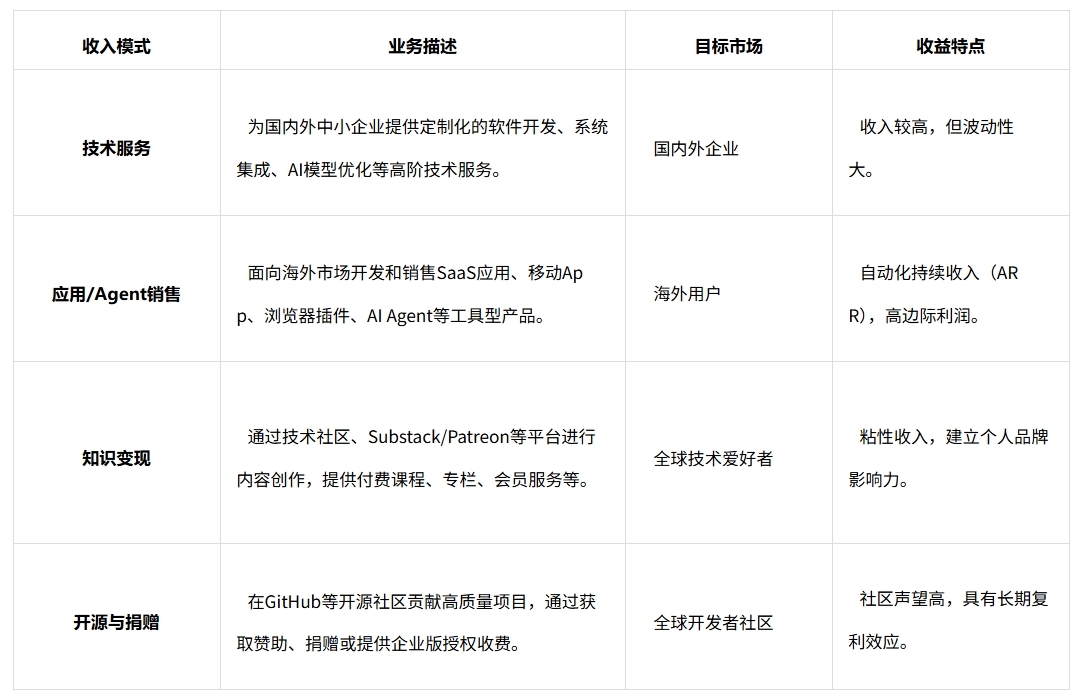
Core Insights - The article highlights the contrasting experiences of independent developers in the AGI era, showcasing both the struggles of many and the successes of a few [2][11]. Group 1: Independent Developer Landscape - Independent developers are defined as individuals or small teams creating software, applications, games, or other digital products without affiliation to large companies [4]. - The emergence of AGI is reshaping the competitive landscape, lowering the technical barriers for becoming a full-stack developer [3]. - Approximately 13.7% of Chinese developers are active as independent developers, indicating a growing trend towards independent creation [2]. Group 2: Revenue Models and Challenges - Independent developers have diversified their income sources, moving away from traditional employment to flexible revenue streams [6]. - The primary revenue sources for independent developers include technical services, application sales, knowledge monetization, and open-source contributions [7]. - Despite the potential for diverse income, the reality is harsh, with only about 20% of independent developers achieving stable income levels comparable to urban salaries [10]. Group 3: Market Dynamics and Income Disparities - The market for independent developers is highly polarized, with the top 10% capturing 90% of the funding, leading to a "winner-takes-all" scenario [17]. - A significant portion of new games released on platforms like Steam earn less than $100, reflecting a challenging environment for many developers [15]. - In 2025, 40% of over 15,000 new games on Steam generated total revenues below $100, indicating a decline in profitability for independent developers [15]. Group 4: Support Systems and Community Building - There is a growing desire among independent developers for connection and support systems to navigate the challenges they face [20]. - Initiatives like the AI OPC service plan and physical community spaces are emerging to support independent developers and foster collaboration [22]. - The upcoming AGI era international digital nomad development seminar aims to address the needs of independent developers and promote community building [22].
“我在美国做游戏,年薪100万,却焦虑不安?”
3 6 Ke· 2025-11-26 00:28
Core Insights - The gaming industry in China is facing significant challenges, including layoffs, project cancellations, and company closures, creating a pervasive sense of anxiety among professionals [1] - In contrast, the U.S. gaming industry shows higher average salaries, with an average of $142,000 (approximately 1.01 million RMB) and a median of $129,000 (approximately 910,000 RMB), indicating a stark difference in compensation compared to the broader U.S. labor market [3][6] - Despite high salaries, 56% of U.S. gaming professionals express dissatisfaction with overall benefits, and 80% believe the industry's stability is lower than other professions, highlighting a growing concern about job security [6][7] Group 1: Salary Insights - The average salary for U.S. gaming professionals is $142,000, with 64% experiencing year-over-year salary increases [3][8] - The salary distribution reveals a significant disparity, with 47% of professionals earning above $120,000, indicating a concentration of high salaries among mid-level and core positions [8][12] - Factors positively correlated with higher salaries include working for AAA or large studios, internal referrals, and higher educational qualifications [14][15] Group 2: Job Security and Industry Stability - The report indicates that 24% of U.S. gaming professionals have experienced layoffs in the past two years, with nearly half of those still seeking employment [31][36] - A significant 74% of current employees perceive gaming development as less stable compared to other industries, with 95% of unemployed individuals sharing this sentiment [36][40] - The dual pressures of layoff risks and lack of salary transparency contribute to heightened anxiety among U.S. gaming professionals [40][42] Group 3: Professional Satisfaction and Work-Life Balance - Despite high salaries, 53% of U.S. gaming professionals report feeling underpaid, while 83% believe their salaries adequately meet their living expenses [20][21] - Only 22% express dissatisfaction with work-life balance, suggesting that long working hours are less of an issue compared to salary concerns [17][20] - The desire for unionization is evident, with 64% supporting the establishment of unions to enhance job security and address industry instability [42][46] Group 4: Side Gigs and Additional Work - A notable trend is the rise of side gigs among U.S. gaming professionals, with 74% working full-time in one job, while 2% engage in multiple jobs [28][31] - The most common side gigs include independent game development and content creation, reflecting a shift towards alternative income sources amid industry uncertainties [28][31] - The motivation for taking on additional work often stems from the need for extra income, creative fulfillment, and career development opportunities [28][31]

怎么“独立游戏制作人”就被玩成了下一个“主理人”?
Hu Xiu· 2025-09-30 11:16
Core Viewpoint - The term "independent game developer" has evolved and is often misused, leading to a decline in its reputation, similar to the term "main person" in branding [1][26]. Group 1: Definition and Perception - The concept of "main person" combines creativity, decision-making, and cultural spirit, representing a brand's persona and core competitiveness [2]. - The relationship between independent game developers and players transcends mere consumption, seeking recognition and resonance with niche cultural tastes [3][4]. - Independent game developers are not just creators but also shape the spirit conveyed through their works, with players recognizing the individual behind the game [5]. Group 2: Industry Trends and Challenges - There has been a noticeable increase in independent game developers in recent years, with many individuals adopting the title for various reasons [12][13]. - Some developers use the title "independent game developer" to navigate social situations, especially when questioned about their career and income [14][15]. - The industry has seen a mix of genuine creators and those who misrepresent themselves, leading to skepticism about the authenticity of many claiming to be independent developers [20][21]. Group 3: Impact on Reputation - The rise of individuals who falsely claim to be independent game developers has contributed to a negative perception of the title, affecting the reputation of serious creators [25][26]. - Early successful independent games helped elevate the standard of domestic independent games, contrasting with the current dilution of the term due to misuse [26]. - There is a call for vigilance against those who merely label themselves as independent developers without substantial contributions, to prevent the term from losing its value [27].
从flash小游戏到3A大作,中国独立游戏野蛮生长史
2 1 Shi Ji Jing Ji Bao Dao· 2025-08-01 00:43
Core Insights - The article highlights the significant growth of China's gaming industry over the past decade, particularly after the lifting of the ban on game console sales in 2014, which has led to a doubling of annual revenue from 140.7 billion to 325.7 billion yuan [1][3] - The rise of independent games is emphasized as a key development, showcasing how small teams have created innovative products that can compete globally, supported by a growing ecosystem of investors and incubators [2][4] Industry Growth - The Chinese gaming industry has seen a revenue increase from 140.7 billion yuan in 2015 to 325.7 billion yuan in 2023, marking a significant growth trajectory [1] - The lifting of the console sales ban in 2014 allowed major consoles like PS4 and Xbox One to enter the market, which contributed to the popularity of independent games [3] Independent Games Development - Independent games have emerged as a vital segment, characterized by small teams focusing on gameplay innovation and a preference for buyout models rather than free-to-play with in-game purchases [3][6] - The concept of independent games gained traction around 2014, influenced by the success of platforms like Steam, which provided easier access for developers to monetize their products [6][7] Investment and Support Ecosystem - Major gaming companies like Tencent and NetEase have begun investing in independent game studios, providing financial support while allowing these studios to maintain operational independence [9][10] - The establishment of incubators and investment funds specifically for the gaming industry has created a more stable funding environment for independent developers [13][16] Market Dynamics - The entry of large companies into the independent game sector has led to a more structured development and monetization process, attracting more developers to the market [11][12] - The focus has shifted towards nurturing creativity and sustainability in game development, with incubators emphasizing the importance of original content and player experience [14][15] Collaborative Ecosystem - The formation of collaborative ecosystems, such as the "Light of Hope" game incubator, aims to connect independent developers with resources, mentorship, and funding opportunities [16][17] - The involvement of experienced professionals from larger companies as mentors for startups is enhancing the development capabilities of independent game creators [17]