Technology

Search documents
Goldman Sachs tops global M&A rankings on $1.48 trillion
RTE.ie· 2026-01-07 07:55
Core Insights - Goldman Sachs led the global dealmaking landscape in 2025, achieving the top ranking in a year characterized by significant political events and larger mergers [1][2] - The firm advised on 38 major deals, totaling $1.48 trillion, marking the highest number of mega deals since 1980 [2][3] - Goldman Sachs secured a 32% market share in M&A, with $4.6 billion in fees, surpassing competitors like JPMorgan and Morgan Stanley [3][6] M&A Market Overview - The year 2025 was described as an "exceptional M&A year," driven by abundant capital and a favorable regulatory environment [2][4] - The number of $10 billion deals increased significantly, with 68 such transactions totaling $1.5 trillion, more than double the previous year [1][4] - Goldman's market share in M&A involving Europe, the Middle East, and Africa reached 44.7%, a level not seen since 1999 [4] Competitive Landscape - JPMorgan ranked second in M&A fees with $3.1 billion, while Morgan Stanley followed closely with $3 billion [3] - Despite Goldman's overall deal volume, it did not participate in the two largest M&A transactions of the year, which were led by other banks [6][10] - Boutique banks like Wells Fargo and Moelis gained prominence due to their involvement in high-profile deals, with Wells Fargo advising on ten $10 billion-plus transactions [10][11] Future Outlook - The current market conditions, including decreasing interest rates and substantial cash reserves in corporate America, are conducive to further M&A activity [15][16] - The ongoing strategic desire for growth among companies is prompting proactive M&A initiatives rather than waiting for companies to be put up for sale [7][15] - The competitive landscape may shift depending on the outcomes of ongoing bids, particularly for Warner Bros, which could affect the rankings of various advisors [11][12]


亚洲股票及主题策略:2026 年竞争式创新持续推进-Asia Equity and Thematic Strategy Competitive Reinvention Continues in 2026
2026-01-07 03:05
January 6, 2026 03:05 PM GMT Investor Presentation | Asia Pacific M Foundation Asia Equity and Thematic Strategy: Competitive Reinvention Continues in 2026 Asia is reinventing growth and corporate strategies and reforming capital markets to better compete in emerging technology and multipolar supply chains. Key views Morgan Stanley Asia (Singapore) Pte.+ Daniel K Blake Equity Strategist Daniel.Blake@morganstanley.com +65 6834-6597 Kristal Ji Equity Strategist | Index | Current | MS Target | Prior | MS | MS ...
Under Biden, America got 150 countries to agree a 15% global corporate tax. Under Trump, America gets an exemption
Yahoo Finance· 2026-01-05 22:06
U.S. multinational corporations will be exempted from paying more corporate taxes overseas in a deal finalized by the Organization for Economic Cooperation and Development. The OECD announced Monday that nearly 150 countries have agreed on the plan, initially crafted in 2021, to stop large global companies from shifting profits to low-tax countries, no matter where they operate in the world. The amended version excludes large U.S.-based multinational corporations from the 15% global minimum tax after ne ...
Oil and defense stocks react to Venezuela news: Chevron, Exxon Mobil, Palantir, Lockheed, Halliburton, more
Fastcompany· 2026-01-05 13:02
Market Reaction to U.S. Intervention - The market reaction to the U.S. military intervention in Venezuela has been significant, particularly among energy stocks, with notable movements in publicly traded companies [1][2]. Energy Sector Performance - Chevron Corporation (NYSE: CVX) has seen a rise of 7.3%, while Exxon Mobil (NYSE: XOM) increased by 4.5%, ConocoPhillips (NYSE: COP) also rose by 7.3%, and Halliburton Company (NYSE: HAL) surged by 10.3% [7]. - The intervention is expected to benefit U.S. oil companies, especially Chevron, which has a substantial presence in the region [3][4]. Foreign Oil Companies' Performance - Shell (NYSE: SHEL) and BP (NYSE: BP), both foreign companies, experienced a slight decline of 0.7% in premarket trading, indicating investor skepticism about foreign companies profiting from U.S. actions in Venezuela [4][5]. Defense Sector Performance - Defense stocks have shown a cautious response, with companies like Lockheed Martin (NYSE: LMT) up by 1%, RTX (NYSE: RTX) by 0.7%, Northrop Grumman (NYSE: NOC) by 1%, General Dynamics (NYSE: GD) by 1%, and Boeing Company (NYSE: BA) by 0.2% [9]. - The expansion of military operations is generally seen as beneficial for defense companies, although investors are currently taking a cautious approach [8]. Tech Sector Performance - Tech companies with defense contracts, such as Palantir Technologies (NASDAQ: PLTR) which rose by 3.8%, Honeywell International (NASDAQ: HON) up by 0.2%, and L3Harris Technologies (NYSE: LHX) up by 0.7%, are also expected to benefit from increased military operations [10].




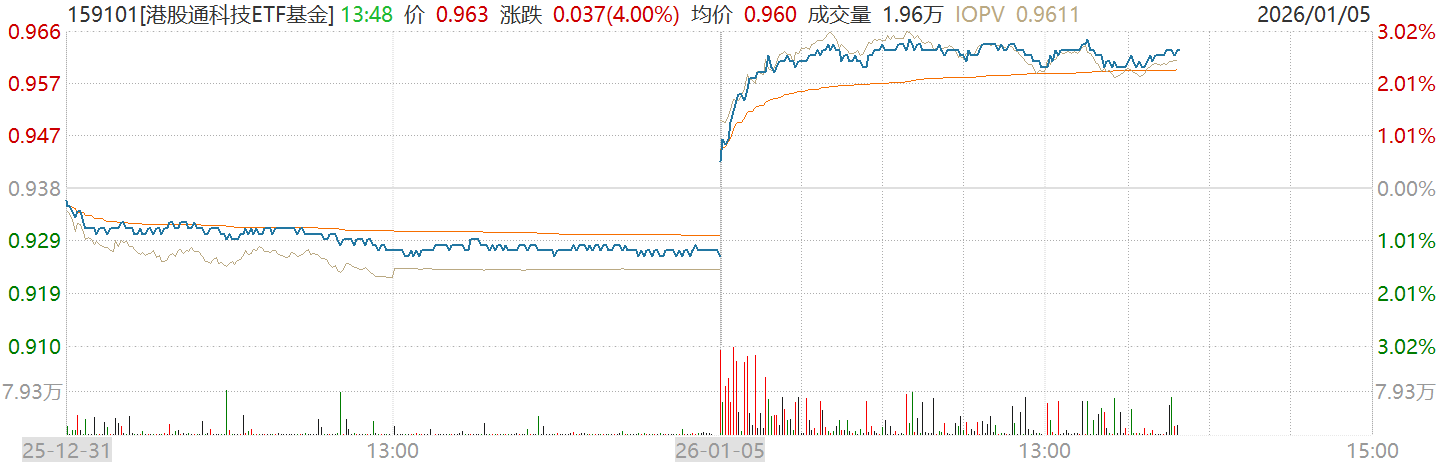
多重利好,南向资金净买入超78亿元,创阶段新高!港股通科技ETF(159101)涨超4%
Mei Ri Jing Ji Xin Wen· 2026-01-05 06:06
Core Viewpoint - The Hong Kong stock market continues to show strong performance, driven by the AI industry trend and significant inflows of capital from the southbound funds, indicating a potential shift in investor sentiment towards technology stocks [1][3]. Group 1: Market Performance - As of January 5, the Hong Kong stock market has seen a substantial increase, with southbound funds recording a net inflow exceeding 7.8 billion yuan, potentially marking the highest single-day net inflow since December 17 of the previous year [1]. - The Hong Kong Stock Connect Technology ETF (159101.SZ) listed in A-shares has risen over 4% [1]. Group 2: AI Industry Influence - The strong performance of Hong Kong technology stocks is primarily driven by trends in the AI industry, with companies like Kuaishou experiencing a significant increase in revenue, doubling their daily revenue on January 3 compared to December 25 [3]. - Baidu's AI chip subsidiary, Kunlun, has submitted an application for a mainboard listing on the Hong Kong Stock Exchange, further indicating the growth potential in the AI sector [3]. Group 3: Currency and Investment Sentiment - The strengthening of the Renminbi, with the offshore rate surpassing 6.97, has enhanced the attractiveness of Hong Kong stocks to overseas investors [3]. - A major fund has significantly increased its holdings in SMIC, boosting confidence in technology stocks [3]. Group 4: Future Outlook - The technology sector in Hong Kong remains relatively undervalued, and the recent surge in stock prices may help reverse negative investor sentiment [3]. - The ongoing expansion narrative of AI applications is expected to benefit Hong Kong technology stocks, presenting opportunities for investment amidst market volatility [3].
Will the Nasdaq 100 ETF Triple Your Money in the Next 10 Years?
The Motley Fool· 2026-01-04 20:00
Core Viewpoint - The Invesco QQQ Trust (QQQ) has historically performed well, with the potential to triple investors' money over the next decade, requiring an average annual return of 11.6% [1][15] Performance History - Over the past decade, QQQ has delivered an average annual return of just over 20%, despite significant drawdowns during the COVID pandemic in 2020 and again in 2022 [2] Future Potential - The future performance of the Nasdaq-100 will depend on several factors, including the ongoing AI revolution, which is expected to impact various sectors significantly [3][5] - The long-term growth potential of AI and quantum computing is substantial, but much of this potential may already be reflected in current stock prices, potentially limiting future returns [6] AI and Technology Investment - Major tech companies have committed significant resources to AI infrastructure, with initial returns being positive, but the ultimate return on investment remains uncertain [7] - The "Magnificent Seven" tech stocks (Nvidia, Apple, Microsoft, Amazon, Alphabet, Meta Platforms, and Tesla) constitute approximately 44% of QQQ's portfolio, making the ETF's performance heavily reliant on these companies [9][10] Valuation Concerns - Current valuations are high, with the S&P 500 trading at about 22 times forward earnings and the "Magnificent Seven" at 29 times, near record highs [12] - Higher starting valuations typically lead to more modest future returns, although strong earnings growth can sustain high stock prices [13] Earnings Growth Outlook - The potential for the AI revolution suggests that Nasdaq-100 components may maintain above-average valuations for some time, allowing for a long-term investment horizon to weather market fluctuations [14] - The ability of major tech companies to continue generating strong earnings growth is crucial for achieving the necessary returns over the next decade [15]
Is the AI boom a bubble waiting to pop? Here’s what history says
Yahoo Finance· 2026-01-04 14:00
Core Viewpoint - The current AI-driven stock market rally raises questions about whether it represents a financial bubble, with historical context suggesting that over-investment is common during technological advancements [1][4]. Group 1: Market Performance - The S&P 500 Index increased by 16% in 2025, significantly driven by AI leaders such as Nvidia Corp., Alphabet Inc., Broadcom Inc., and Microsoft Corp. [2] - Major tech companies are projected to increase capital expenditures by 34%, totaling approximately $440 billion over the next year [2]. Group 2: Investment Commitments - OpenAI has pledged over $1 trillion for AI infrastructure, raising concerns due to its lack of profitability and the circular nature of its financial arrangements with publicly traded tech giants [3]. Group 3: Historical Context - Historical analysis indicates that technological advancements often lead to over-investment, as seen with railroads, electricity, and the internet, suggesting the current AI boom may follow a similar pattern [4]. - The average duration of equity bubbles since 1900 is just over two-and-a-half years, with an average peak-to-trough gain of 244% [7]. Group 4: Market Sentiment - Concerns are growing among investors regarding the sustainability of equity valuations, especially as the S&P 500 has recorded three consecutive years of double-digit gains [5]. - A significant selloff in AI stocks could severely impact the S&P 500, given that Nvidia, Microsoft, Alphabet, Amazon.com, Broadcom, and Meta Platforms comprise nearly 30% of the index [5].
Morgan Stanley drops surprising message on tech stocks
Yahoo Finance· 2026-01-03 18:33
Group 1 - Large-cap tech stocks are expected to make a significant comeback, as the market may be underestimating their potential [1] - Recent market trends show a shift towards industrials and cyclicals, with the Industrial Select Sector SPDR Fund (XLI) up 2.80% over the past month, while the Technology Select Sector SPDR Fund (XLK) is down 0.33% [2] - The Magnificent 7, a group of major tech stocks, has seen stalled gains despite strong earnings and cooling valuations [6][11] Group 2 - Investor sentiment can change rapidly, leading to previously strong stocks feeling less favorable [4] - Slimmon argues that the recent sell-off in Big Tech was not due to fundamental issues but rather a shift in investor focus towards safer assets amid rate-cut expectations [11][12] - The Magnificent 7 represents approximately one-third of the S&P 500's weight and nearly 45% of the Nasdaq 100 [8]





CES And Jobs Data To Dominate First Full Trading Week Of 2026
Seeking Alpha· 2026-01-03 16:00
Economic Data Release - The week will begin with ISM Manufacturing PMI and ISM Manufacturing Prices data for December on Monday [2] - S&P Global Services PMI and ISM Non-Manufacturing PMI for December will be released on Tuesday [2] - JOLTS Job Openings for November and ADP Nonfarm Employment numbers for December are scheduled for Wednesday [2] - Initial Jobless Claims data will be released on Thursday [2] - Nonfarm Payrolls and unemployment numbers for December are due on Friday [2] Earnings Reports - Constellation Brands, Marks & Spencer, Albertsons, and Applied Digital will report their earnings on Wednesday [3][4] - Tesco PLC is set to report earnings on Thursday [4] Market Events - The CES conference in Las Vegas will focus on AI, robotics, digital health, and mobility, featuring keynote speeches from Nvidia CEO Jensen Huang [5] - IREN Limited and GameStop are expected to experience volatility based on options volume [4] - The analyst quiet period will expire for Lumexa, Wealthfront, JM Group, and Cardinal Infrastructure, allowing analysts to post ratings [4]