鸿蒙座舱

Search documents
华为最新业绩来了!去年营收8809亿,研发投入1923亿
券商中国· 2026-03-31 13:45
Core Viewpoint - Huawei's latest annual report for 2025 shows a steady growth in revenue and profit, with a global sales revenue of 880.9 billion yuan and a net profit of 68 billion yuan, reflecting a year-on-year increase of 2.2% and 8.7% respectively compared to 2024 [2]. Business Performance - The ICT and terminal businesses remain the backbone of Huawei, generating revenues of 375 billion yuan and 344.47 billion yuan, with year-on-year growth of 2.6% and 1.6% respectively [3]. - The digital energy business reported a revenue of 77.3 billion yuan, marking a year-on-year increase of 12.7% [3]. - The smart automotive solutions business saw a significant revenue increase of 72.1%, reaching 45.018 billion yuan [3]. - Cloud computing revenue slightly decreased by 3.5% to 32.16 billion yuan [3]. - Regional performance showed growth across all markets, with the Asia-Pacific region being the fastest-growing, achieving a revenue of 50.1 billion yuan, up 15.7% year-on-year [3]. Research and Development - Huawei invested 192.3 billion yuan in R&D, accounting for 21.8% of total revenue, with cumulative R&D expenditure exceeding 1.382 trillion yuan over the past decade [4]. - As of December 31, 2025, Huawei employed approximately 114,000 R&D staff, representing 53.7% of its total workforce, and held around 165,000 valid authorized patents globally [4]. - Future R&D efforts will focus on connectivity, computing, cloud, terminals, smart driving, and artificial intelligence, aiming to enhance core competitiveness and create value for customers and partners [4]. Strategic Direction - Huawei's rotating chairman Meng Wanzhou emphasized the company's commitment to navigating uncertainties while maintaining strategic focus and high-quality development [5].

当“科技”成为轿跑新灵魂,尚界Z7让年轻人不必再做选择题
财联社· 2026-03-27 00:29
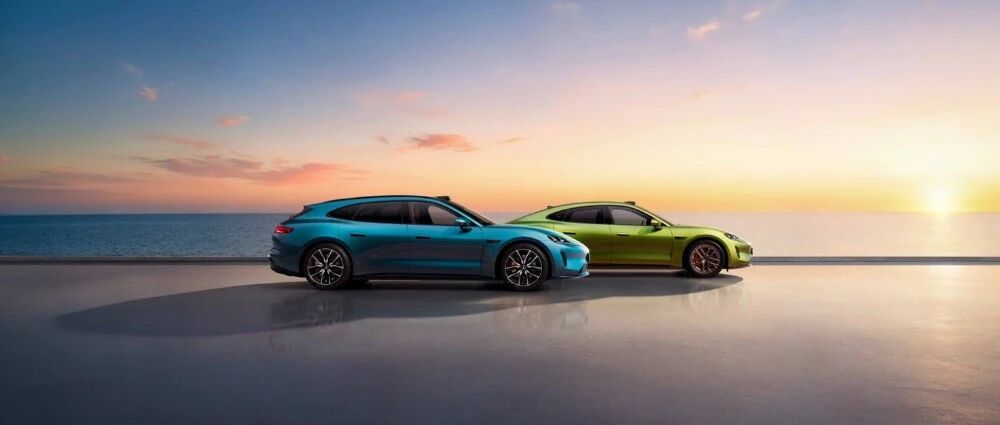
Core Viewpoint - The coupe market is at a crossroads between being well-received and commercially successful, facing severe homogenization as most players focus solely on acceleration metrics, neglecting the broader needs of young consumers [1][3][4] Group 1: Market Dynamics - The current trend in the coupe market emphasizes speed, reducing the value proposition to mere acceleration figures, which does not align with the actual demands of younger users [1][4] - New products like the Shangjie Z7 and Z7T are attempting to redefine the coupe experience by integrating technology as a core value, moving beyond the "acceleration-first" narrative [1][5] Group 2: Product Features - The Shangjie Z7 features advanced technology such as Huawei's 896-line dual-path laser radar, enhancing its ability to detect small obstacles and improve safety in driving scenarios [5][7] - The vehicle is equipped with a comprehensive suite of 13 advanced technologies, including the Huawei Tuling platform and health-focused features, making high-tech options standard rather than optional [8][17] Group 3: User-Centric Approach - The Shangjie Z7 aims to resonate with Generation Z by focusing on emotional value, aesthetic appeal, and practical intelligence, rather than just performance metrics [14][16] - The brand's strategy emphasizes understanding the true needs of young consumers, positioning the Z7 as a "full partner" rather than just a performance vehicle [12][13] Group 4: Market Impact - The introduction of the Shangjie Z7 and Z7T has led to significant market interest, with over 25,000 orders within 24 hours, indicating a strong demand for vehicles that align with the preferences of younger buyers [17][18] - This shift in focus from speed to a more holistic value proposition is expected to reshape the coupe market, prioritizing user experience and technological integration [18]
AWE盛宴启幕,鸿蒙智行技术赋能智慧出行新图景
第一财经· 2026-03-18 08:51
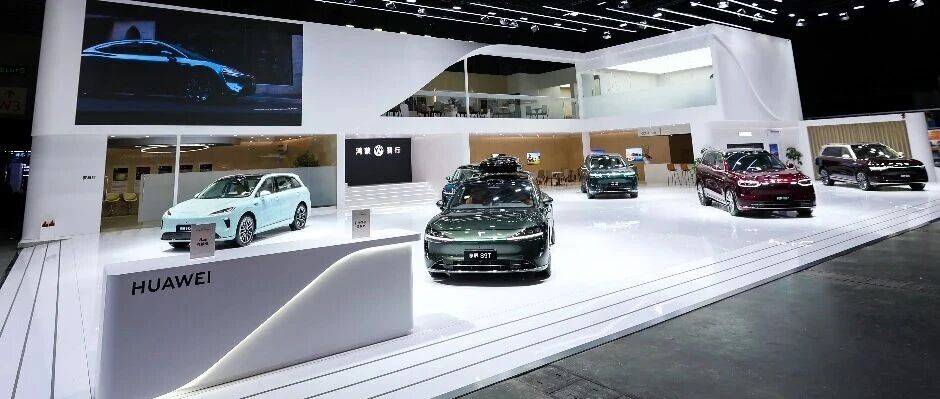
Core Viewpoint - The article highlights Huawei's full-scenario strategy showcased at the 2026 AWE exhibition, emphasizing the launch of the HarmonyOS Intelligent Driving (鸿蒙智行) and its five vehicle models, which have become the focal point of the event [1][5][17]. Group 1: Technological Advancements - Huawei's HarmonyOS Intelligent Driving demonstrates its comprehensive technological capabilities through hardware upgrades like laser radar and software iterations in the ADS system, solidifying its leadership in the smart mobility sector [3][6]. - The ADS system has undergone significant enhancements, achieving a 30% reduction in system latency and a 50% decrease in heavy braking rates, improving traffic efficiency by 20% [7]. - The new 896-line laser radar, which is four times the resolution of mainstream 192-line radars, enhances obstacle detection capabilities, allowing for stable identification of low-lying obstacles from 120 meters away [9]. Group 2: User Experience and Interaction - The immersive and interactive experience at the Huawei exhibition allows attendees to tangibly feel the technological advancements of HarmonyOS Intelligent Driving, moving beyond mere product displays [6][10]. - The intelligent cockpit, built on the HarmonyOS, enables seamless integration with Huawei's smart devices, enhancing user experience through natural language interaction and proactive service [10]. Group 3: Ecosystem Integration - HarmonyOS Intelligent Driving serves as a pivotal component in Huawei's full-scenario ecosystem, breaking down barriers between vehicles and home environments, thus transforming cars into extensions of smart living [12][14]. - The integration with over 3200 brands and 400 product categories within the HarmonyOS ecosystem allows for a cohesive smart experience, positioning HarmonyOS Intelligent Driving as a central hub in the smart mobility landscape [14][15]. - The article emphasizes that the competition in the smart automotive industry is shifting from isolated functionalities to a comprehensive ecosystem approach, with HarmonyOS Intelligent Driving leading this transformation [14][16]. Group 4: Future Directions - Huawei aims to continue leveraging its full-stack technology to drive breakthroughs in smart driving and cockpit technologies while deepening integration with the Harmony ecosystem [16][17]. - The article concludes that the future of smart mobility lies in the deep integration of travel and lifestyle, with HarmonyOS Intelligent Driving poised to lead this evolution [17].
今日新闻丨启境GT7正式亮相!别克至境世家纯电版上市,售价48.99万元!岚图泰山黑武士版上市,售价50.99万元!
电动车公社· 2026-03-17 16:38
Core Viewpoint - The article highlights the recent launches of electric vehicles, specifically the启境GT7, Buick至境世家, and岚图泰山黑武士版, emphasizing their advanced technology and competitive pricing in the electric vehicle market [2][4][18]. Group 1:启境GT7 - The启境GT7 features Huawei's latest 896-line laser radar and L3-level driving architecture, along with the ADS Ultra version and HarmonyOS cockpit [4][6]. - It is equipped with a new generation HUAWEI XMC digital chassis engine and a three-motor system, utilizing a customized new generation Kirin battery based on an 800V platform [6][8]. - The collaboration between Huawei and GAC aims to position the启境GT7 as a strong contender in the pure electric coupe segment, pending its pricing strategy [8]. Group 2: Buick至境世家 - The Buick至境世家 pure electric version was launched at a price of 489,900 yuan, maintaining the same exterior design as its hybrid counterpart [10][11]. - It features a dual-motor system with a power output of 482 kW and a 96 kWh lithium iron phosphate battery, offering a CLTC electric range of 601 km and a 0-100 km/h acceleration time of 5.1 seconds [15][17]. - The introduction of the pure electric version is expected to enhance the sales synergy with the hybrid model, which has already established a foothold in the high-end MPV market [17]. Group 3: 岚图泰山黑武士版 - The岚图泰山黑武士版 was launched at a price of 509,900 yuan, featuring aesthetic and interior adjustments, including a fully blacked-out design and embroidered details [18][20]. - It is equipped with Huawei's latest L3-level driving capabilities, although it currently operates under L2-level assistance due to regulatory limitations [22]. - The vehicle includes advanced features such as a three-chamber air suspension and bi-directional rear wheel steering, enhancing its driving dynamics [20].

双手奉上的雷达,说明华为想通了
虎嗅APP· 2026-03-06 00:26
Core Viewpoint - Huawei's automotive business has reached a new strategic phase, integrating its technology and market operations through the collaboration of its two core divisions: Huawei QianKun as the technology foundation and Hongmeng Zhixing for market implementation [3][7][10]. Group 1: Strategic Integration - The recent launch of the new generation laser radar at the Hongmeng Zhixing event signifies a strategic alignment within Huawei's automotive business, marking the end of internal competition between its two business models [3][6]. - Huawei has transitioned from a dual approach of being a technology supplier (Huawei Inside) to a more integrated model where QianKun provides comprehensive smart automotive solutions while Hongmeng Zhixing focuses on consumer-facing products [6][7]. - This collaboration is essential for creating a complete competitive ecosystem in the smart automotive sector, addressing the industry's need for both advanced technology and effective market execution [8][7]. Group 2: Product Development and Market Performance - The first product to exemplify this collaborative model is the Zun Jie S800, which aims to penetrate the ultra-luxury market and showcases Huawei's full-stack capabilities [4][12]. - The Zun Jie S800 has achieved significant market success, becoming the best-selling ultra-luxury sedan in China, with a monthly delivery of 4,376 units in December 2025, surpassing competitors like Porsche Panamera and BMW 7 Series [21][22]. - This success indicates a paradigm shift in the Chinese automotive industry, redefining luxury not through traditional metrics but by emphasizing safety and intelligent features [22][23]. Group 3: Technological Advancements - The new laser radar introduced in the Zun Jie S800 features a unique dual-focus optical architecture, allowing for simultaneous wide-angle and long-range imaging, addressing a critical industry challenge [13][14]. - The Zun Jie S800 is supported by a comprehensive technology ecosystem, including a multi-sensor perception system and an advanced decision-making platform, enhancing its operational capabilities [16][18]. - This technological edge positions the Zun Jie S800 as a strong competitor in the luxury market, leveraging Huawei's continuous data feedback loop to improve safety and user experience [23][19].
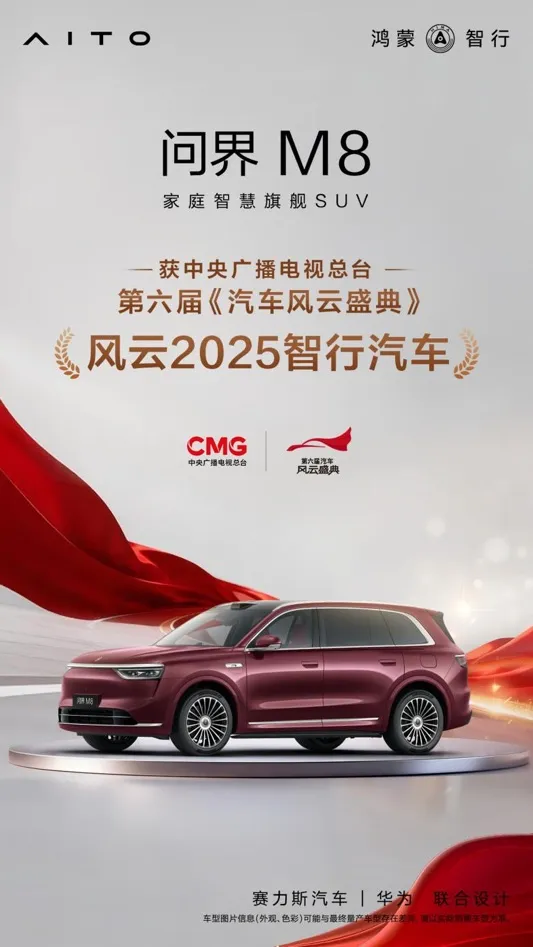
问界M8获第六届《汽车风云盛典》“风云2025智行汽车”
Cai Jing Wang· 2026-02-19 09:04
Core Insights - The sixth "Automotive Wind and Cloud Ceremony," organized by the China Central Radio and Television, concluded successfully, with the "family smart flagship SUV" Wanjie M8 winning the "Wind and Cloud 2025 Intelligent Vehicle" honor, showcasing its strength in the smart automotive sector and gaining recognition from both industry authorities and consumers [1][3]. Industry Overview - The "Automotive Wind and Cloud Ceremony" is recognized as one of the most authoritative and innovative annual events in the Chinese automotive industry, often referred to as the "Oscar of the automotive circle." It serves as a platform for showcasing technological innovations and gathering industry consensus, marking the development trends in China's automotive sector [3]. Company Highlights - Wanjie M8, launched in April 2025, has delivered over 150,000 units and integrates Huawei's Qian Kun intelligent driving ADS 4 system, featuring 30 high-precision sensors for comprehensive perception capabilities [3][4]. - The brand has established a product lineup including Wanjie M9, M8, M7, and M5, adhering to the "five high" standards of safety, reliability, performance, quality, and value, while combining traditional luxury with technological luxury [4]. Market Performance - Wanjie has officially entered the "million club," with total sales exceeding 420,000 units in 2025, achieving the highest average transaction price among new force brands, indicating a clear trend of high-quality development [6]. - The brand has received top rankings in various metrics, including NPS (Net Promoter Score), brand development confidence index, and preference index for brands priced above 300,000 yuan, establishing itself as a leader in the high-end automotive market [6]. Technological Advancements - Wanjie follows a "software-defined vehicle" development strategy, leveraging its innovative intelligent safety system and advanced technology platforms to create a comprehensive technical barrier from foundational architecture to user experience [6][9]. - The collaboration with Huawei enhances Wanjie's technological capabilities, translating cutting-edge technology into perceptible user experiences, thereby serving every user journey effectively [6]. Customer-Centric Approach - Wanjie has developed an intelligent service system that transforms traditional passive services into proactive and anticipatory care, embodying the principle of "serving users wholeheartedly" by focusing on both vehicle and user needs [7]. Future Outlook - As the wave of electrification and intelligence continues, Wanjie aims to deepen its focus on luxury smart electric vehicles, supporting the advancement of Chinese automotive brands in the global market through technological iterations and service upgrades [9].
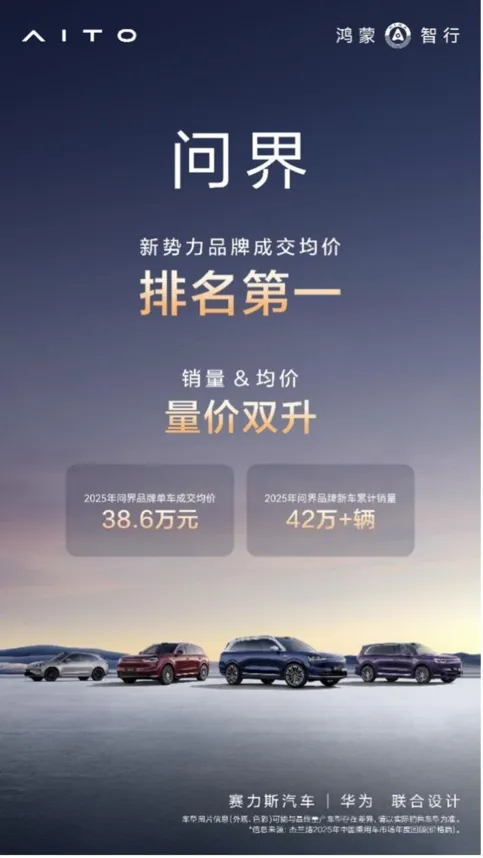
问界M8如何改变高端新能源的价值排序
Cai Jing Wang· 2026-02-14 09:05
Core Insights - The article highlights the significant performance of the AITO Wenjie brand in the Chinese electric vehicle market, particularly with the Wenjie M8 model, which has achieved a high average transaction price and substantial sales growth [1][3][11]. Group 1: Market Performance - AITO Wenjie achieved an average transaction price of 386,000 yuan, ranking first among new force brands, with total sales exceeding 420,000 units in 2025, marking two consecutive years of growth in both sales and average price [1]. - The Wenjie M8 model has delivered over 150,000 units within eight months of its launch, accounting for more than 35% of the brand's total sales, thus driving the brand's overall average transaction price upward [3][4]. Group 2: Product Features and Consumer Demand - The Wenjie M8 is positioned in the market with a price range of 359,800 to 449,800 yuan, catering to the growing demand for family-oriented vehicles that serve as mobile living spaces, rather than just transportation tools [4][7]. - The vehicle's success is attributed to its comprehensive "systematic scene solution," integrating advanced driving assistance, smart cockpit features, and safety measures tailored to family travel needs [8][9]. Group 3: Quality and Brand Positioning - The Wenjie M8 ranks second in quality among mid-to-large SUV models, reflecting market recognition of its product quality and indicating that Chinese brands have reached a leading level in the high-end market [5]. - The brand's strategy emphasizes a "Five High" standard—high safety, reliability, performance, quality, and value—shifting the industry focus from product competition to value competition [11][12]. Group 4: Innovation and Collaboration - AITO Wenjie has pioneered a cross-industry collaboration model with Huawei, integrating ICT technology into automotive design, which enhances the smart experience and differentiates the brand in the high-end market [12]. - This collaboration has led to a deep synergy from technology development to product definition, establishing a competitive edge in intelligent experiences and high-end value [12]. Group 5: Market Impact and Future Trends - The success of the Wenjie M8 is reshaping the competitive landscape of the 400,000 yuan SUV market, as consumers increasingly compare it with traditional luxury brands, indicating a shift towards valuing smart features and adaptability [13]. - The article concludes that the competitive advantage in the electric vehicle sector will increasingly depend on a systematic understanding of user needs and the ability to meet those demands through innovative product development [14].
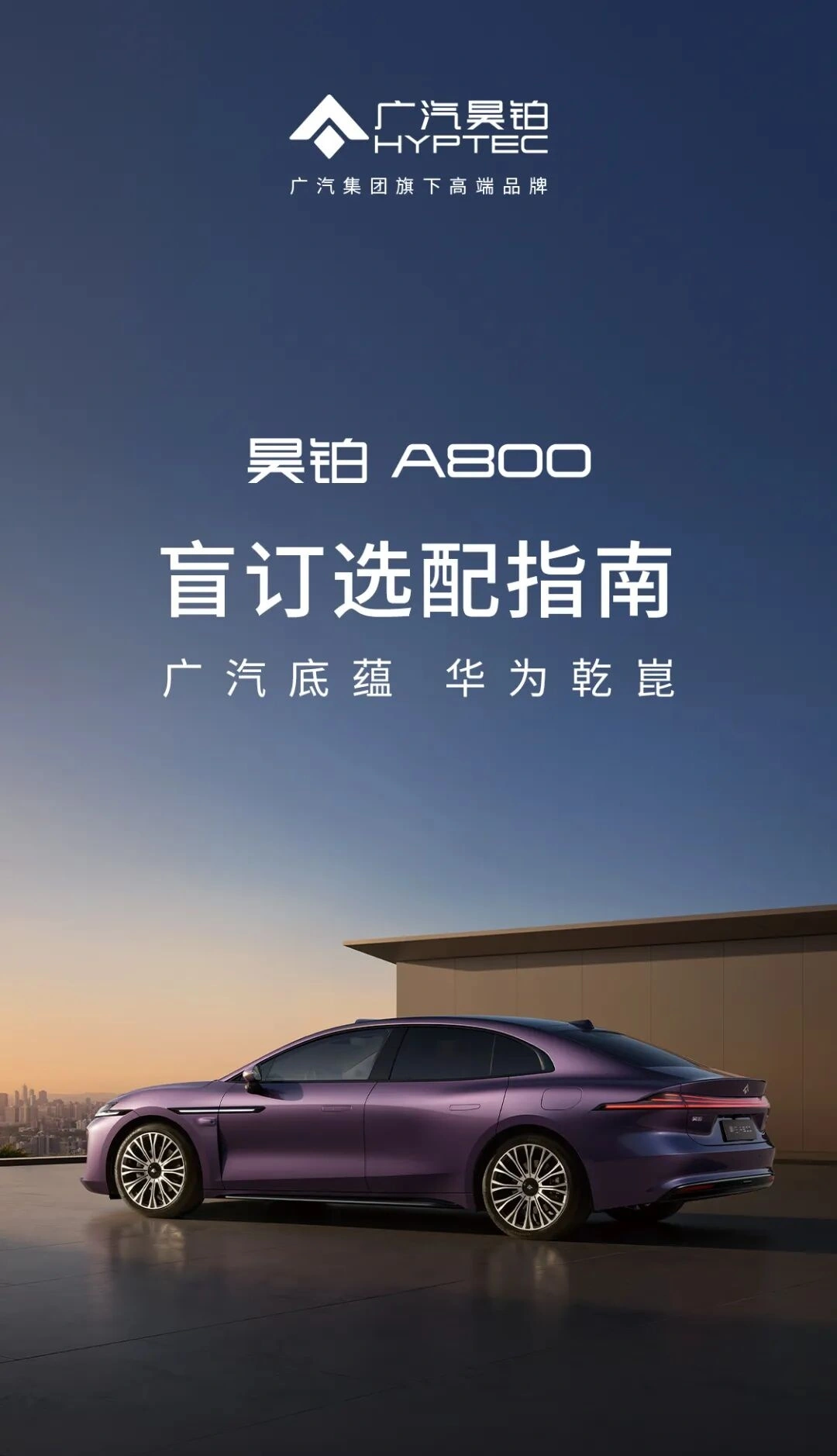
广汽昊铂 A800 豪华轿车开启盲订选配:6 种外观色 / 3 款内饰色,可选华为乾崑智驾四激光雷达方案
Xin Lang Cai Jing· 2026-02-11 10:21
Core Viewpoint - GAC Haobo officially announced the launch of blind ordering for the Haobo A800 luxury sedan, which features Huawei's QianKun ADS and HarmonyOS cockpit configurations [1][14]. Group 1: Vehicle Specifications - The Haobo A800 offers 6 exterior color options: Yunmu Purple, Blade Shadow White, Matte Moonlight Gray, Moonlight Gray, Yaojing Black, and Super Star Silver [4][18]. - It has 3 interior color choices: Chibi Danxia (not available for the Wisdom Leading version), Dover White Cliff, and Cold Lake Black Mountain [4][18]. - The vehicle provides 2 wheel options: 20-inch 12-spoke vortex wheels and 20-inch 7-hole butterfly wheels with a floating logo [4][18]. Group 2: Performance and Features - The A800 is equipped with a 1.5-liter range extender engine producing 118 kW, paired with lithium iron phosphate batteries from Jiangsu Zhengli New Energy Technology Co., Ltd [11][22]. - It features advanced driving assistance with Huawei's QianKun ADS V4.1 and HarmonyOS cockpit, including laser radar and intelligent driving flip lights [7][20]. - The vehicle boasts a comprehensive range of luxury features, including a 1200 km combined range, full vehicle mechanical massage, electric sleeping headrests, and 14 safety airbags [8][20].

乾崑智驾跨越百万丰碑,高楼引望迈向千万瀚海
NORTHEAST SECURITIES· 2026-02-10 01:15
Investment Rating - The report maintains an "Outperform" rating for the industry [4] Core Insights - The commercialization of L3 autonomous driving has reached a turning point, transitioning from "optional" to "preferred" [1][14] - The approval of L3 licenses marks a significant shift from technical validation to operational readiness, establishing a clear regulatory framework [14] - The competitive landscape has evolved from hardware specifications to a focus on end-to-end models driven by data and algorithms, enhancing industry concentration [1][20] Summary by Sections 1. Commercialization of L3 Autonomous Driving - The dual approval of operational licenses and road rights has established a commercial closure for L3 autonomous driving, with clear responsibilities defined [14] - User perception of intelligent driving has matured, with advanced features becoming a key factor in purchasing decisions, as 60% of consumers view autonomous driving as the most anticipated technological breakthrough [16][17] - The paradigm of intelligent driving is shifting towards an end-to-end model, where the core competitive logic is now based on data quality, computational power, and model iteration efficiency [20][21] 2. Huawei's QianKun Intelligent Driving - Huawei's QianKun Intelligent Driving has evolved from a single supplier to a public technology platform, enhancing its market position [30][45] - The company has developed a multi-tiered cooperation model, including component supply, HI mode, and Harmony Intelligent Driving, to cover various market segments [31][32] - The QianKun Intelligent Driving system has undergone significant iterations, establishing a technological moat centered around end-to-end models [36] 3. Independent Entity "Yinwang" - The establishment of Yinwang as an independent entity has alleviated concerns among automakers regarding technology control, allowing for broader collaboration [41][42] - The strategic partnership with automakers has led to a valuation of 115 billion RMB, positioning Yinwang as a unicorn in the industry [45] - Yinwang aims to become a neutral public platform for the smart electric vehicle industry, similar to Bosch's role in the traditional automotive sector [48][49] 4. Hardware Cost Breakdown - The cost of intelligent driving hardware per vehicle exceeds 10,000 RMB, with significant portions attributed to chips and PCB components [2][3] - The potential market space for various components in the intelligent driving supply chain is substantial, with estimates reaching billions in growth opportunities [2] 5. Investment Opportunities - The report identifies potential investment opportunities in advanced process wafer fabs, packaging and testing companies, and PCB manufacturers, highlighting the growth potential in the intelligent driving sector [3]
特斯拉接入CarPlay,马斯克向苹果「低头」?
创业邦· 2026-02-06 03:12
Core Viewpoint - Tesla's decision to develop Apple CarPlay marks a significant shift in its approach to in-car technology, which has traditionally focused on its own self-developed systems [4][7][32]. Group 1: Tesla's Shift to Apple CarPlay - Tesla has been known for its self-developed in-car systems, but it is now moving towards integrating Apple CarPlay, which has sparked mixed reactions among Tesla owners [7][8]. - The integration of CarPlay is seen as a response to user demand, despite Tesla's historically strong self-developed ecosystem [7][10]. - The decision to adopt CarPlay raises questions about Tesla's commitment to its own technology and whether it is yielding to competitive pressures [8][10]. Group 2: Market Context and Competitor Analysis - Many domestic brands like Haval, Geely, and BYD have abandoned CarPlay, indicating a broader industry trend where self-developed systems are preferred over third-party solutions [11][20]. - The article highlights that CarPlay's value is diminishing in the context of advanced self-developed systems that offer more comprehensive features [20][22]. - Apple has struggled to deliver on its promises regarding CarPlay 2.0 and its subsequent iterations, leading to skepticism among major automakers about its relevance and capabilities [28][30]. Group 3: User Experience and Preferences - Some users still find value in CarPlay for its seamless integration across different vehicles and its superior voice recognition capabilities, particularly for specific language needs [13][17]. - Tesla's implementation of CarPlay will not fully replace its native system, as it will only occupy a portion of the display, ensuring that critical vehicle information remains accessible [17][32]. - The article suggests that Tesla's move to integrate CarPlay is a pragmatic choice to enhance user experience without compromising vehicle safety and data control [32].