Brokerage

Search documents
X @Bloomberg
Bloomberg· 2025-09-17 07:58
Chinese brokerages are issuing debt at a record pace, taking advantage of low financing costs and more investors wanting to borrow to juice returns from the nation’s $1.5 trillion stock rally https://t.co/zYIt13XIkJ ...
Alchemy Markets Launches TradingView Integration for Direct Chart-Based Trading
Yahoo Finance· 2025-09-16 14:36
Valletta, Malta, September 16th, 2025, FinanceWire Traders gain access to TradingView’s advanced tools and seamless execution through Alchemy Markets Alchemy Markets, a global multi-asset brokerage, has announced the official integration of TradingView into its trading infrastructure. This collaboration enables clients to execute trades directly from TradingView’s charts, enhancing both precision and efficiency for traders across asset classes. Initially available to clients in the European Union, the int ...
Covering Crypto
Fidelity Investments· 2025-09-16 14:30
Company Information - Fidelity Brokerage Services LLC is a member of NYSE and SIPC [1] Contact Information - The company's address is 900 Salem Street, Smithfield, RI 02917 [1]


China Market Update: Jack’s Back As “Purchase In China” Effort Outlined
Forbes· 2025-09-16 13:36
Market Overview - Asian equities advanced as the U.S. dollar weakened, indicating a positive market sentiment [2] - The Hong Kong High Court allowed Evergrande's liquidators access to founder Xu Jiayin's $7.7 billion in assets amid ongoing restitution efforts from offshore bondholders [8] Chinese Policy Measures - Following President Xi's article on a "unified national market," the Ministry of Commerce and nine agencies introduced "Several Measures for Expanding Service Consumption" to boost domestic demand [3] - The measures include support for tourism, cultural activities, sporting events, and childcare subsidies, aiming to encourage consumers to "purchase in China" [4] Company Performance - Trip.com Group Limited (TCOM) rose by 4.09% and Meituan gained 3.03%, benefiting from the new consumption policies [4] - Alibaba Group Holding Limited (BABA) was the most heavily traded stock in Hong Kong, declining by 0.71% after announcing a $60 million investment in AI video generation startup Aishi Technology [5] - Tencent Holdings Limited (0700 HK) saw a slight increase of 0.23%, attributed to the success of its AI initiatives, with significant growth in daily average users of its AI assistant [6] Electric Vehicle Sector - Electric vehicle stocks performed well, with BYD Company Limited rising by 1.67%, Li Auto Inc. climbing by 2.61%, and CATL increasing by 2.58% [7] Market Dynamics - The rally in Chinese stocks may pose challenges for active managers who are underweight in this sector as quarter-end reporting approaches [9]


HOOD Platform Assets Cross $300B Mark: A Catalyst for Top-Line Growth?
ZACKS· 2025-09-15 14:51
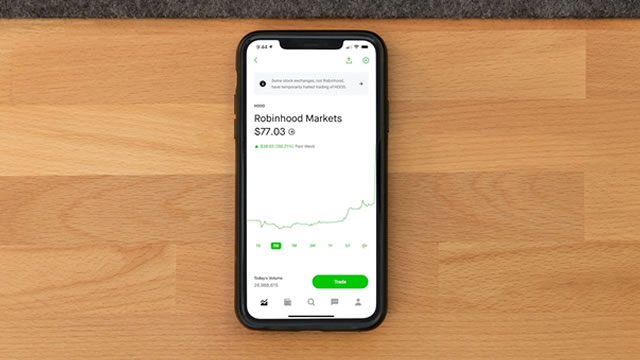
Core Insights - Robinhood Markets (HOOD) is experiencing significant growth in platform assets, which is becoming the main driver of its financial performance, with total platform assets reaching $304 billion in August 2025, a 112% increase year over year [1][9] - The increase in customer assets is enhancing interest-earning balances, leading to a growing stream of interest income, with cash sweep balances rising to $34.1 billion (up 50% year over year) and margin balances increasing to $12.5 billion (up 127%) [2][9] - The growth in platform assets is also boosting trading and derivatives activity, with equity notional rising 107% year over year and options contracts advancing 33% [3] Financial Performance - In Q2 2025, Robinhood's net revenues grew by 45% year over year, with transaction-based revenues increasing by 65%, indicating strong customer engagement and monetization opportunities [3] - The Zacks Consensus Estimate for Robinhood's sales in the current quarter (9/2025) is $1.04 billion, with expected year-over-year growth of 63.99% [5] - Earnings estimates for 2025 and 2026 imply year-over-year growth of 45.9% and 18.3%, respectively, with recent upward revisions to $1.59 and $1.88 [14] Competitive Landscape - Robinhood's peers, Interactive Brokers and Charles Schwab, are also seeing growth in total customer assets, which supports their commission income and net interest income [6][7] - Schwab reported total client assets of $10.8 billion in the second quarter, contributing to higher net interest revenues and trading income [7] Valuation Metrics - Robinhood's shares have increased by 208.7% this year, significantly outperforming the industry average gain of 26.9% [10] - The company is currently trading at a high premium, with a 12-month trailing price-to-tangible book (P/TB) ratio of 13.95X compared to the industry average of 2.97X [12]

Hong Kong's HK$50 billion Silver Bonds attract senior citizens amid rate-cut expectations
Yahoo Finance· 2025-09-15 09:30
Core Insights - There is a significant increase in interest for the latest batch of Silver Bonds in Hong Kong compared to last year, with higher application volumes and values reported by major banks [1][4] - The Hong Kong government's Silver Bonds issue amounts to HK$50 billion (approximately US$6.4 billion) with a three-year tenor and a minimum interest rate of 3.85 percent, which is attractive compared to current bank deposit rates [3][4][5] - The Silver Bonds are specifically designed for senior citizens aged 60 and above, providing them with a secure investment option to cope with rising living costs [6] Subscription Trends - HSBC noted that around 30 percent of applicants for Silver Bonds are new investors, indicating a growing interest in the program [1] - ICBC (Asia) reported that approximately 75 percent of subscriptions were made through online channels, with an average subscription of over 30 lots per customer, reflecting a 20 percent increase from last year [4] - Futu Securities also observed a rise in customer inquiries at its branches, suggesting heightened interest in the Silver Bonds [2] Market Context - The anticipated rate-cutting cycle by the US Federal Reserve and expected declines in Hong Kong interest rates make Silver Bonds an appealing low-risk investment option for senior investors [3] - The return on Silver Bonds is significantly higher than the current interest rate of around 2 percent for 12-month HK dollar time deposits, which is expected to attract between 300,000 to 350,000 senior citizens to subscribe [5]
Robinhood CEO says just like every company became a tech company, every company will become an AI company—but faster
Yahoo Finance· 2025-09-13 21:51
Earlier advances in software, cloud, and mobile capabilities forced nearly every business—from retail giants to steel manufacturers—to invest in digital transformation or risk obsolescence. Now, it’s AI’s turn. Companies are pumping billions of dollars into AI investments to keep pace with a rapidly changing technology that’s transforming the way business is done. Robinhood CEO Vlad Tenev told David Rubenstein this week on Bloomberg Wealth that the race to implement AI in business is a “huge platform shi ...
Microsoft CEO Satya Nadella-backed Groww to file for $800 million IPO
The Economic Times· 2025-09-12 14:05
Core Viewpoint - Billionbrains Garage Ventures Ltd., the parent company of India's largest investment platform Groww, is preparing for an initial public offering (IPO) in Mumbai, aiming to raise between $650 million and $800 million at a valuation of up to $8 billion, backed by Microsoft CEO Satya Nadella [1][6]. Group 1: IPO Details - The IPO could make Groww the largest brokerage in India by market value, surpassing its nearest competitor Angel One Ltd., which is valued at approximately $2.3 billion [6]. - The deal size may be revised if the market regulator approves a proposal to lower the minimum public float for large listings from 10% to 8% for companies with a post-IPO market value between 500 billion rupees and 1 trillion rupees [2][6]. - Major financial institutions advising the offering include JPMorgan Chase & Co., Kotak Mahindra Bank Ltd., Citigroup Inc., Axis Bank Ltd., and Motilal Oswal Investment Advisors [6]. Group 2: Company Performance - As of August, Groww had 12.07 million active clients on the National Stock Exchange of India Ltd., representing a 26% share of the exchange's user base [6]. - Other notable investors in Groww include Peak XV Partners, Ribbit Capital, and Tiger Global Management [6].


X @Bloomberg
Bloomberg· 2025-09-12 12:24
Groww, backed by Microsoft CEO Satya Nadella, is set to file for an India IPO that could make it the nation’s largest brokerage by market value https://t.co/zyglizV1RT ...
Robinhood Reports Strong Year-On-Year Growth Despite Mixed August Metrics
FinanceFeeds· 2025-09-12 10:05
Core Insights - Robinhood's customer base remains stable with 26.7 million funded customers, flat month-over-month but up 2.4 million year-over-year [1][2] - Total platform assets increased to $304 billion, a 2% rise from July and a 112% increase compared to August 2024 [2] - Net deposits for August reached $4.8 billion, reflecting a 19% annualized growth rate [2] Customer Metrics - The brokerage experienced a slight decline in new accounts due to the escheatment of approximately 180,000 low-balance accounts [1] - Year-over-year growth in customer numbers indicates strong retention and acquisition strategies [1][2] Trading Activity - Equity notional volumes totaled $199.2 billion, down 5% from July but more than double compared to a year earlier [3] - Options trading remained stable at 195.5 million contracts, representing a 33% increase year-over-year [3][4] - Crypto trading volumes showed mixed results, with $13.7 billion in notional volume, down 18% from July but up 154% year-over-year [3] Daily Average Revenue Trades (DARTs) - Equity DARTs fell 7% month-on-month to 2.5 million, while options DARTs rose 9% to 1.2 million [4] - Crypto DARTs decreased 14% to 0.6 million but still doubled compared to August 2024 [4] Margin and Cash Balances - Margin balances grew to $12.5 billion, a 10% increase from July and a 127% rise year-over-year [5] - Cash sweep balances reached $34.1 billion, up 1% from the previous month and 50% higher than a year ago [5][6] Securities Lending - Securities lending revenue for August was $53 million, a 13% decline from July but up 165% compared to August 2024 [7] - The year-on-year growth indicates strong demand for stock borrow despite monthly fluctuations [7] Overall Outlook - Robinhood's August results indicate a platform that is expanding its assets and margin activity, with mixed trading volumes across asset classes [8] - The addition of Bitstamp is positively impacting crypto flows, while increased cash sweep balances and lending revenues suggest effective monetization of customer balances [8][9] - With a 112% year-over-year asset growth, Robinhood is positioned for continued scaling ahead of its next quarterly update [9]