
Furniture

Search documents
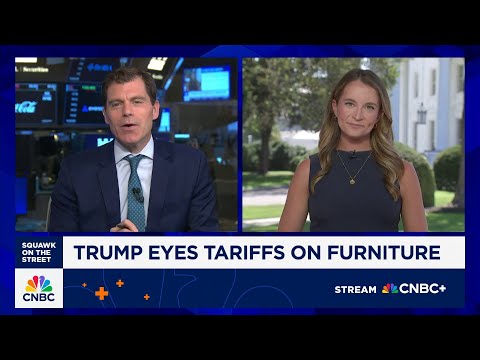
Furniture industry prepares for tariffs after President's Trump Social post
CNBC Television· 2025-08-25 15:00
Speaking of which, let's get to Megan Cassella with the latest out of Washington on those tariffs. Hey, Megan. >> Hey guys, good morning.That's absolutely right. The latest industry really under fire here from this White House talking about new tariffs. All of that new talk stemming from a true social post that the president posted late on Friday in which he said he was pleased to announce that we are doing a major tariff investigation on furniture coming into the United States.He said within the next 50 da ...

X @Bloomberg
Bloomberg· 2025-08-25 14:49
Market Trends - Furniture stocks experienced a plunge following Trump's call for a tariff probe [1] News Source - Bloomberg Stock Movers report provides details on the furniture stock plunge [1]
New Strong Sell Stocks for August 25th
ZACKS· 2025-08-25 10:26
Group 1 - Atour Lifestyle Holdings Limited (ATAT) is a China-based lifestyle brands and hotel company with a current year earnings estimate revised 1.9% downward over the last 60 days [1] - La-Z-Boy Incorporated (LZB) is a furniture company that has seen its current year earnings estimate revised 10.6% downward over the last 60 days [1] - Primo Brands Corporation (PRMB) is a beverage company with a current year earnings estimate revised 14.4% downward over the last 60 days [2]


La-Z-Boy Sees Stock Down Then Up As Tarrif Threats Boost Prospects
Forbes· 2025-08-24 21:10
Company Overview - La-Z-Boy Inc., a Michigan-based furniture manufacturer, is expanding following a recent acquisition in the southeast, which is expected to close in October [7] - The company reported a mixed fiscal first quarter 2026, with total sales declining 1% year-over-year to $492 million, driven by a 5% increase in retail sales but only a 1% improvement in wholesale sales [4][5] Financial Performance - Adjusted operating margin narrowed to 4.8% from 6.6% a year prior, and adjusted earnings per share dropped 24% to $0.47, below the $0.53 analyst consensus [5] - Cash flow from operations totaled $36 million, with $22 million returned to shareholders through dividends and buybacks [5] Market Position and Strategy - La-Z-Boy's retail division consists of nearly 210 company-owned stores and is part of a broader network of nearly 370 stores, including Joybird, which has 14 stores in the U.S. [6] - The company is balancing optimism in long-term industry fundamentals with a pragmatic approach to current consumer demand, as stated by CEO Melinda Whittington [9] Industry Context - The Trump administration has launched an investigation into imported furniture, potentially leading to new tariffs, which may not significantly impact La-Z-Boy due to its U.S.-based manufacturing [10][11] - The U.S. furniture industry is facing challenges, with companies like Wayfair experiencing weakened demand for big-ticket items amid a slower housing market [12]


特朗普要对进口家具下手?是否征税、税率多少 50天内见分晓
Di Yi Cai Jing· 2025-08-23 04:33
Core Viewpoint - The U.S. government is initiating a significant tariff investigation on furniture imports, which may lead to new tariffs aimed at reviving domestic furniture manufacturing [1][2]. Group 1: Tariff Investigation - President Trump announced a 50-day investigation into furniture imports, with unspecified tariff rates to be determined [1]. - The investigation is part of a broader inquiry under Section 232 of the Trade Expansion Act, which assesses whether imports threaten national security [1][3]. - The investigation has already led to a sharp decline in stock prices for major furniture retailers, with Wayfair down 10% and RH down 9.9% [1]. Group 2: Price Trends - Furniture prices in the U.S. have been rising due to increased tariffs on major import sources like Vietnam, with significant price increases noted in recent months [2]. - The Consumer Price Index (CPI) for furniture and bedding saw increases of 0.4% and 0.9% in June and July, respectively, following a period of deflation [2]. - Other furniture categories, including office and outdoor furniture, experienced their largest price increases since May, with a 1.5% rise in May and 1.6% and 1.5% increases in June and July [2]. Group 3: Broader Trade Context - The Trump administration has been increasingly utilizing Section 232 and Section 301 investigations, with a total of 11 product categories currently under investigation, including steel, aluminum, and semiconductors [3]. - The trend indicates a shift from raw materials to downstream industries, suggesting a comprehensive approach to trade protection [3][4]. - Previous Section 232 investigations have led to extensive tariffs on various products, with the potential for tariffs to extend to a wide range of goods, including furniture [4].
特朗普要对进口家具下手?是否征税、税率多少,50天内见分晓
Di Yi Cai Jing· 2025-08-23 04:28
Group 1 - The U.S. Department of Commerce is conducting an investigation into furniture imports under Section 232 of the Trade Expansion Act, which may lead to significant tariffs on imported furniture [1][6] - President Trump announced that the investigation will be completed within 50 days, and tariffs will be imposed on furniture from other countries, although the specific rates are yet to be determined [1][3] - Following the announcement, stock prices of major furniture retailers dropped significantly, with Wayfair down 10%, RH down 9.9%, and Williams-Sonoma down 6.7%, while La-Z-Boy, which primarily produces furniture in North America, saw a 3.7% increase [1] Group 2 - Furniture prices in the U.S. have been rising due to increased tariffs on major furniture importing countries, including Vietnam, leading to a notable increase in consumer prices for furniture and bedding [3][4] - The Consumer Price Index (CPI) for furniture and bedding has shown increases of 0.4% and 0.9% in June and July, respectively, following a period of significant deflation [3] - Other categories of furniture, such as office and outdoor furniture, have also experienced price increases, with the largest rise since May recorded at 1.5% [3] Group 3 - The investigation into furniture is part of a broader trend where the U.S. government is increasingly using Section 232 investigations to assess the impact of imports on national security, extending beyond just tariffs on steel and aluminum [6][9] - The current trend indicates a movement from raw materials to the entire supply chain, suggesting that the scope of investigations may widen to include various products and their derivatives [8][9] - Legal experts have noted that the authority granted to the President under Section 232 is extensive, with limited judicial review, allowing for broad implications for various industries [9]

Trump says he will place tariffs on furniture — causing shares of Wayfair, Williams-Sonoma to plunge
New York Post· 2025-08-22 22:43
Core Viewpoint - The Trump administration is investigating imported furniture for potential tariffs, which has led to significant stock declines for companies reliant on foreign manufacturing, while some domestic manufacturers have seen stock increases [1][2][5]. Company Impact - Major home goods companies such as Wayfair, RH, and Williams-Sonoma experienced stock declines of over 6% following the announcement [2][4]. - In contrast, La-Z-Boy's shares rose nearly 2.5% as the company primarily manufactures within the United States [5]. Industry Context - The furniture industry is facing challenges, including a year-long decline in demand for big-ticket items due to a sluggish housing market and persistent inflation affecting consumer spending [9][10]. - The investigation into furniture tariffs is part of a broader trade agenda aimed at reducing reliance on foreign manufacturing and encouraging domestic production, particularly in traditional furniture-making states like North Carolina and South Carolina [11][12]. Trade Relations - The timing of the potential tariffs comes amidst ongoing trade negotiations with global partners, which have provided some market stability, although many disputes remain unresolved [8]. - It is unclear whether the new furniture tariffs would be in addition to existing country-specific duty rates negotiated through bilateral trade deals [7][13].




X @外汇交易员
外汇交易员· 2025-08-22 22:18
Trade Policy - US is initiating a significant tariff investigation on furniture entering the US [1] - The investigation is expected to be completed within 50 days [1] - Tariffs will be imposed on furniture entering the US from other countries at an undetermined rate [1] Industry Impact - The goal is to bring furniture business back to states like North Carolina, South Carolina, and Michigan [1]
Trump says U.S. will conduct 'major tariff investigation' on furniture
CNBC Television· 2025-08-22 21:20
Just within the past couple of moments, the president of the United States announcing a major tariff investigation in the furniture industry, posting on social media a couple minutes ago, "I am pleased to announce that we are doing a major tariff investigation on furniture coming into the United States within the next 50 days. That investigation will be completed and furniture coming from other countries into the United States will be tariffed at a rate yet to be determined. This will bring the furniture bu ...

X @Bloomberg
Bloomberg· 2025-08-22 20:38
Trade Policy - The US is initiating a "major Tariff Investigation on Furniture" entering the country [1] - This investigation sets the stage for potential industry-specific tariffs on furniture [1]