家具

Search documents
什么消费最先“稳定”?
一瑜中的· 2026-03-31 12:51
Group 1: Core Viewpoint - The article discusses the stabilization of essential consumer goods in the retail sector, indicating that these goods may have returned to a stable growth phase starting in 2024, with growth rates around 4% for 2024 and 2025 [2][3][12]. Group 2: Consumer Segmentation - The retail sector is divided into four categories: subsidy-related retail (7.9 trillion, 16% of total), real estate-related retail (0.2 trillion, 0.2%), price-volatile retail (2.6 trillion, 5.2%), and essential retail (39 trillion, 79%) [2][11]. - Essential retail has historically been the most stable segment, with an average annual growth rate fluctuation of only 0.6 percentage points from 2009 to 2019 [11][12]. Group 3: Economic Observations - The weekly economic activity index (WEI) rose to 5.49% as of March 22, 2026, up from 4.98% the previous week, indicating an upward trend in economic activity [4][20]. - Retail sales of passenger cars showed a significant narrowing of decline, with a year-on-year decrease of 7% as of March 22, compared to a previous decline of 19% [4][27]. - Real estate sales saw a rebound, with residential sales in 67 cities increasing by 12% year-on-year as of March 28, 2026 [4][27]. Group 4: Production and Infrastructure - Cement shipment rates improved to 32.8% as of March 27, 2026, although the rate of improvement has slowed [4][31]. - The overall operating rates in various industries showed mixed results, with some sectors performing better than last year while others lagged [4][31]. Group 5: Trade and Exports - China's port container throughput showed a significant rebound, with a week-on-week growth of 3.7% as of March 22, 2026 [4][38]. - The number of cargo ships from China to the U.S. saw a year-on-year decline of 22.4% as of March 27, 2026, indicating a worsening trend in direct trade flow [4][39]. Group 6: Price Trends - Oil prices continued to rise, with Brent crude at $112.6 per barrel, while gold prices fell to $4,492 per ounce, down 1.8% [4][58]. - Domestic coal prices increased, with Shanxi thermal coal priced at 761 yuan per ton, up 3.5% [4][59].


2026年1-2月经济数据点评:开年经济数据普遍回暖,关注地缘冲突风险外溢
Zhong Cheng Xin Guo Ji· 2026-03-25 05:37
Economic Overview - The economic data for early 2026 shows a general recovery, with most indicators improving compared to the end of last year, particularly in industrial production supported by exports and high-tech sectors[3] - The industrial added value for January-February 2026 increased by 6.3% year-on-year, surpassing the previous year's levels, indicating strong recovery in industrial production[3] Industrial Performance - Industrial exports saw a significant growth of 27.1%, with integrated circuit exports soaring by 72.6%, contributing 3.4 percentage points to overall export growth[4] - The industrial production index maintained a high level, with January-February 2026 showing a month-on-month increase of 0.39% and 0.83% respectively, averaging 0.61%[3] Consumer Trends - Social retail sales in January-February 2026 grew by 2.8% year-on-year, although this represents a slowdown compared to the previous year, with retail sales of goods increasing by 2.5%[8] - During the Spring Festival, domestic travel reached 596 million trips, generating a total expenditure of approximately 803.48 billion yuan, marking a historical high[8] Investment Insights - Fixed asset investment in January-February 2026 showed a year-on-year growth of 1.8%, recovering by 5.6 percentage points from the previous year, with significant contributions from infrastructure investment[11] - Infrastructure investment grew by 11.4% year-on-year, supported by proactive fiscal policies and the implementation of two "500 billion" policy tools[16] Real Estate Market - The real estate market exhibited a "volume drop, price rise" trend, with new housing sales area declining by 13.5% year-on-year, while second-hand housing transactions showed signs of recovery[13] - The average price of new residential buildings in January was 17,000 yuan per square meter, reflecting a month-on-month increase of 0.18%[13] Global Economic Context - Geopolitical tensions in the Middle East have led to increased energy prices, with Brent crude oil prices rising from $70 to over $100 per barrel, impacting global inflation and trade dynamics[20] - The ongoing conflict has raised concerns about supply chain disruptions and increased shipping costs, which may affect China's export orders and overall economic stability[21]
2026年1-2月经济数据解读:供需两端均有所回暖
East Money Securities· 2026-03-19 06:06
Economic Overview - The economic data for January-February 2026 indicates a strong start, with industrial value-added increasing by 6.3% year-on-year, and the service production index rising by 5.2% year-on-year [1][6] - Retail sales of consumer goods grew by 2.8% year-on-year, while fixed asset investment (excluding rural households) increased by 1.8% year-on-year, marking a shift from negative to positive growth [1][6] Consumer Trends - Consumer spending showed significant improvement, with retail sales of consumer goods rising from 0.9% in December 2025 to 2.8% in January-February 2026, driven by the extended Spring Festival holiday and early subsidies for "trade-in" programs [6][8] - Excluding automobiles, retail sales increased by 3.7%, up 2 percentage points from December 2025 [6][8] - Service retail outperformed goods retail, with notable growth in tourism and leisure services, and restaurant income increasing by 4.8%, accelerating by 1.6 percentage points compared to the previous year [6][8] Investment Insights - Fixed asset investment turned positive with a cumulative year-on-year growth of 1.8%, compared to a decline of 3.8% in December 2025 [6][8] - Manufacturing and infrastructure investments rebounded significantly, with year-on-year growth rates of 3.1% and 11.4%, respectively, both exceeding December 2025 levels [6][8] - Real estate investment saw a year-on-year decline of 11.1%, but the rate of decline narrowed by 6.4 percentage points [6][8] Industrial Performance - The industrial sector demonstrated robust growth, with a year-on-year increase of 6.3% in industrial value-added, up from 5.2% in December 2025 [6][8] - Export delivery value also rose by 6.3% year-on-year, reflecting strong external demand [6][8] - High-tech manufacturing played a crucial role, with a year-on-year growth of 13.1%, surpassing the overall industrial growth rate [6][8] Service Sector Dynamics - The service sector maintained growth momentum, with the service production index increasing by 5.2% year-on-year, slightly up from December 2025 [6][8] - The cultural tourism and leisure entertainment markets were particularly active, benefiting from the extended holiday period [6][8] - The information transmission, software, and IT services sector saw a significant year-on-year growth of 10.1% [6][8] Real Estate Market - The real estate market remains weak, with declines in housing construction, new starts, completions, and sales continuing [6][8] - The price index for new residential properties in 70 large and medium-sized cities fell by 3.5% year-on-year, while second-hand residential prices decreased by 6.3% [6][8] Future Outlook - Economic growth momentum is expected to continue improving, supported by policy implementation and recovery in industrial activity [6][8] - The recent geopolitical tensions may lead to price increases in upstream resources, particularly in oil, which could have downstream effects on various sectors [6][8]
1-2月投资消费数据点评:内生动能渐次回归,弱复苏格局深化
金融街证券· 2026-03-18 11:07
Consumption Insights - In January-February 2026, the total retail sales of consumer goods increased by 2.8% year-on-year, a significant rebound from 0.86% in December 2025[1] - Core consumption, excluding automobile sales, grew by 3.7%, returning to levels seen in the second half of 2024[1] - Current potential consumption growth is estimated to be in the range of 4%-5%, with core consumer goods growth nearing the lower bound of this range[5] Investment Trends - Fixed asset investment increased by 1.8% year-on-year in January-February 2026, with infrastructure investment rising by 11.4% and manufacturing investment by 3.1%, while real estate development investment fell by 11.1%[2] - The share of private investment in fixed asset investment has been declining, dropping to 50.1% in 2024, and is expected to fall below 50% in 2025[4] - Private fixed asset investment decreased by 2.6% year-on-year, but the decline is less severe compared to a 6.4% drop in 2025, indicating a gradual accumulation of internal growth momentum[10] Policy and Financial Support - Special bonds for local governments are expected to maintain a high issuance quota of 4.4 trillion yuan in 2026, with 82.42 billion yuan issued in January-February, a 38.1% increase year-on-year[13] - The government is focusing on using special bonds for project investment rather than resolving existing risks, which may alleviate funding constraints for local investments[3] - Policy tools such as long-term special bonds and structural monetary policy are being utilized to support infrastructure and manufacturing investments[11] Risks and Outlook - Risks include potential unexpected declines in consumption, insufficient policy support, and weak recovery of internal growth momentum[20] - The overall investment environment is in a weak recovery phase, with the sustainability of effective investments relying on internal growth dynamics[19]
经济开门红的两个维度和三个后续
2026-03-18 02:31
Summary of Key Points from the Conference Call Industry Overview - The macroeconomic data for January-February 2026 indicates a strong recovery, with Q1 GDP growth expected around 5%, at the upper limit of the annual target of 4.5%-5% [2][3] - Industrial value added increased by 6.3% year-on-year, driven significantly by exports, while high-tech manufacturing grew by 13.3% [1][4] - The new energy vehicle production saw a decline of 13.7%, marking the first drop since 2020, attributed to rising costs and subsidy reductions [1][4] Core Insights and Arguments - The economic indicators show a marked improvement compared to the end of 2025, with exports and retail sales increasing, while fixed asset investment and social retail sales lagged behind [2][3] - The resilience of social retail sales, particularly in goods consumption, is crucial for economic momentum, as service retail grew by 5.6% while total retail sales only increased by 2.8% [3][6] - The real estate market is showing signs of internal recovery, with second-hand housing prices in major cities like Beijing and Shanghai experiencing slight increases [1][4][8] Important but Overlooked Content - The Producer Price Index (PPI) is expected to turn positive by March, influenced by rising oil prices, which may lead to a wage-price spiral if cost pressures are effectively managed [1][4] - Fixed asset investment grew by 1.8% year-on-year, with broad infrastructure investment leading at 9.8%, while real estate investment continued to decline by 11% [7][8] - The automotive manufacturing sector saw a significant drop in investment growth from 12% to 2.6%, reflecting the overall downward trend in the industry [7][8] - The recovery in the second-hand housing market, particularly in first-tier cities, is a critical indicator of potential stabilization in the real estate sector, which could signal a bottoming out of the market if the trend continues [8]
商贸零售行业定期报告:社零+2.8%,开局良好
CAITONG SECURITIES· 2026-03-17 12:41
Investment Rating - The industry investment rating is maintained as "Positive" [2] Core Insights - The total retail sales for January-February 2026 reached 86,079 billion yuan, with a nominal year-on-year increase of 2.8%, exceeding market expectations; retail sales excluding automobiles increased by 3.7% year-on-year [4][12] - In January-February, the retail sales of catering amounted to 10,264 billion yuan, with a year-on-year increase of 4.8%, while commodity retail sales were 75,815 billion yuan, with a year-on-year increase of 2.5% [4][13] - Essential goods showed strong performance due to holiday effects and increased return migration, with year-on-year growth in food and oil (+10.2%), beverages (+6.0%), tobacco and alcohol (+19.1%), and daily necessities (+6.6%) [4][20] - For discretionary goods, textiles and clothing, as well as communication equipment, led the growth, with cosmetics (+4.5%), gold and silver jewelry (+13.0%), textiles and clothing (+10.4%), and communication equipment (+17.8%) showing significant increases [4][22] - The real estate chain remained relatively flat, while the automotive chain continued to be weak, with retail sales of passenger cars declining by 18.9% year-on-year [4][25] - Online retail sales grew by 9.2% in January-February, totaling 32,546 billion yuan, with physical online retail sales reaching 20,812 billion yuan, up 10.3% year-on-year [4][35] Summary by Sections Overall Retail Data - The total retail sales for January-February 2026 were 86,079 billion yuan, with a nominal year-on-year increase of 2.8%, and a 3.7% increase excluding automobiles [4][12] - Urban and rural retail sales increased by 2.7% and 3.2% year-on-year, respectively [4][13] Limited Above Data - The retail sales of limited above units reached 32,218 billion yuan, with a year-on-year increase of 2.7% [4][20] - Retail sales of limited above commodities and catering increased by 2.5% and 4.7% year-on-year, respectively [4][20] Classification Data - Essential consumption categories showed significant growth: food and oil (+10.2%), beverages (+6.0%), tobacco and alcohol (+19.1%), daily necessities (+6.6%) [4][22] - Discretionary consumption categories included textiles and clothing (+10.4%), cosmetics (+4.5%), gold and silver jewelry (+13.0%), and communication equipment (+17.8%) [4][22] Online Retail Data - Online retail sales totaled 32,546 billion yuan, with a year-on-year increase of 9.2% [4][35] - Physical online retail sales reached 20,812 billion yuan, with a year-on-year increase of 10.3% [4][35] - Online service retail sales amounted to 11,734 billion yuan, with a year-on-year increase of 7.3% [4][35]
社零数据点评:1-2月社零+2.8%,消费开年温和复苏
HUAXI Securities· 2026-03-17 11:37
Investment Rating - Industry rating: Recommended [4] Core Insights - The retail sales of consumer goods in January-February 2026 increased by 2.8% year-on-year, slightly above the consensus expectation of 2.7% [1] - The real estate sector showed significant declines in new construction, completion, sales area, and development investment, with year-on-year decreases of 23.3%, 26.9%, 15.9%, and 10.7% respectively [1][2] - The furniture and cultural office supplies sectors experienced growth rates of 8.8% and 5.8% respectively, indicating a structural recovery in the home goods market [2] - The cosmetics sector saw retail sales of 75.3 billion yuan, with a year-on-year increase of 4.5%, although February faced temporary pressure due to logistics delays and decreased consumer demand [3][6] - The gold and jewelry retail sector reported a retail sales increase of 13.0% year-on-year, supported by rising gold prices and a recovering economy [6] Summary by Category Home Goods - The real estate market is stabilizing, with expectations of recovery supported by ongoing policies and macroeconomic stability [2] - The home goods market is benefiting from trade-in subsidies, activating consumer demand [2] - Key companies to watch include Oppein Home and Mousse, which have strong channel capabilities and product innovation [7] Cosmetics - The cosmetics market is expected to recover, driven by consumer upgrade trends and the upcoming 618 shopping festival [3] - Brands with strong cultural characteristics and clear improvement trends are recommended, such as Maogeping and Lin Qingxuan [7] Gold and Jewelry - The gold and jewelry sector is expected to maintain resilience, particularly among high-end and youth-oriented brands [6] - Companies with strong brand premiums and differentiated pricing models, such as Laopu Gold, are highlighted for investment [7]
数据点评 | 经济开门红的“预期差”(申万宏观·赵伟团队)
申万宏源证券上海北京西路营业部· 2026-03-17 02:55
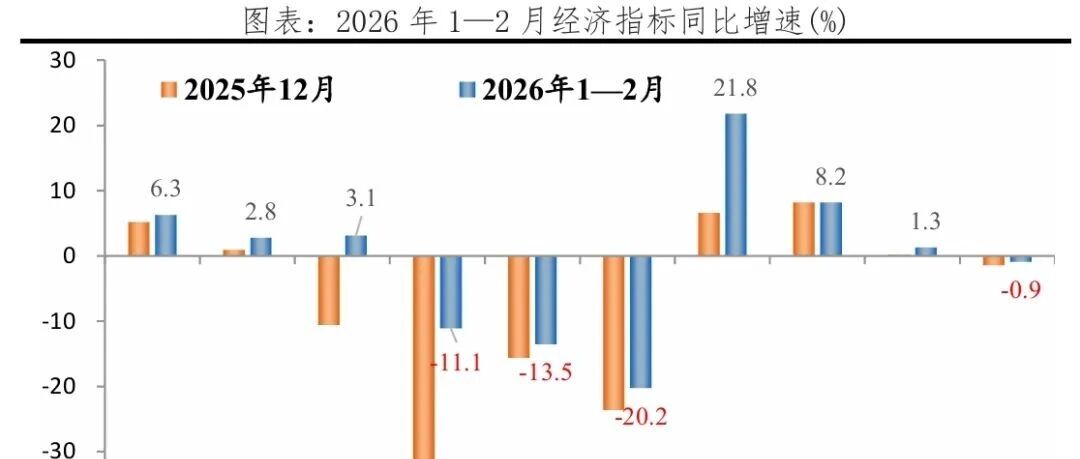
Core Viewpoint - The "expected difference" in domestic demand improvement is greater than that of external demand, driven by a longer Spring Festival holiday, continuation of national subsidy policies, and recovery of consumer confidence [7][14][95]. Consumption - In January-February, the total retail sales of consumer goods increased by 2.8% year-on-year, exceeding the expected 2.4%, with a rebound of 1.9 percentage points from December 2025. This improvement is attributed to two main factors: the longer Spring Festival holiday boosting consumption in tobacco, alcohol, and food categories, and the new round of "old-for-new" funding stimulating significant growth in home appliances and furniture [6][14][93]. - Restaurant income saw a year-on-year growth rate increase of 2.6 percentage points to 4.8%, while service retail sales also rose by 0.1 percentage points to 5.6% compared to the end of last year [7][14][93]. Investment - Fixed asset investment showed a remarkable rebound, with a year-on-year increase of 1.8% in January-February, a rise of 16.9 percentage points from December 2025, marking an unprecedented recovery. This improvement is supported by a decrease in the proportion of special refinancing bonds and enhanced cash flow for enterprises due to previous debt-clearing policies [7][17][57]. - Infrastructure investment improved significantly, rising by 20.4 percentage points to 11.4%, while manufacturing investment increased by 12.7 percentage points to 3.1%. Service industry investment also saw a notable recovery, with a decrease in the year-on-year decline to -0.6% [17][62][68]. Real Estate - Although sales, new construction, and completion rates remain low, real estate investment showed a significant rebound, with a year-on-year decline narrowing to -11.1%, an improvement of 24.7 percentage points. The sales area of commercial housing also improved slightly, with a year-on-year decline of 13.5%, up by 2.1 percentage points from December 2025 [8][29][68]. - The credit financing growth rate for real estate companies increased, contributing to the rebound in real estate investment. However, new construction and completion rates still face uncertainties, with declines of 3.7 and 9.6 percentage points, respectively [29][94]. Production - The industrial added value increased by 6.3% year-on-year in January-February, reflecting a significant rebound influenced by the "Spring Festival misalignment" and demand improvement. This increase is estimated to be boosted by 0.7-0.8 percentage points due to the holiday effects [6][37][94]. - Labor-intensive industries, such as food manufacturing and beverages, showed substantial production increases, while sectors like electrical machinery and non-metallic minerals also improved, likely due to stronger exports and investment recovery [37][94].
2026年1-2月经济增长数据点评:中国经济“开门红”
Ping An Securities· 2026-03-17 00:38
Economic Growth Data - In the first two months of 2026, China's industrial production value increased by 6.3% year-on-year, while the service production index grew by 5.2%[2] - Industrial production growth accelerated by 1.1 percentage points compared to December 2025, and the service sector's growth improved by 0.2 percentage points[2] - Social retail sales rose by 2.8% year-on-year, with fixed asset investment increasing by 1.8%, both showing significant improvements from December 2025 by 1.9 and 5.6 percentage points respectively[2] Sector Performance - High-tech manufacturing value added surged by 13.1%, outpacing overall industrial growth by 6.8 percentage points[2] - Export delivery value also rebounded, growing by 6.3% year-on-year, matching the industrial production growth rate and improving by 3.1 percentage points from December 2025[2] - The service sector saw notable growth in information transmission, software, and IT services (10.1%), finance (7.0%), and transportation (6.3%) during the same period[2] Investment Trends - Fixed asset investment showed a year-on-year increase of 1.8%, with infrastructure and manufacturing investments rising by 9.8% and 3.1% respectively[2] - Real estate investment declined by 11.1%, but this was a smaller drop compared to the previous year's overall decline by 6.1 percentage points[2] - Equipment and tool purchases increased by 11.5%, indicating strong policy support for investment recovery[2] Risks and Outlook - Potential risks include the effectiveness of growth stabilization policies falling short of expectations, unexpected severity of overseas economic downturns, and escalation of geopolitical conflicts[8]
经济开门红——全面解读1-2月经济数据
泽平宏观· 2026-03-16 16:06
Economic Overview - The national economy showed a "new strong, old weak, external strong, internal stable" trend in the first two months of 2026, with high-tech manufacturing and equipment manufacturing leading the growth [2][3] - Industrial production accelerated, with a year-on-year increase of 6.3% in industrial added value, up 1.1 percentage points from December [2][8] - Fixed asset investment turned positive, growing by 1.8% year-on-year, a significant recovery of 16.9 percentage points from December [2][12] Industrial Production - High-tech manufacturing and equipment manufacturing sectors experienced significant growth, with high-tech manufacturing value-added increasing by 13.1% year-on-year [6][9] - The production of upstream raw materials improved due to rising international oil prices, while midstream machinery and equipment sectors benefited from policy effects [9][10] Investment Trends - Fixed asset investment (excluding rural households) showed a year-on-year increase of 1.8%, with high-tech industry investment growing by 5.1% [12][20] - Infrastructure investment surged by 11.4% year-on-year, driven by the acceleration of major projects and statistical adjustments [17][18] Real Estate Market - The decline in real estate investment narrowed, with sales area and sales amount decreasing by 13.5% and 20.2% respectively, but showing improvement from December [15][16] - Real estate companies are still cautious in land acquisition, with a significant drop in land transaction volume [16] Export Performance - Exports exceeded expectations, with a year-on-year growth of 21.8%, driven by global manufacturing recovery and enhanced competitiveness [25][26] - Exports to countries along the Belt and Road increased by 28.5%, accounting for over 50% of total exports [25][26] Consumer Spending - Social retail sales increased by 2.8% year-on-year, with service consumption performing well due to the long Spring Festival holiday [23][24] - Traditional consumer goods saw a significant demand boost during the holiday period, with restaurant income rising by 4.8% [23] Financial Data - Social financing maintained a stable growth rate of 8.2%, supported by government bonds and bank loans [28][29] - M2 growth remained at 9.0%, while M1 increased by 5.9%, indicating a shift in deposit trends towards non-bank institutions [29] Price Trends - CPI rose by 1.3% year-on-year, the highest in nearly three years, influenced by the timing of the Spring Festival [31][32] - PPI decline narrowed, reflecting input inflation and strong demand in certain technology sectors [31][32]