
多个行业

Search documents
191只北交所股票今日上涨,4只涨停
Zheng Quan Shi Bao Wang· 2025-09-04 10:32
Market Overview - On September 4, the total trading volume of stocks on the Beijing Stock Exchange reached 1.67 billion shares, with a total transaction value of 37.974 billion yuan, an increase of 5.949 billion yuan compared to the previous trading day [1] - A total of 191 stocks closed higher, accounting for 69.96% of the tradable stocks, with notable gainers including Hongzhi Technology, Gaisi Food, and Zhongke Meiling, which rose by 21.92%, 16.36%, and 15.85% respectively [1] Stock Performance - Among the stocks with significant trading volume, Beitri, Derui Lithium, and Naconoer had transaction values of 793 million yuan, 755 million yuan, and 614 million yuan respectively [1] - The trading activity showed that 128 stocks had transaction values exceeding 10 million yuan, indicating a robust trading environment [1] Trading Metrics - The turnover rate for stocks on the exchange was notably high, with 74 stocks having a turnover rate exceeding 10%, and 20 stocks exceeding 20% [1] - The stocks with the highest turnover rates included Zhongke Meiling at 54.90%, Gaisi Food at 43.43%, and Wuhan Land Electric at 37.18% [1] Notable Stock Movements - Stocks that experienced significant price changes included: - Beitri: Closed at 27.69 yuan, up 1.24% with a turnover rate of 2.54% [1] - Derui Lithium: Closed at 35.18 yuan, up 3.47% with a turnover rate of 25.73% [1] - Naconoer: Closed at 60.30 yuan, down 3.30% with a turnover rate of 7.51% [1] - Hongzhi Technology: Closed at 28.37 yuan, up 21.92% with a turnover rate of 20.90% [1] - Gaisi Food: Closed at 15.36 yuan, up 16.36% with a turnover rate of 43.43% [1]
北交所成交活跃股:14股换手率超20%
Zheng Quan Shi Bao Wang· 2025-08-20 09:06
Summary of Key Points Core Viewpoint - The trading volume and value of stocks on the Beijing Stock Exchange (BSE) showed a significant decrease on August 20, with a total trading volume of 1.565 billion shares and a trading value of 40.69 billion yuan, down by 13.315 billion yuan compared to the previous trading day. Despite this, 169 stocks closed higher, indicating a mixed market performance [1]. Trading Performance - On August 20, 169 stocks on the BSE closed higher, accounting for 62.13% of the tradable stocks. Notable gainers included Hongyuan Co., which surged by 358.02%, Jihe Technology with a rise of 20.08%, and Zhuozhao Adhesive with an increase of 19.67% [1][2]. - Conversely, 99 stocks closed lower, with significant declines seen in Haineng Technology (-10.96%), Boxun Biology (-8.82%), and Beiyikang (-7.20%) [1]. Stock Activity - Hongyuan Co. (920018) experienced a remarkable increase of 358.02% with a turnover rate of 94.11%, and a trading value of approximately 1.108 billion yuan. A total of 134 stocks had trading values exceeding 100 million yuan, with Shuguang Shuchuang and Ge Bi Jia following closely behind [2]. - The trading activity was characterized by high turnover rates, with 66 stocks having turnover rates exceeding 10%, and 14 stocks exceeding 20%. The top turnover rates were recorded for Hongyuan Co. (94.11%), Boxun Biology (34.33%), and Tiangong Co. (33.79%) [2]. Notable Stocks - The top-performing stocks in terms of closing price and percentage increase included: - Shuguang Shuchuang: Closing price of 97.49 yuan, up by 6.89% - Hongyuan Co.: Closing price of 42.00 yuan, up by 358.02% - Jihe Technology: Closing price of 42.75 yuan, up by 20.08% [2][3]. Market Dynamics - The overall market dynamics reflected a decrease in trading value, yet a substantial number of stocks managed to achieve significant gains, indicating potential opportunities for investors in specific sectors or companies [1][2].
8月18日增减持汇总:金徽股份等12家公司减持 暂无A股增持(表)
Xin Lang Zheng Quan· 2025-08-18 13:18
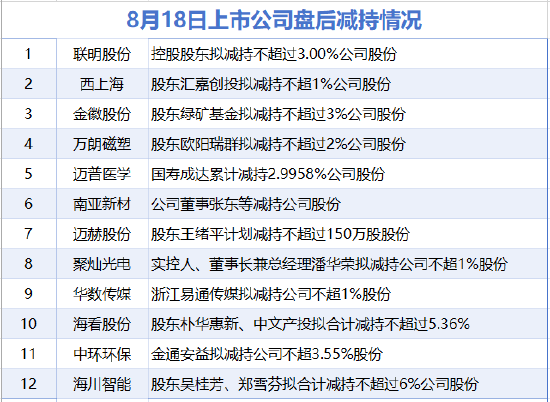
Summary of Key Points Core Viewpoint - As of August 18, a total of 12 listed companies have disclosed share reduction plans, with no companies announcing share increases on the same day [1]. Group 1: Companies with Share Reduction Plans - Lianming Co., Ltd. plans to reduce its holdings by up to 3.00% of the company's shares [2]. - Xishanghai's shareholder Huijia Chuangtou intends to reduce its stake by no more than 1% [2]. - Jinhui Co., Ltd.'s shareholder Green Mining Fund plans to reduce its holdings by up to 3% [2]. - Wanlang Magnetic Plastic's shareholder Ouyang Ruiqun intends to reduce its stake by no more than 2% [2]. - Maipu Medical's shareholder Guoshou Chengda has cumulatively reduced its holdings by 2.9958% [2]. - Nanya New Materials' board member Zhang Dong and others are reducing their shares [2]. - Maihe Co., Ltd.'s shareholder Wang Xuping plans to reduce up to 150,000 shares [2]. - Juzan Optoelectronics' actual controller and chairman Pan Huarong intends to reduce no more than 1% of the company's shares [2]. - Huashu Media's Zhejiang Yitong Media plans to reduce its stake by no more than 1% [2]. - Haikan Co., Ltd.'s shareholders Park Huahui and Zhongwen Chantu plan to collectively reduce up to 5.36% [2]. - Zhonghuan Environmental's Jintong Anyi intends to reduce its holdings by no more than 3.55% [2]. - Haichuan Intelligent's shareholders Wu Guifang and Zheng Xuefen plan to collectively reduce up to 6% [2].





192家上市公司被出具“非标”!7大会计处理问题
梧桐树下V· 2025-08-17 13:16
Core Viewpoint - The China Securities Regulatory Commission (CSRC) released the 2024 annual financial report accounting supervision report, indicating that while listed companies generally comply with accounting standards and financial disclosure rules, there are still significant issues in areas such as revenue recognition, long-term equity investments, financial instruments, asset impairment, and non-recurring gains and losses [1][2][7]. Revenue-Related Issues - Companies improperly adopted the time period method for revenue and cost recognition, leading to unreasonable income and cost confirmations [7][8]. - Incorrect accounting for sales revenue under pricing models, treating price fluctuations as variable consideration instead of embedded derivatives [9]. - Mismanagement of sales rebates, where companies recognized full revenue upon delivery without appropriately accounting for future rebates [10]. - Inadequate handling of contract fulfillment costs, failing to recognize costs as assets when they are directly related to fulfilling contracts [11]. Long-Term Equity Investments and Business Combinations Issues - Companies incorrectly judged the scope of consolidated financial statements, failing to recognize control over subsidiaries [12][13]. - Misapplication of goodwill recognition in non-similar control business combinations, treating step acquisitions as separate transactions [16][17]. - Inappropriate handling of contingent consideration in business combinations, failing to recognize it as part of the acquisition cost [18][19]. - Errors in accounting for minority shareholder performance commitments, leading to incorrect classification of contingent consideration [20][21]. Financial Instruments Recognition and Measurement Issues - Inadequate provision for expected credit losses, with companies misclassifying receivables with different risk characteristics [25][26]. - Incorrect distinction between financial liabilities and equity instruments, leading to misclassification of obligations [27]. - Failure to timely recognize financial liabilities related to the purchase of minority interests [28]. - Improper handling of price adjustment clauses in inventory purchases, failing to account for embedded derivatives [29][30]. Asset Impairment Issues - Companies inadequately recognized inventory impairment, failing to assess the recoverable amount based on estimated selling prices [31]. - Misclassification of prepaid accounts and other receivables, leading to inappropriate impairment provisions [32][33]. - Errors in measuring the recoverable amount of assets, using inappropriate valuation methods [34]. - Inadequate provision for impairment of construction in progress, failing to recognize impairment indicators [35]. Other Recognition and Measurement Issues - Companies improperly accounted for customized product-related R&D expenses, failing to determine whether they should be capitalized or treated as contract fulfillment costs [36][37]. - Incorrect treatment of fixed asset repair expenses, misclassifying them as operating expenses instead of capitalizing them [38]. - Errors in recognizing and measuring construction in progress, including mismanagement of contractual obligations and related costs [39]. - Inappropriate handling of penalties for lease termination, misclassifying them as operating expenses rather than adjusting lease liabilities [40][41].

A股半年报盘点丨113家上市公司已披露 12家公司净利润超10亿元
Di Yi Cai Jing· 2025-08-07 00:15
Summary of Key Points Core Viewpoint - The A-share market has shown a positive trend in the 2025 semi-annual reports, with a majority of companies reporting profits and significant growth in both revenue and net profit [1][2]. Group 1: Financial Performance - A total of 113 A-share listed companies have disclosed their 2025 semi-annual reports, with 100 companies reporting profits and 13 companies reporting losses [1]. - The cumulative revenue of these companies reached 708.21 billion, reflecting a year-on-year increase of 6.52% [1]. - The total net profit amounted to 82.32 billion, showing a year-on-year increase of 29.1% [1]. - Among the companies that disclosed their reports, 79 reported an increase in net profit year-on-year, while 34 experienced a decline [1]. Group 2: Revenue and Profit Leaders - In terms of revenue, two companies reported over 5 billion: Shunbo Alloy with 7.13 billion, and Jereh with 6.90 billion [1]. - The top three companies by net profit included Jereh with 1.24 billion, Shengmei Shanghai with 696 million, and Tapai Group with 435 million [1]. - A total of 12 companies reported net profits exceeding 1 billion, with Ningde Times leading at 30.49 billion, followed by Huaneng International at 9.26 billion, and WuXi AppTec at 8.56 billion [1]. Group 3: Significant Growth in Net Profit - A total of 31 companies reported a net profit growth exceeding 50%, with the highest increases seen in Zhimingda at 2147.93%, Shijia Photon at 1712.00%, and Nanjiguang at 982.43% [2].
今日视点:为民营经济添柴续力 让发展活力持续迸发
Zheng Quan Ri Bao· 2025-08-04 22:30
Core Viewpoint - The private economy serves as a "barometer" of economic vitality and is crucial for driving economic growth, with private enterprises achieving a total import and export value of 12.48 trillion yuan in the first half of the year, reflecting a year-on-year growth of 7.3% and accounting for 57.3% of China's foreign trade [1] Group 1: Policy Support - There is a need for more direct and efficient policy implementation to support private enterprises, with over 500 discussions held by the National Development and Reform Commission (NDRC) with private companies in the past two years [2] - The government has introduced favorable measures, including a 3 trillion yuan fund for quality projects to support private enterprises and the implementation of the Private Economy Promotion Law [2] Group 2: Innovation Focus - Private enterprises are encouraged to invest in hard technology and focus on innovation, particularly in critical areas of the industrial chain, to enhance competitiveness [3] - The demand for customized products and advanced technology over mere price competition highlights the importance of innovation in the private sector [3] Group 3: Business Environment - The improvement of the business environment is essential, with recent changes allowing for easier business registration and more flexible regulatory practices [4] - Continuous optimization of the business environment is necessary to support private enterprises in focusing on production and market expansion [4] Group 4: Market Expansion - Private enterprises are urged to tap into domestic and international markets, with over 57% of foreign trade attributed to private enterprises in the first half of the year [5] - The potential of the domestic market, with over 400 million middle-income consumers, and opportunities in international markets, such as tariff reductions under RCEP, are highlighted as areas for growth [5]
7月30日增减持汇总
Xin Lang Cai Jing· 2025-07-30 14:46
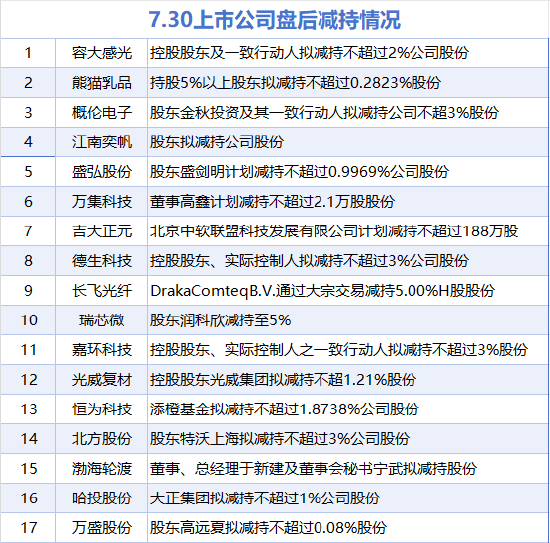
Summary of Key Points Core Viewpoint - On July 30, a total of 17 A-share listed companies disclosed share reduction plans, with no companies announcing share increases on the same day [1]. Group 1: Companies and Their Share Reduction Plans - Rongda Photoelectric plans to reduce no more than 2% of its shares by controlling shareholders and their concerted actions [2]. - Panda Dairy's shareholders holding over 5% intend to reduce no more than 0.2823% of their shares [2]. - Gaolun Electronics' shareholder, Jinqiu Investment and its concerted parties, plan to reduce no more than 3% of the company's shares [2]. - Jiangnan Yifan's shareholders plan to reduce their holdings [2]. - Shenghong Co., Ltd. plans to reduce no more than 0.9969% of its shares by shareholder Sheng Jianming [2]. - Wanjitech's director Gao Xin plans to reduce no more than 21,000 shares [2]. - Jida Zhengyuan plans to reduce no more than 1.88 million shares by Beijing Zhongruan Alliance Technology Development Co., Ltd. [2]. - Desheng Technology's controlling shareholder and actual controller plan to reduce no more than 3% of the company's shares [2]. - KRAST's DrakaComteq B.V. plans to reduce 5.00% of its H-shares through block trading [2]. - Ruixinwei's shareholder Run Kexin plans to reduce holdings to 5% [2]. - Jiahuan Technology's controlling shareholder and actual controller's concerted party plans to reduce no more than 3% of shares [2]. - Guangwei Composites' controlling shareholder Guangwei Group plans to reduce no more than 1.21% of shares [2]. - Hengwei Technology's Tiancheng Fund plans to reduce no more than 1.8738% of shares [2]. - Beifang Co., Ltd.'s shareholder Tewo Shanghai plans to reduce no more than 3% of shares [2]. - Bohai Ferry's director and general manager, along with the board secretary, plan to reduce their shares [2]. - Hatou Co., Ltd.'s Dazheng Group plans to reduce no more than 1% of shares [2]. - Wansheng Co., Ltd.'s shareholder Gao Yuanxia plans to reduce no more than 0.08% of shares [2].


北交所股票成交概况:160股上涨,97股下跌
Zheng Quan Shi Bao Wang· 2025-07-14 09:53
Summary of Key Points Core Viewpoint - The trading volume and turnover of stocks on the Beijing Stock Exchange (BSE) showed a decrease on July 14, with a total trading volume of 1.101 billion shares and a turnover of 22.509 billion yuan, down by 2.315 billion yuan compared to the previous trading day. Trading Performance - Among the tradable stocks on the BSE, 160 stocks closed higher, accounting for 59.70% of the total, with notable gainers including Guoyi Tender (up 18.33%), Chunguang Intelligent (up 12.67%), and Wanda Bearings (up 7.36%) [1] - Conversely, 97 stocks closed lower, with *ST Yunchuang leading the declines at 14.27%, followed by Zhisheng Information (down 7.11%) and Tonghui Information (down 6.87%) [1] Active Stocks - A total of 63 stocks had a turnover exceeding 100 million yuan, with the highest turnover recorded for Benlang New Materials (826 million yuan), Wanda Bearings (645 million yuan), and Guoyi Tender (580 million yuan) [1] - The trading activity indicated that 29 stocks had a turnover rate exceeding 10%, with 6 stocks exceeding 20%. The highest turnover rates were observed in *ST Guangdao (35.99%), Benlang New Materials (33.90%), and Zhongshe Consulting (25.81%) [1] Detailed Stock Performance - The closing prices and performance of notable stocks included: - Benlang New Materials: Closing price 18.92 yuan, unchanged, turnover rate 33.90%, turnover 825.59 million yuan [2] - Wanda Bearings: Closing price 131.30 yuan, up 7.36%, turnover rate 15.66%, turnover 644.71 million yuan [2] - Guoyi Tender: Closing price 21.30 yuan, up 18.33%, turnover rate 18.53%, turnover 580.02 million yuan [2] - *ST Yunchuang: Closing price 14.00 yuan, down 14.27%, turnover rate 17.62%, turnover 204.51 million yuan [2] Market Trends - The overall market showed a mixed performance with a significant number of stocks experiencing both gains and losses, reflecting a volatile trading environment on the BSE [1][2]
听企声 解企忧 护发展——广州创新打造纪企联动平台携手优化营商环境
Guang Zhou Ri Bao· 2025-06-20 10:45
Group 1 - The implementation of the Private Economy Promotion Law aims to enhance the relationship between government and private enterprises, providing support and solutions for private businesses [1][2] - The establishment of the "Lianqi Alliance" in Nansha District serves as a platform for communication between the government and private enterprises, promoting a clean and compliant business environment [2][3] - The Guangzhou Municipal Commission for Discipline Inspection and Supervision emphasizes the importance of integrity in business practices as a foundation for high-quality development [2][5] Group 2 - The "Lianqi Alliance" has expanded its membership, including specialized and leading enterprises, to foster a culture of zero tolerance for bribery and to create a favorable business environment [2][4] - A new anti-bribery management standard has been developed to help local enterprises identify and manage bribery risks effectively [4][5] - The introduction of a "blacklist" system for companies convicted of bribery aims to deter corrupt practices and encourage lawful business operations [5][6] Group 3 - The Guangzhou Municipal Commission for Discipline Inspection has launched various initiatives to improve the business environment, including detailed guidelines for government-business interactions [6][11] - The "Huaqi Lianmeng" initiative in Huadu District has successfully addressed issues of corruption and misconduct among enforcement personnel, enhancing service quality for businesses [7][8] - The establishment of communication platforms and rapid response mechanisms has facilitated timely resolution of business-related issues, fostering a supportive environment for enterprise development [10][12] Group 4 - Continuous efforts to improve the business environment have resulted in a significant increase in the number of high-tech enterprises in Nansha District, with over 1,310 high-tech companies established [5][14] - The implementation of various programs and activities, such as "Warm Nansha" and "I Serve Enterprises," aims to address the concerns of businesses and enhance their operational confidence [14][16] - The collaboration between different districts in Guangzhou showcases a comprehensive approach to optimizing the business environment, focusing on transparency and efficiency in government services [16][17]
商业价值换贷款 湖北已向中小企业放款41.2亿
Chang Jiang Shang Bao· 2025-06-10 00:21
Core Insights - Hubei Province has launched a commercial value credit loan policy for small and medium-sized enterprises (SMEs) to address financing difficulties, with significant participation from banks and a total of 105,750 enterprises registered on the platform as of June 4 [1][3] Group 1: Policy Implementation - The commercial value credit loan policy aims to provide pure credit loans to SMEs by evaluating their operational foundation, capabilities, social value, and innovation ability [2] - A unified risk compensation fund has been established to support the implementation of the credit loan policy, with an initial scale of 1 billion yuan, jointly funded by provincial and municipal governments [3] Group 2: Financial Data - As of June 4, 15 banks have completed 1,745 loan disbursements totaling 4.12 billion yuan, with 1,686 enterprises receiving credit approvals amounting to nearly 5 billion yuan [3] - The credit evaluation system categorizes enterprises into four levels (A, B, C, D), with corresponding credit limits ranging from 1 million yuan to 10 million yuan [2] Group 3: Broader Support Measures - Hubei Province has introduced multiple initiatives to support SME development, including plans to establish 30 national-level SME characteristic industrial clusters by 2027 [4] - Additional measures include increasing the issuance of inclusive loans to small and micro enterprises, aiming for a loan balance exceeding 3 trillion yuan by the end of 2027 [4]