财务信息披露

Search documents
1.8亿关店损失未平,八年财报失实又起 中百集团遭监管警示
Jing Ji Guan Cha Wang· 2026-01-24 12:04
一纸监管警示函,揭开了中百集团(000759)(000759.SZ)长达八年的财务信披失真。1月23日,中百控 股集团股份有限公司公告披露,因2016至2023年连续八年财报失实、重大诉讼延迟披露,公司及十名历 任高管被湖北证监局采取出具警示函的行政监管措施。这不仅是对历史数据的"纠错",更是对其公司治 理根基的公开质疑。 截至2025年12月5日,中百集团在2025年度已关闭30家门店,预计产生1.8亿元关店损失,两次追溯调整 八年财报,高层人事频繁更迭。经营收缩、数据修正与高管更迭同期发生,将这家老牌零售商的转型阵 痛与治理考题一并置于台前。 2025年12月18日,中百集团公告汪梅方因"工作调整"辞去总经理职务,但仍保留董事长、战略委员会召 集人等关键职位;同日,董事会聘任李慧斌为新任总经理,并提名其为董事候选人。李慧斌目前同时担 任董事会秘书、总经理及核心子公司中百仓储超市有限公司总经理,形成董事会秘书、总经理、核心子 公司负责人由同一人兼任的治理结构。 2025年12月5日公告显示,公司年内关闭30家仓储大卖场,主要分布于武汉、宜昌、襄阳等地,关店原 因包括长期亏损、租赁到期无法续签及业态转型需要。 ...

交易商协会披露五类涉及财务信息披露的违规情形
Xin Hua Cai Jing· 2025-11-17 08:36
Core Viewpoint - The trading association has issued a special reminder regarding typical violations related to financial information disclosure, emphasizing the importance of accurate financial reporting for debt financing tool issuers and the role of intermediaries in ensuring compliance [1] Group 1: Financial Information Disclosure Violations - Companies are engaging in trade activities that resemble agency roles, using the gross method to inflate revenue figures, which leads to inaccurate financial reporting [2] - Some issuers are recognizing revenue based on past experiences rather than adhering to specific business models and contract terms, resulting in inflated mid-year revenue that is later adjusted downward [3] - Certain issuers fail to terminate the recognition of land assets for which they have lost control, leading to inflated asset values and misleading financial information [4] Group 2: Related Party Transactions and Disclosure Issues - There are instances where issuers do not accurately disclose related parties and transactions in their offering documents and annual reports, which can mislead investors [5][6] - Companies are not following disclosure rules for correcting accounting errors, making it difficult for investors to obtain accurate information [7]
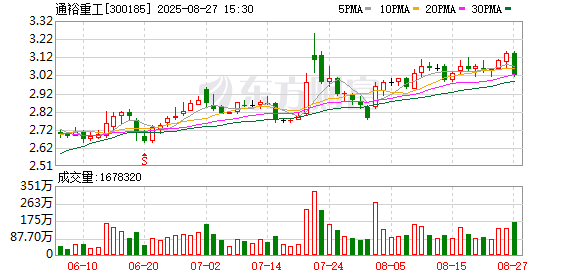
通裕重工收警示函:存货核算差错致年报失真 7名责任人被追责
Mei Ri Jing Ji Xin Wen· 2025-08-27 14:32
Core Viewpoint - Tongyu Heavy Industry received a warning letter from the Shandong Securities Regulatory Bureau due to accounting errors related to inventory valuation, which affected the accuracy of its financial reports for 2022 and 2023 [2][3] Group 1: Accounting Issues - The warning letter highlighted significant problems in financial information disclosure, specifically due to mismanagement and incorrect inventory accounting methods, leading to discrepancies between reported and actual inventory [3] - The company had to correct its annual reports for 2022 and 2023, resulting in reductions in inventory and retained earnings [3] Group 2: Regulatory Actions - The Shandong Securities Regulatory Bureau identified seven responsible personnel, including the chairman and general manager, who will face administrative penalties recorded in the securities market integrity archives [2][3] Group 3: Company Operations - Despite the regulatory measures, the company stated that its normal production and operational activities would not be adversely affected [5] - The company emphasized its commitment to addressing the issues raised in the warning letter and improving its internal management and control systems [5] Group 4: Financial Impact - As of mid-2025, the company's inventory amounted to 3.096 billion yuan, representing 20.54% of its total assets, indicating the importance of accurate inventory accounting for revenue and profit reporting [4]


部分上市公司2024年财报存在会计处理或财务信息披露错误
Ren Min Wang· 2025-08-19 05:40
Core Viewpoint - The China Securities Regulatory Commission (CSRC) released a report indicating that while listed companies generally comply with accounting standards and financial disclosure rules, there are still issues related to accounting treatment and financial information disclosure in certain areas [1][2]. Group 1: Financial Reporting Issues - As of April 30, 2025, a total of 5,413 listed companies in the A-share market disclosed their 2024 annual financial reports, including 3,185 from the main board, 1,377 from the ChiNext, 586 from the Sci-Tech Innovation Board, and 265 from the Beijing Stock Exchange [1]. - Among the companies that disclosed their reports, 192 received non-standard audit opinions, including 56 with unqualified opinions containing emphasis of matter, 35 with unqualified opinions containing going concern issues, and 72 with qualified opinions [1]. Group 2: Revenue Recognition Issues - The report identified that some companies improperly recognized revenue and costs using the time period method, miscalculated sales revenue under point pricing models, and inadequately handled sales rebates and contract fulfillment costs [2]. Group 3: Long-term Investments and Mergers - Issues were noted in the areas of long-term equity investments and business combinations, including incorrect judgments on the scope of consolidated financial statements and improper recognition of goodwill from step acquisitions of businesses under common control [2]. Group 4: Financial Instruments and Asset Impairment - The report highlighted problems with the recognition and measurement of financial instruments, such as inappropriate provisions for expected credit losses and misclassification of equity investments [2]. - Additionally, some companies failed to appropriately recognize inventory impairment and did not accurately measure the recoverable amount of assets [2]. Group 5: Disclosure and Regulatory Actions - The CSRC plans to continue monitoring the accounting information disclosure issues identified in the report, enhance the regulatory framework for financial reporting, and provide practical guidance on accounting issues that are of market concern [3].
192家上市公司被出具“非标”!7大会计处理问题
梧桐树下V· 2025-08-17 13:16
Core Viewpoint - The China Securities Regulatory Commission (CSRC) released the 2024 annual financial report accounting supervision report, indicating that while listed companies generally comply with accounting standards and financial disclosure rules, there are still significant issues in areas such as revenue recognition, long-term equity investments, financial instruments, asset impairment, and non-recurring gains and losses [1][2][7]. Revenue-Related Issues - Companies improperly adopted the time period method for revenue and cost recognition, leading to unreasonable income and cost confirmations [7][8]. - Incorrect accounting for sales revenue under pricing models, treating price fluctuations as variable consideration instead of embedded derivatives [9]. - Mismanagement of sales rebates, where companies recognized full revenue upon delivery without appropriately accounting for future rebates [10]. - Inadequate handling of contract fulfillment costs, failing to recognize costs as assets when they are directly related to fulfilling contracts [11]. Long-Term Equity Investments and Business Combinations Issues - Companies incorrectly judged the scope of consolidated financial statements, failing to recognize control over subsidiaries [12][13]. - Misapplication of goodwill recognition in non-similar control business combinations, treating step acquisitions as separate transactions [16][17]. - Inappropriate handling of contingent consideration in business combinations, failing to recognize it as part of the acquisition cost [18][19]. - Errors in accounting for minority shareholder performance commitments, leading to incorrect classification of contingent consideration [20][21]. Financial Instruments Recognition and Measurement Issues - Inadequate provision for expected credit losses, with companies misclassifying receivables with different risk characteristics [25][26]. - Incorrect distinction between financial liabilities and equity instruments, leading to misclassification of obligations [27]. - Failure to timely recognize financial liabilities related to the purchase of minority interests [28]. - Improper handling of price adjustment clauses in inventory purchases, failing to account for embedded derivatives [29][30]. Asset Impairment Issues - Companies inadequately recognized inventory impairment, failing to assess the recoverable amount based on estimated selling prices [31]. - Misclassification of prepaid accounts and other receivables, leading to inappropriate impairment provisions [32][33]. - Errors in measuring the recoverable amount of assets, using inappropriate valuation methods [34]. - Inadequate provision for impairment of construction in progress, failing to recognize impairment indicators [35]. Other Recognition and Measurement Issues - Companies improperly accounted for customized product-related R&D expenses, failing to determine whether they should be capitalized or treated as contract fulfillment costs [36][37]. - Incorrect treatment of fixed asset repair expenses, misclassifying them as operating expenses instead of capitalizing them [38]. - Errors in recognizing and measuring construction in progress, including mismanagement of contractual obligations and related costs [39]. - Inappropriate handling of penalties for lease termination, misclassifying them as operating expenses rather than adjusting lease liabilities [40][41].
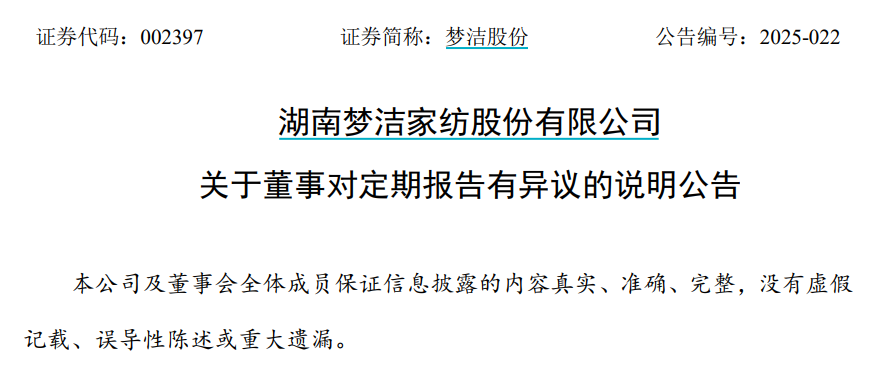
超10次被董事投出反对票,梦洁股份超6000万资金流失仍为追回
Huan Qiu Wang· 2025-04-28 01:35
Core Points - Dream洁股份 reported a revenue of 1.715 billion yuan for 2024, a year-on-year decrease of 20.48%, while achieving a net profit attributable to shareholders of 24.88 million yuan, an increase of 10.99% [1] - Board member Chen Jie voted against multiple resolutions, including the annual report, citing significant guarantee risks related to the subsidiary Fujian Dafa Sleep Technology Co., Ltd., incomplete financial disclosures, ineffective internal controls, and the reasonableness of director compensation [1][2] - Chen Jie has cast over 10 dissenting votes against various board proposals, raising concerns about the rationality of sales expenses related to terminal construction [2] - The company stated that its financial report received a standard unqualified audit opinion from Zhongchao Zhonghuan Accounting Firm, and emphasized that all other board members and senior management confirmed the accuracy and completeness of the 2024 annual report [2] - Chen Jie highlighted a past incident where Dafa Sleep provided 66.0273 million yuan to its legal representative without proper review and disclosure, leading to criticism from the Shenzhen Stock Exchange in 2022, with the amount still unrecovered and classified as bad debt [4] - Chen Jie expressed concerns about the lack of institutional control over important business operations and systemic failures in decision-making processes within Dream洁股份 and its subsidiary [4]