
航天探测

Search documents
浩瀚深空,天问二号要“探访”哪些“朋友”?
Xin Hua She· 2025-05-29 04:38
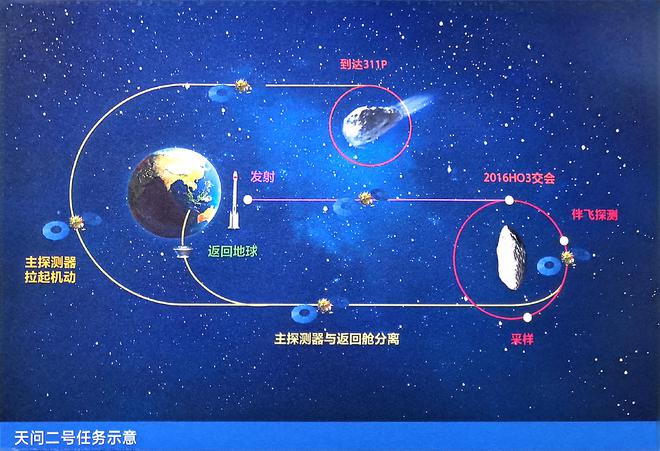
Core Points - The Tianwen-2 mission successfully launched on May 29, focusing on the exploration of near-Earth asteroid 2016HO3 and main-belt comet 311P, marking a significant step in interplanetary exploration [1][6] Group 1: Asteroid 2016HO3 - Asteroid 2016HO3 is described as a "quasi-satellite" of Earth, with an orbit closely matching that of Earth, making it a rare target for study [3] - The asteroid is considered a "living fossil" of the solar system, preserving primordial information from its formation, which is crucial for understanding the early composition and evolution of the solar system [3][4] Group 2: Main-belt Comet 311P - Main-belt comet 311P exhibits both asteroid and comet characteristics, displaying comet-like features such as multiple tails during certain periods, despite being located in the asteroid belt [4][5] - The origin of 311P remains uncertain, whether it is a native object of the asteroid belt or captured from the outer solar system, making it a valuable subject for scientific research [5] Group 3: Significance of the Mission - The Tianwen-2 mission represents a continuation of China's advancements in space exploration, following successful lunar missions and the Tianwen-1 Mars mission, and is the first to conduct interplanetary sample return [6] - The mission aims to enhance human understanding of deep space and contribute to original scientific discoveries, as stated by the head of the National Space Administration [6]

开启十年“追星”路 天问二号先“取星尘” 再探彗星
Yang Shi Xin Wen Ke Hu Duan· 2025-05-28 23:51
Core Viewpoint - The successful launch of the Tianwen-2 probe marks a significant advancement in China's deep space exploration, initiating the country's first dual-target exploration of extraterrestrial small bodies [1][4]. Group 1: Mission Objectives - The Tianwen-2 mission has two primary objectives: to conduct a flyby, sample collection, and return from the asteroid 2016 HO3, and to perform scientific exploration of the main belt comet 311P [4]. - The mission is designed to complete multiple tasks in a single launch, with a total mission duration of approximately 10 years, encompassing 13 flight phases [7]. Group 2: Mission Phases - The asteroid sampling and return process consists of nine stages, starting with the launch phase, followed by the asteroid transfer phase lasting about one year, which includes deep space maneuvers and mid-course corrections [9]. - After reaching the asteroid, the probe will enter various phases including approach, rendezvous, and close-range exploration, ultimately determining the sampling area before executing the sample collection [10]. Group 3: Scientific Significance - The asteroid 2016 HO3 is considered a "quasi-satellite" of Earth, providing valuable insights into the early solar system's material composition and evolutionary history [11]. - The main belt comet 311P, located between Mars and Jupiter, possesses characteristics of both comets and asteroids, making it crucial for understanding the composition and evolution of small celestial bodies [13]. Group 4: Challenges and Difficulties - The Tianwen-2 mission faces significant challenges, including the precise design of the trajectory to the asteroid, which requires high accuracy due to the differing orbital periods of the Earth and the asteroid [16]. - Sampling methods must be adaptable to varying surface conditions of the asteroid, necessitating careful planning post-close-range exploration [17]. - The return phase involves overcoming extreme conditions during re-entry, with speeds approaching 12 kilometers per second, requiring meticulous engineering of thermal protection and aerodynamic design [18].
天都一号成功进入地月往返3:1共振轨道
news flash· 2025-05-27 10:41
Core Viewpoint - The successful maneuver of the Tiandu-1 spacecraft into a 3:1 resonance orbit between the Earth and the Moon marks a significant achievement in space exploration, providing critical data for future navigation and control technologies in complex gravitational environments [1] Group 1 - Tiandu-1 has successfully completed a key orbital maneuver, transitioning to a 3:1 resonance orbit between the Earth and the Moon after approximately one week of continuous testing [1] - This mission makes Tiandu-1 the first probe to enter a 3:1 resonance orbit, highlighting advancements in China's space exploration capabilities [1] - The flight data obtained from Tiandu-1 will support technological breakthroughs in spacecraft orbit maintenance, control, and autonomous navigation in complex gravitational environments [1]