
Software and Cloud Computing

Search documents
81岁老板一边狂赚1000亿成全球首富,一边公司大裁员!老员工自嘲:“我们被 GPU 替代了”
Sou Hu Cai Jing· 2025-09-12 03:46
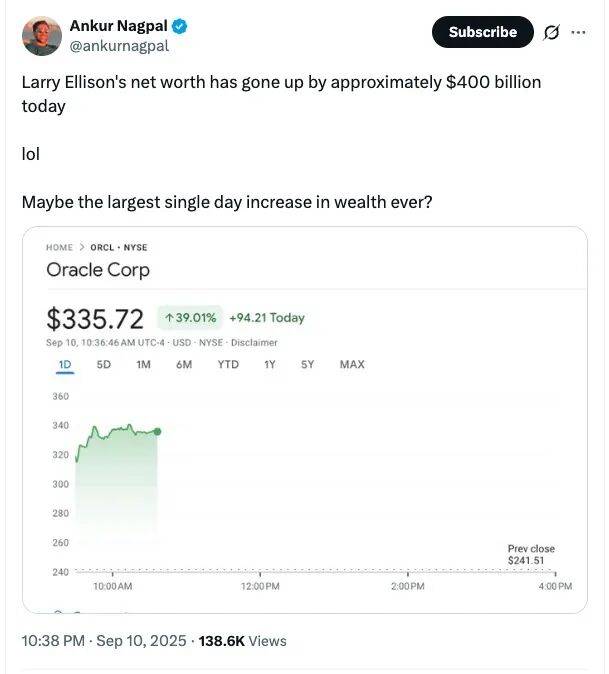
Core Insights - Larry Ellison, co-founder and CTO of Oracle, experienced a wealth increase of nearly $100 billion in a single day, marking the largest single-day wealth increase in history, primarily due to his 41% stake in Oracle [1][2] - Oracle's stock price surged 38% following the announcement of significant future revenue projections for its cloud infrastructure, particularly in AI, despite the company reporting first-quarter earnings that fell short of analyst expectations [7][8] - The company signed a landmark $300 billion cloud computing contract with OpenAI, highlighting the unprecedented demand for AI data center capabilities [7][8] Company Performance - Oracle's cloud infrastructure revenue is projected to grow from $18 billion this year to $144 billion over the next four years, with a 77% growth expected in the current fiscal year [8] - The company's total revenues for the latest quarter reached $14.93 billion, a 12% increase year-over-year, with cloud revenues growing by 28% [10] - Despite the revenue growth, Oracle's net income decreased by 4% to $2.93 billion, reflecting challenges in meeting earnings expectations [10] Stock Buybacks and Shareholder Returns - Since 2011, Oracle has spent $142 billion on stock buybacks, significantly reducing the number of outstanding shares and increasing Ellison's ownership percentage from 22% to 41% [1][3] - Ellison receives $500 million in quarterly dividends from Oracle, and he has pledged 277 million shares for loans, allowing him to access liquidity without selling shares [2] Workforce Changes - Oracle is undergoing significant layoffs, with reports indicating over 3,000 employees have been affected globally, particularly in the cloud infrastructure division [11][14] - The restructuring expenses for the latest quarter reached $402 million, a 448% increase year-over-year, indicating a major shift in the company's workforce strategy [10][12] - Employees have reported a sudden and impersonal layoff process, with many being informed of their termination during brief online meetings [13][14]


Oracle Shares Jump 40% on Bullish AI Outlook
Youtube· 2025-09-10 17:35
Core Insights - The order book for the company stands at approximately $450 billion, which is expected to translate into revenue over the next several years as data centers become operational [1] - The company is positioned in the AI cloud space by renting out GPUs for model training and inference workloads, similar to other hyperscalers [2][6] - The company has a high-margin software and applications business that supports its expansion in cloud infrastructure, unlike competitors who may need to borrow at higher costs [3] - By the end of the decade, the company anticipates a potential upside of $60 billion compared to consensus estimates [4] - The company has recently upgraded its infrastructure and is sourcing chips from Nvidia to enhance its offerings [5] - There is a significant shortage of computing capacity in the market, leading to increased demand for the company's services [6][7] - The company's cloud infrastructure revenue was around $10 billion last year, significantly lower than competitors like Amazon and Azure, which reported $125 billion and $75 billion respectively [8] - The company has been undergoing a transformation since 2017, shifting focus towards providing computing capacity and services [9]

Oracle(ORCL) - 2026 Q1 - Earnings Call Transcript
2025-09-09 22:02
Financial Data and Key Metrics Changes - Oracle's remaining performance obligations (RPOs) reached $455 billion, a 359% increase from the previous year and up $317 billion from the end of Q4 [5] - Total cloud revenue increased by 27% to $7.2 billion, while total revenues for the quarter were $14.9 billion, up 11% from last year [5][7] - Operating income grew by 7% to $6.2 billion, and non-GAAP EPS was $1.47, with GAAP EPS at $1.01 [8] - Operating cash flow for the last four quarters was up 13% to $21.5 billion, while free cash flow was negative $5.9 billion [8] Business Line Data and Key Metrics Changes - Cloud infrastructure revenue was $3.3 billion, up 54%, with OCI consumption revenue increasing by 57% [6] - Cloud application revenue was $3.8 billion, up 10%, while strategic back-office application revenue was $2.4 billion, up 16% [7] - Autonomous database revenue rose by 43%, and multi-cloud database revenue grew by 1,529% [6] Market Data and Key Metrics Changes - Oracle expects cloud infrastructure revenue to grow 77% to $18 billion this fiscal year, with projections of $32 billion, $73 billion, $114 billion, and $144 billion over the next four years [10] - The company anticipates total revenue growth of 16% in constant currency for fiscal year 2026 [11] Company Strategy and Development Direction - Oracle is positioning itself as a leader in AI workloads, having signed significant cloud contracts with major AI companies [5] - The company is focusing on both AI training and inferencing markets, emphasizing the importance of its AI database and the ability to vectorize data for AI models [17][75] - Oracle aims to provide a comprehensive cloud solution, offering customers flexibility between public and dedicated cloud options [28] Management's Comments on Operating Environment and Future Outlook - Management expressed confidence in the demand for Oracle Cloud Infrastructure and the potential for RPO to exceed half a trillion dollars [10] - The company is optimistic about its ability to accelerate revenue and profit growth, driven by the large RPO backlog [9][11] - Management highlighted the unique advantages Oracle has in the AI inferencing market due to its extensive data capabilities [17][46] Other Important Information - Oracle's CapEx for fiscal year 2026 is expected to be around $35 billion, primarily for revenue-generating equipment [9][52] - The company has reduced shares outstanding by a third over the last 10 years, repurchasing 440,000 shares for $95 million this quarter [9] Q&A Session Summary Question: What else is driving Oracle's forecasts beyond AI training? - Management noted a significant demand for inferencing capacity, indicating that many companies are running out of it [24] Question: How much CapEx and operational costs will be needed to service new contracts? - Management explained that CapEx is expected to be about $35 billion, with equipment being put in place only when needed to generate revenue quickly [52][53] Question: How can Oracle maintain a differentiated position in the AI training business? - Management emphasized that Oracle's networks move data faster than competitors, providing a cost advantage [61] Question: How soon will enterprise customers adopt the new Oracle AI Database? - Management indicated that there is a strong demand for AI capabilities, and Oracle is well-positioned to meet this demand securely [75]
SAP to Invest $23 Billion in Europe Sovereign Cloud
PYMNTS.com· 2025-09-02 18:23
Core Viewpoint - SAP is investing 20 billion euros ($23.3 billion) to expand its sovereign cloud services, reflecting Europe's demand for data localization and compliance with local regulations [1][2]. Company Summary - The investment will enhance SAP's Sovereign Cloud portfolio, providing European customers with a complete technology stack while ensuring sensitive data remains under local control [2]. - SAP's offering includes an Infrastructure-as-a-Service (IaaS) platform built on open-source technologies, hosted entirely within EU-based data centers [4]. - SAP has introduced a Germany-specific cloud, Delos Cloud, designed to comply with German regulations [4]. Industry Summary - The concept of sovereign cloud is gaining traction as European regulators enforce stricter data privacy and security laws, such as GDPR and the EU AI Act [3]. - Other cloud providers are also responding to this trend; AWS announced a new sovereign cloud for Europe, while Microsoft and Google Cloud have introduced similar offerings to ensure data remains within Europe and complies with local laws [5][6].


Oracle and Google Cloud announce enterprise AI partnership
Proactiveinvestors NA· 2025-08-14 17:19
Group 1 - Proactive provides fast, accessible, informative, and actionable business and finance news content to a global investment audience [2] - The news team covers medium and small-cap markets, as well as blue-chip companies, commodities, and broader investment stories [3] - Proactive's content includes insights across various sectors such as biotech, pharma, mining, natural resources, battery metals, oil and gas, crypto, and emerging technologies [3] Group 2 - Proactive is committed to adopting technology to enhance workflows and content production [4] - The company utilizes automation and software tools, including generative AI, while ensuring all content is edited and authored by humans [5]

Microsoft Becomes Second Company Valued Over $4 Trillion After Strong Second Quarter Earnings
Forbes· 2025-07-31 14:40
Core Insights - Microsoft’s valuation surpassed $4 trillion after exceeding expectations for second-quarter revenue, marking it as the second company in history to reach this milestone, following Nvidia [1] - The significant revenue increase for Microsoft was attributed to its Azure cloud computing service [1] Company Performance - Microsoft achieved a revenue surge in the second quarter, contributing to its valuation growth [1] - The company’s performance highlights the increasing importance and demand for cloud computing services in the current market [1]


1 Magnificent Growth Stock to Buy Before It Soars Higher After This Event
The Motley Fool· 2025-06-21 09:55
Core Viewpoint - Oracle's stock has seen significant gains, increasing by 77% since its 52-week low in April, and is expected to continue its upward trajectory following the release of its latest quarterly report [1][2]. Financial Performance - Oracle reported $57.4 billion in annual revenue for fiscal 2025, reflecting a 9% increase in constant currency terms [5]. - The company anticipates revenue to reach at least $67 billion in fiscal 2026, representing a nearly 17% increase [5]. Growth Drivers - The demand for cloud infrastructure services, particularly for AI applications, is a major growth catalyst for Oracle [2][7]. - Oracle's remaining performance obligations (RPO) increased by 41% year-over-year to $138 billion, indicating strong future revenue potential [6]. - CEO Safra Catz projects that RPO will more than double in fiscal 2026, suggesting sustained growth [7]. AI and Infrastructure Projects - Oracle is a key partner in the $500 billion Stargate AI infrastructure project, which could significantly enhance its revenue pipeline [8]. - The company is experiencing high demand for cloud AI infrastructure, with one customer expressing interest in purchasing Oracle's entire cloud capacity [9]. Capacity Expansion - Oracle plans to build 30 dedicated data centers in fiscal 2026 and increase its MultiCloud data centers from 23 to 70 [10]. - The company forecasts Oracle Cloud Infrastructure (OCI) revenue to grow by 70% in fiscal 2026, following a 50% increase last year [11]. Valuation and Future Outlook - Oracle's non-GAAP net income for fiscal 2025 was $6.03 per share, an 8.5% increase from the previous year [12]. - The company expects capital expenses to reach $25 billion in fiscal 2026, which is a slower increase compared to the previous year [12]. - Oracle is projected to exceed its long-term revenue expectations, with anticipated annual bottom-line growth of over 20% through fiscal 2029 [14]. - The stock is currently trading at 31 times forward earnings, aligning with the Nasdaq-100 index's earnings multiple, indicating an attractive valuation for investors [15][16].
Oracle(ORCL) - 2025 Q3 - Earnings Call Transcript
2025-03-10 23:47
Financial Data and Key Metrics Changes - The company reported a record booking quarter, adding $48 billion to its backlog, with a remaining performance obligation (RPO) balance of $130 billion, up 63% year-over-year from $80 billion last year [7][22] - Total cloud revenue for SaaS and IaaS was $6.2 billion, up 25%, with SaaS revenue at $3.6 billion, up 10%, and IaaS revenue at $2.7 billion, up 51% [12][13] - Total revenues for the quarter were $14.1 billion, up 8% from last year, with non-GAAP EPS at $1.47, up 4% in USD [20][18] Business Line Data and Key Metrics Changes - Infrastructure cloud services now have an annualized revenue of $10.6 billion, with OCI consumption revenue up 57% [14][15] - Cloud database services revenue was up 28%, with annualized revenue of $2.3 billion, and Autonomous Database consumption revenue up 42% [15][17] - Application subscription revenues were $4.8 billion, up 6%, while software license revenues were down 8% to $1.1 billion [17][18] Market Data and Key Metrics Changes - The company marked a milestone with its 101st cloud region coming online, with expectations to have more cloud regions than competitors combined [8][9] - The multi-cloud business grew 200% in the last three months, indicating strong demand across various hyperscalers [31] Company Strategy and Development Direction - The company is focused on AI training and inferencing, with a new AI data platform that allows existing database customers to utilize AI models [32][30] - The company expects total cloud infrastructure revenue for fiscal year 2025 to grow faster than 50%, with a target of $66 billion in revenue for FY '26 [25][24] - The company is committed to returning value to shareholders through technical innovation, acquisitions, and prudent use of debt [23] Management's Comments on Operating Environment and Future Outlook - Management expressed confidence in meeting revenue targets, citing strong demand for cloud services and AI capabilities [25][66] - The company anticipates significant increases in RPO and revenue as capacity comes online and demand continues to grow [66][67] Other Important Information - The company repurchased nearly 1 million shares for a total of $150 million and increased the quarterly dividend by 25% [23][24] - The company expects capital expenditures for fiscal year 2025 to be around $16 billion, more than double the previous year [21] Q&A Session Summary Question: Can you expand on Stargate and Oracle's unique value add? - Oracle's technology advantage allows for building large AI clusters that run faster and more economically than competitors, translating to economic advantages in securing large contracts [37][38] Question: How is demand unfolding across different environments? - Demand is strong across multi-cloud, OCI, and dedicated services, with significant growth in bookings and revenue expected [44][46] Question: What is the state of AI training versus inferencing opportunities? - The training business is growing rapidly, but inferencing is seen as a larger opportunity due to the vast number of Oracle databases available for training AI models [56][64] Question: How should we understand CapEx trajectory given RPO strength? - The company starts data centers smaller than competitors and grows based on demand, leading to higher utilization and lower CapEx [100][101]