债券投资

Search documents
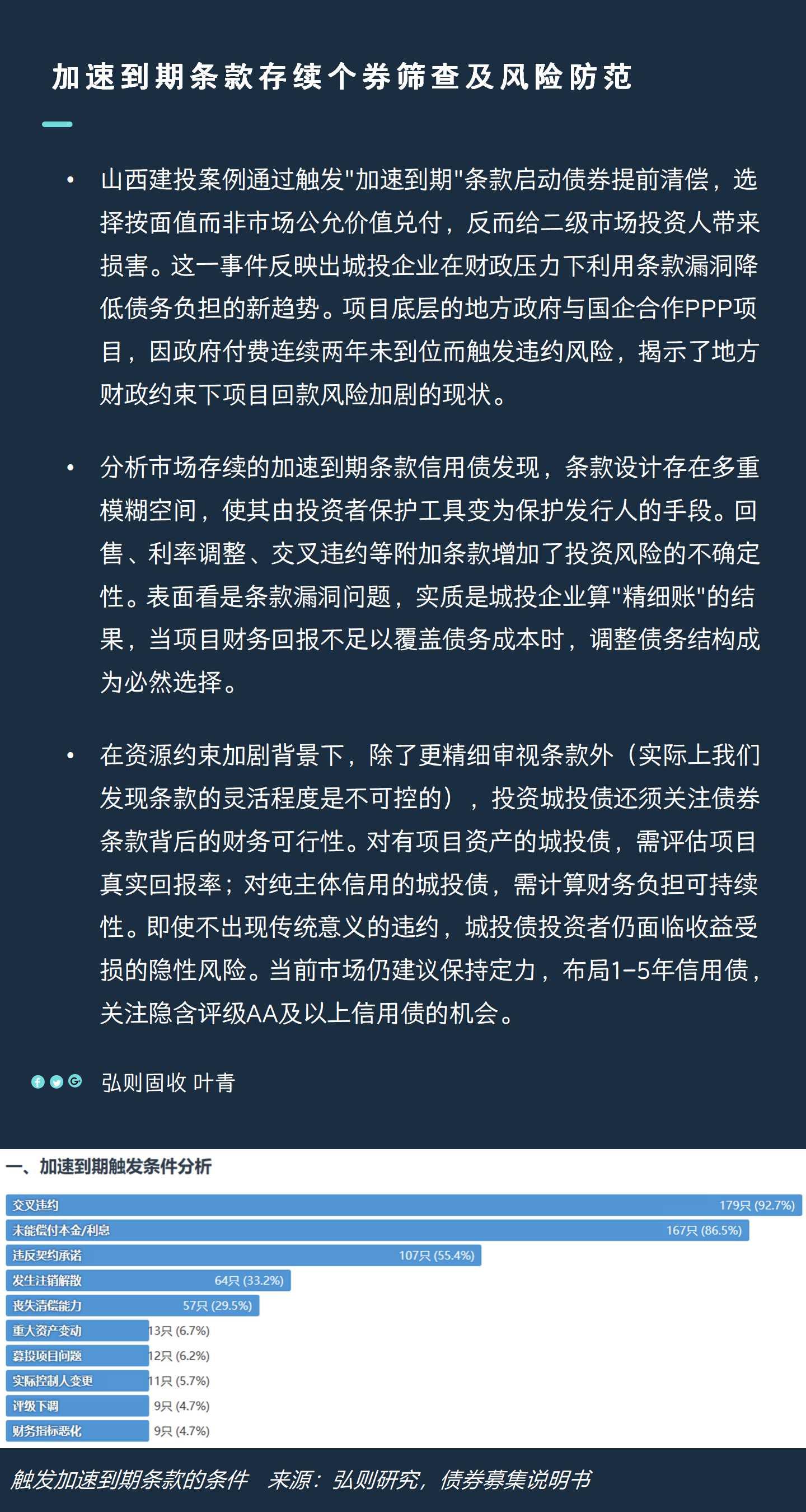
弘则固收叶青:加速到期条款存续个券筛查及风险防范
news flash· 2025-04-29 23:23
Core Viewpoint - The case of Shanxi Construction Investment triggering the "accelerated maturity" clause for early bond repayment at face value rather than market value has harmed secondary market investors, reflecting a new trend of local government financing vehicles exploiting clause loopholes to reduce debt burdens under fiscal pressure [1] Group 1: Event Analysis - The event highlights the increasing risk of default due to continuous non-payment from local governments in PPP projects, revealing the heightened repayment risk under local fiscal constraints [1] - The design of accelerated maturity clauses in existing credit bonds shows multiple ambiguities, transforming from a protective tool for investors to a means of protection for issuers [1] Group 2: Investment Implications - Investors in local government bonds must assess the financial feasibility behind bond clauses, focusing on the real return rates of project-backed bonds and the sustainability of financial burdens for pure credit bonds [1] - Even without traditional defaults, investors in local government bonds face hidden risks of reduced returns, suggesting a cautious approach in the current market with a focus on 1-5 year credit bonds and opportunities in bonds with implied ratings of AA and above [1]

当风险显而易见时,往往能得到丰厚的回报
阿尔法工场研究院· 2025-03-24 12:44
Core Viewpoint - Investors who held Argentine bonds are now reaping significant rewards, as the value of these bonds has surpassed their initial principal, outperforming "safe" U.S. Treasury investments [2][4]. Group 1: Investment Performance - The turnaround in Argentine bonds is attributed to President Javier Milei's extensive reforms of the bloated national institutions while maintaining popularity [3]. - The high yields from these bonds have compensated for a 25% drop in bond prices, leading to over 50% returns when reinvesting the coupon payments [4]. - In contrast, U.S. 30-year Treasury bonds have seen a loss of approximately 10% during the same period [4]. Group 2: Lessons from Investment - The experience with Argentine bonds highlights three key lessons: high-risk investments can yield substantial returns, hidden risks persist even when they are not immediately apparent, and political changes can be unpredictable [5]. - Argentina's history of defaults, having defaulted nine times since its independence in 1816, underscores the evident risks associated with its bonds [6]. - High-risk borrowers can still attract investment if they offer sufficiently high interest rates, as evidenced by academic research showing that high-risk country bonds often yield higher long-term returns than safer assets [7][8]. Group 3: Market Dynamics and Risks - Investors must be prepared for significant losses on specific bonds, similar to individual stocks, with Argentine bonds experiencing a 75% price drop at one point [9]. - Diversifying across multiple high-yield assets and holding them long-term can mitigate risks despite high volatility [10]. - Hidden risks, such as those seen in Greece before the 2007 financial crisis, can lead to severe consequences when market conditions shift unexpectedly [11][12]. Group 4: Political and Governance Factors - Political dynamics pose significant challenges for investors, as seen with Milei's unexpected success in implementing austerity measures during an economic downturn [14]. - Argentina may soon regain market access, which could change the investment landscape significantly [15]. - Investors should be wary of governance quality, enforcement issues, and fiscal capacity when considering sovereign debt investments [16].