
Cybersecurity

Search documents
NetScout Systems (NTCT) Surpasses FQ3 2026 Estimates With Revenue of $250.7M
Yahoo Finance· 2026-02-24 11:53
Core Insights - NetScout Systems Inc. reported FQ3 2026 financial results with revenue of $250.7 million, exceeding expectations by $16.99 million despite a slight year-over-year decline of 0.53% [1][6] - The diluted EPS increased by 6.4% year-over-year to $1.00, indicating strong profitability [1] - The company anticipates FY2026 revenue between $835 million and $870 million, with non-GAAP EPS projected between $2.37 and $2.45 [2] Revenue Breakdown - Product revenue saw a slight decline due to the timing of customer orders, while service revenue grew by 4.1% [2] - The cybersecurity segment experienced significant growth, surging by 9% over the first nine months of the year [2] - A notable factor in the quarter's performance was approximately $15 million in deal pull-ins, as customers utilized year-end budget surpluses to accelerate orders [2] Strategic Insights - The CEO highlighted the increasing use of NetScout's Smart Data for AI-driven applications, enhancing data utility through integration with platforms like Splunk [3] - NetScout provides service assurance and cybersecurity solutions aimed at protecting digital business services across various regions including the US, Europe, and Asia [3]

Wall Street Futures Stabilize as Investors Weigh AI Disruption Fears and New Tariff Risks
Stock Market News· 2026-02-24 11:07
Market Overview - U.S. stock futures are stabilizing with S&P 500 futures up 0.34% and Nasdaq 100 futures gaining 0.49% after a significant sell-off [1] - The Dow Jones Industrial Average futures are up approximately 127 points, or 0.2%, indicating bargain hunting by investors [1] Major Index Performance and Trends - The S&P 500 is attempting to reclaim the 6,850 level after closing down 1.04% [3] - The Nasdaq Composite shed 1.13% but remains a focal point for growth-oriented investors [3] - The 10-year Treasury yield is near 4.04%, serving as a barometer for long-term inflation risks due to new tariff policies [3] - The broader market is approximately 15% higher compared to the same time last year, although the S&P 500 has recently dipped into negative territory for 2026 [3] Economic Indicators - The Conference Board's Consumer Confidence Index for February is expected to show a reading of approximately 87.6, up from 84.5 in January, indicating resilience in household sentiment [4] - The S&P CoreLogic Case-Shiller Home Price Index reported a modest 1.3% year-over-year increase, slightly below expectations, suggesting a cooling housing market [4] Federal Reserve Insights - A number of Federal Reserve officials are scheduled to speak, with investors looking for hints regarding interest rate policies ahead of the March meeting [5] - The introduction of "Trump Tariffs" is expected to add new inflationary variables into the Fed's models [5] Corporate News and Ticker Movements - Nvidia is preparing to report quarterly earnings, with its stock up nearly 1% in premarket trading due to expectations of continued AI infrastructure spending [6] - IBM's stock fell 13% after reports of competitive AI coding tools threatening its legacy consulting business [6] - Home Depot reported a nearly 20% decrease in earnings per share compared to last year, reflecting challenges in the home improvement sector [7] - Whirlpool shares fell over 7% following an $800 million public offering announcement [7] - Eli Lilly gained ground after competitor Novo Nordisk released disappointing clinical trial data for its obesity treatment [7] - Tesla is down roughly 3% due to trade tensions affecting global EV sentiment [8] - Microsoft faces increased competition in the AI productivity space [8] - CrowdStrike and American Express are being monitored after significant losses linked to AI-driven displacement fears [8] - Alphabet is one of the few megacaps showing relative strength, up 0.5% in early trading [8]



CrowdStrike Dived. Why a New AI Tool Crushed Cybersecurity Stocks.
Barrons· 2026-02-24 10:25
CrowdStrike, Zscaler Dived. Why a New AI Tool Crushed Cybersecurity Stocks. - Barron'sSkip to Main ContentThis copy is for your personal, non-commercial use only. Distribution and use of this material are governed by our Subscriber Agreement and by copyright law. For non-personal use or to order multiple copies, please contact Dow Jones Reprints at 1-800-843-0008 or visit www.djreprints.com.# CrowdStrike Dived. Why a New AI Tool Crushed Cybersecurity Stocks.By [Nate Wolf]ShareResize---ReprintsIn this articl ...


World shares are mixed after heavy selling of potential AI losers hits Wall Street
BusinessLine· 2026-02-24 10:13
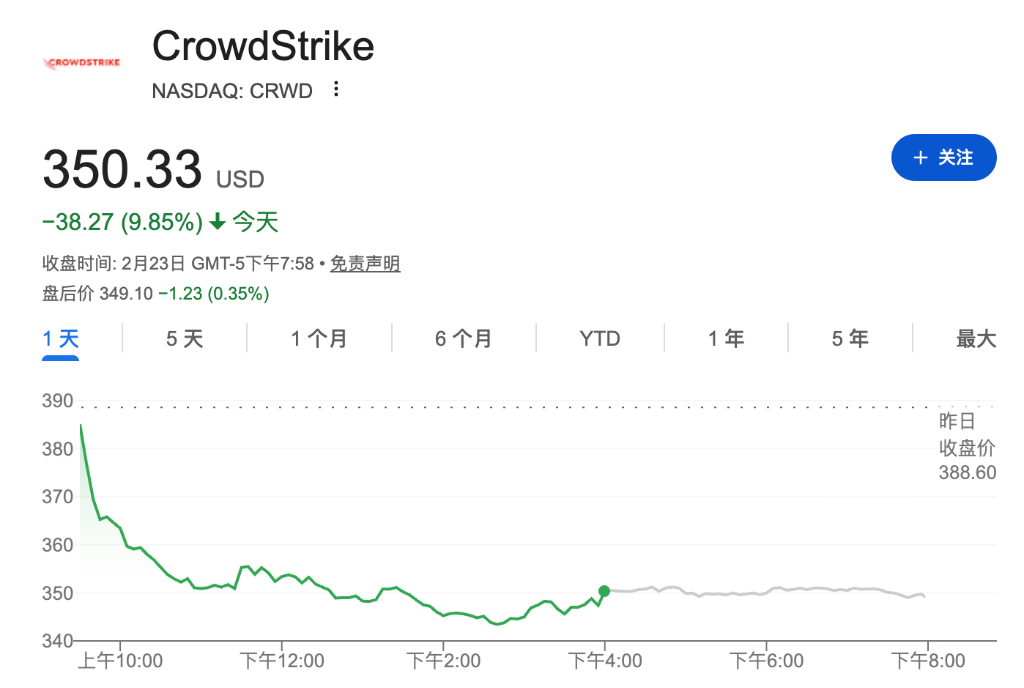
Market Overview - Global shares exhibited mixed performance, with U.S. stocks experiencing a slump due to heavy selling in companies potentially affected by the rise of artificial intelligence (AI) [1] - A report from Citrini Research highlighted concerns that AI could undermine the "human-centric consumer economy," leading to negative employment outcomes [1][2] Sector Performance - Gains were noted in the computer-chip sector, benefiting from the development of AI technologies [2] - In Asian markets, the Nikkei 225 index rose by 0.9% to 57,321.09, with Advantest and Disco Corp. seeing increases of 4.5% and 2.1% respectively [3][4] - The Shanghai Composite index increased by 0.9% to 4,117.41, while South Korea's Kospi rose by 2.1% to 5,969.64, driven by strong performance from Samsung Electronics, which jumped 3.6% [4] U.S. Stock Movements - U.S. stocks fell sharply, with the S&P 500 down 1% to 6,837.75 and the Dow Jones Industrial Average dropping 1.7% to 48,804.06, following President Trump's announcement of new tariffs [5][6] - Companies like CrowdStrike and AppLovin faced significant losses, with CrowdStrike down 9.8% and AppLovin down 9.1%, reflecting investor concerns over AI competition [7] Upcoming Earnings and Market Sentiment - Anticipation surrounds Nvidia's upcoming profit report, with concerns that major clients like Alphabet and Amazon may struggle to recover investments in Nvidia's chips [8] - Crude oil prices increased slightly, with U.S. benchmark crude rising to $66.62 per barrel, amid geopolitical tensions [8][9]

AI会“杀死”网安平台?美银驳斥:它是增强者,不是替代者
Hua Er Jie Jian Wen· 2026-02-24 09:57
Core Viewpoint - The market's fear regarding AI disrupting the cybersecurity industry is considered overblown, as AI tools currently serve as enhancers rather than replacements for comprehensive cybersecurity platforms [3][6]. Group 1: Market Reaction - Following the launch of Claude Code Security by Anthropic, there was significant sell-off in cybersecurity stocks, with CrowdStrike and Zscaler dropping approximately 10%, Netskope plummeting over 12%, and the Global X cybersecurity ETF reaching its lowest level since November 2023 [1][2]. Group 2: AI's Role in Cybersecurity - AI tools are currently unable to replace complete cybersecurity platforms; instead, they enhance specific tasks such as code scanning [3][4]. - The report emphasizes that while AI can improve efficiency in certain areas, it lacks the capabilities needed for visibility, control, and reliability that comprehensive platforms provide [3][5]. Group 3: Competitive Landscape - Comprehensive platform vendors like CrowdStrike and Palo Alto Networks maintain a strong competitive edge due to their integrated data foundations and detection-response capabilities [3][6]. - Independent vendors focusing on application security, such as Checkmarx and Snyk, may face increased competitive pressure and need to demonstrate their unique value in the AI era [3][4]. Group 4: Limitations of AI Tools - AI tools like Claude are limited to pre-production code analysis and cannot perform essential functions such as real-time monitoring and execution control, which are critical for cybersecurity [5][8]. - The report highlights the fundamental differences between developer tools and runtime security environments, indicating that AI's current limitations prevent it from challenging the core functions of cybersecurity platforms [5][8]. Group 5: Future Outlook - The transformation of the cybersecurity landscape by AI is expected to follow a path similar to that of cloud computing, benefiting comprehensive platform vendors that can integrate vast telemetry data and runtime sensor capabilities [7][8]. - Independent firms in application security may face risks of being partially replaced by AI tools, necessitating a reevaluation of their core value propositions [7][8].
Software Stocks Slide on AI Fears: What Does It Mean for Bitcoin’s Price?
Yahoo Finance· 2026-02-24 09:43
Group 1 - Software stocks have experienced significant declines, with the iShares Expanded Tech-Software Sector ETF (IGV) falling 15% in February, marking its worst monthly performance since 2008 and sitting approximately 35% below its peak [2][3] - The downturn in software stocks is largely attributed to investor fears regarding artificial intelligence disruption, particularly following the introduction of new AI tools that are perceived to threaten existing business models [3][6] - The release of Anthropic's "Claude Code Security" has particularly impacted cybersecurity stocks, leading to a loss of $20 billion in market value for CrowdStrike within two trading sessions and a more than 10% drop in IBM shares [4][5][6] Group 2 - The software selloff has been widespread, affecting even those stocks considered to be immune to AI disruption, as indicated by the pressure on Goldman Sachs' basket of such stocks [6] - A report from Citrini Research has intensified market concerns, presenting a hypothetical scenario where AI automation leads to increased corporate profits by June 2028, further fueling investor anxiety [7]

BIO-key and RunLevel Strengthen Identity Security Across Mozambique’s National Payments Infrastructure for Sociedade Interbancária de Moçambique (SIMO)
Globenewswire· 2026-02-24 09:30
Core Insights - BIO-key International, Inc. has entered into a multi-year agreement with Sociedade Interbancária de Moçambique (SIMO) to enhance identity and access security in Mozambique's financial ecosystem [1][3] - The partnership aims to modernize SIMO's identity security infrastructure, aligning with international best practices and supporting the digital transformation of Mozambique's financial sector [3][4] Group 1: Agreement Details - The agreement involves the integration of BIO-key's PortalGuard® IAM platform, PIN:You™ tokenless authentication, and Single Sign-On (SSO) capabilities into SIMO's environment [2] - This collaboration builds on a previous IAM deployment in May 2025 for a major National Bank in Mozambique [1] Group 2: Strategic Importance - SIMO plays a crucial role in Mozambique's banking system by providing interoperability, clearing, and settlement services through the national electronic payments network, SIMOrede [4][6] - As digital banking adoption increases in Mozambique, the need for robust identity security is essential for maintaining trust and regulatory compliance [4] Group 3: Stakeholder Perspectives - Juna Chiloveque, SIMO's CISO, emphasized the importance of identity security for ensuring trust and operational resilience in payment services [5] - Miguel Guerreiro from RunLevel highlighted the commitment to strengthening digital trust across Africa's financial ecosystems through this partnership [5] - Alex Rocha from BIO-key noted that the collaboration marks a significant step in supporting secure digital banking infrastructure in Mozambique [5]


WALLIX reinforces its strategic footprint in the Middle East as demand for digital sovereignty accelerates
Globenewswire· 2026-02-24 08:00
Core Insights - WALLIX has achieved 10 years of sustained growth in the Middle East, with a reported 37% growth in recurring revenue across EMEA (excluding France) in 2025, driven by approximately 40% growth in the Middle East–Africa region [1][3] - The company emphasizes its commitment to digital sovereignty, providing solutions that comply with local data governance and regulatory requirements while promoting an independent European approach to cybersecurity [4][6] Group 1: Company Performance - The Middle East–Africa region is now WALLIX's second-largest geographic area and the leading contributor within EMEA, with growth close to 40% [3] - Significant contracts have been secured in the Middle East, particularly in securing industrial OT environments across utilities, healthcare, and construction sectors [3] Group 2: Local Presence and Strategy - WALLIX has established a strong regional footprint in the Middle East, supported by a local team and over 40 certified partners across Gulf countries [2] - The company employs a "Channel First" strategy, ensuring rapid access to solutions and close customer support [2] Group 3: Digital Sovereignty and Compliance - Digital sovereignty is a strategic imperative for organizations in the UAE and Saudi Arabia, with WALLIX providing solutions that protect critical assets while ensuring compliance with local regulations [4] - WALLIX's solutions are designed to preserve state autonomy and ensure full control over critical systems and sensitive data, adhering to internationally recognized standards such as ISO 27001 [4] Group 4: Product Offering - WALLIX One is a unified platform that supports organizations in securing complex IT and industrial OT environments, providing comprehensive identity and access protection [5][6] - The platform allows for various deployment options, including on-premises, cloud, hybrid, or managed services, tailored to the specific needs of organizations [6]
CNBC Daily Open: Unstable tariff situation and new AI disruption spark market sell-off
CNBC· 2026-02-24 07:27
Group 1: Cybersecurity Sector - Investors lost confidence in cybersecurity companies following Anthropic's launch of Claude Code Security, which can scan code for vulnerabilities and suggest solutions, leading to a decline in shares of CrowdStrike, Palo Alto Networks, and Cloudflare, with IBM experiencing the largest drop of nearly 13.2% [1] Group 2: European Markets - The Stoxx 600 index in European markets fell by 0.45%, primarily due to a significant drop of over 15% in Novo Nordisk's stock after disappointing trial results for its next-generation weight loss drug [2] - The cryptocurrency market also faced a downturn, with Bitcoin losing more than 5% and falling below $63,000, nearly half of its record high of over $125,000 reached in October [2] Group 3: Trade and Economic Uncertainty - The European Union's trade deal with the U.S. is currently "on hold" following a Supreme Court ruling deeming Trump's "reciprocal" tariffs illegal, contributing to market uncertainty described as "pure tariff chaos" by Bernd Lange [3] - Bill Winters, CEO of Standard Chartered, highlighted that uncertainty around trade tariffs is problematic, although not as severe as in April, and it hampers investment [4] Group 4: Competition in the Electric Vehicle Sector - Intense competition, particularly in the Chinese electric vehicle sector, is leading to destructive cost-cutting measures, raising questions about the future trajectory of rivalry between the U.S. and China [5]


US Stocks | IBM posts steepest daily drop since 2000 after Anthropic says AI can modernize COBOL
The Economic Times· 2026-02-24 03:07
Group 1 - IBM shares experienced a significant decline of 13.2%, marking their largest drop since October 18, 2000 [1][5] - The decline was triggered by AI startup Anthropic's announcement that its Claude Code tool can modernize COBOL systems, which are widely used on IBM mainframes in sectors like banking, insurance, and government [1][5] - Traditionally, modernizing COBOL systems required extensive consulting efforts over several years, but Anthropic claims that AI can reduce this timeframe to mere quarters [2][5] Group 2 - The software sector has faced considerable pressure recently due to market concerns regarding the advancing capabilities of AI tools, particularly following the introduction of Anthropic's Claude plug-ins [4][5] - Shares of cybersecurity firms, including CrowdStrike and Datadog, also fell as investors assessed the potential impact of Anthropic's new security tool on the industry [5]
