
ETFs

Search documents
100 Tech Leaders or 30 Industry Titans: QQQ vs. DIA Showdown
Yahoo Finance· 2026-01-17 10:59
Core Insights - QQQ and DIA are two prominent U.S. equity ETFs with distinct investment strategies and sector exposures [4][5][6] Group 1: ETF Characteristics - QQQ tracks the NASDAQ-100, focusing on over 100 large non-financial companies, primarily in technology (55%), communication services (17%), and consumer cyclical (13%) [1] - DIA tracks the Dow Jones Industrial Average, consisting of 30 large-cap U.S. companies, with significant exposure to financial services (28%), technology (20%), and industrials (15%) [2] - QQQ has a higher concentration in tech-driven growth, while DIA offers a more stable mix of established blue-chip stocks [4][5] Group 2: Performance and Volatility - QQQ has delivered higher returns over the past year and five years, but with greater volatility and deeper drawdowns compared to DIA [5][6] - DIA provides a higher dividend yield of 1.4% versus QQQ's 0.4%, appealing to income-focused investors [3][8] Group 3: Investment Philosophy - QQQ's performance is driven by momentum in artificial intelligence and large-cap tech dominance, which can amplify both gains and losses [6] - DIA's returns stem from a balanced mix of industrial, financial, and healthcare companies that generate substantial profits and distribute them to shareholders [6][8] Group 4: Structural Differences - QQQ employs market-cap weighting, giving more influence to larger companies like Nvidia and Microsoft, while DIA uses a price-weighted system, leading to a unique allocation [7] - QQQ has $412 billion in assets under management, making it one of the most liquid ETFs, while DIA has $45 billion, providing sufficient trading volume for investors [7]
An SCHD Comeback in 2026? Why I'm Not Seeing It Yet.
Yahoo Finance· 2026-01-15 18:42
Core Viewpoint - The Schwab U.S. Dividend Equity ETF has struggled to keep pace with the market due to its focus on traditional dividend-paying stocks, while growth stocks, particularly in technology, have driven returns in recent years [3][4][5]. Group 1: ETF Performance and Market Trends - The Schwab U.S. Dividend Equity ETF has underperformed compared to its peers and the Morningstar Large Value category over the past three years, primarily due to its heavy allocation towards defensive and energy stocks [4][5]. - The ETF's yield of 3.7% is not compelling compared to other investment options, such as Treasury bonds, which offer yields above 3.5% [7]. - The ETF's significant 19% allocation to the energy sector has been problematic, as this sector has underperformed relative to the S&P 500 [8]. Group 2: Future Outlook and Potential Catalysts - A potential improvement in market breadth, with a rotation away from megacap tech stocks towards value and dividend payers, could benefit the ETF [9]. - Earnings growth in technology, driven by AI, may slow down, allowing other sectors to contribute positively to the ETF's performance [11]. - A market correction could favor defensive and dividend stocks, potentially leading to a resurgence in the ETF's performance [13]. Group 3: Investment Strategy and Considerations - The ETF's investment strategy is well-constructed, focusing on dividend growth, quality, and high yield, which helps filter out underperforming stocks [15]. - Despite recent struggles, the ETF remains a solid choice for a core dividend equity position in a portfolio, although its ability to outperform the market in 2026 is uncertain [15].
EWU: An Attractive ETF For Dividend Growth Investors
Seeking Alpha· 2026-01-15 17:28
Core Insights - The article discusses the author's long-term investment approach, focusing on REITs, preferred stocks, and high-yield bonds, which began in high school in 2011 [1] - The author has recently combined long stock positions with covered calls and cash secured puts, indicating a strategic evolution in investment tactics [1] Group 1 - The author expresses a fascination with markets and the economy that has persisted over the years [1] - The investment strategy is fundamentally driven, emphasizing a long-term perspective [1] - Coverage primarily includes REITs and financials, with occasional insights on ETFs and other stocks influenced by macroeconomic trends [1]


SCHD Vs. SPY: Rotation To Value Is Gaining Momentum (NYSEARCA:SCHD)
Seeking Alpha· 2026-01-15 17:26
Group 1 - The article focuses on the Schwab U.S. Dividend Equity ETF (NYSEARCA: SCHD) and its 2025 reconstitution, highlighting its impact and outlook for 2026 [1] - Sensor Unlimited, an economist with a PhD, has been covering the mortgage market, commercial market, and banking industry for the past decade, providing insights on asset allocation and ETFs [1] - The investing group Envision Early Retirement, led by Sensor Unlimited, offers solutions for generating high income and growth through dynamic asset allocation, featuring two model portfolios for different investment strategies [1] Group 2 - The article does not provide any specific financial data or performance metrics related to SCHD or the broader market [2][3]

SCHD Vs. SPY: Rotation To Value Is Gaining Momentum
Seeking Alpha· 2026-01-15 17:26
Core Insights - The article discusses the Schwab U.S. Dividend Equity ETF (SCHD) and its 2025 reconstitution, highlighting its impact on the ETF's performance and outlook for 2026 [1]. Group 1: ETF Analysis - The focus is on the 2025 reconstitution of SCHD, which is expected to influence its investment strategy and performance [1]. - The article emphasizes the importance of understanding the ETF's asset allocation and its implications for investors [1]. Group 2: Analyst Background - Sensor Unlimited, an economist with a PhD in financial economics, has a decade of experience covering the mortgage market, commercial market, and banking industry [1]. - The analyst specializes in asset allocation and ETFs, particularly those related to the overall market, bonds, banking, and housing markets [1]. Group 3: Investment Strategies - The investing group Envision Early Retirement, led by Sensor Unlimited, offers solutions for generating high income and growth with isolated risks through dynamic asset allocation [1]. - The group provides two model portfolios: one for short-term survival and another for aggressive long-term growth, along with direct access for discussions and monthly updates [1].

Bull vs Bear: Can Foreign Equities Repeat in 2026?
Etftrends· 2026-01-14 22:41
Core Viewpoint - The discussion centers around the performance of foreign equities in 2026, with contrasting views on whether they can replicate the strong returns seen in 2025. One analyst expresses skepticism about the sustainability of last year's gains, while the other remains optimistic about continued favorable conditions for international strategies [1][7]. Performance Metrics - The S&P World ex-U.S. Index achieved a 34.5% return as of January 9, 2026. Notable ETFs included the KraneShares Emerging Markets Consumer Technology Index ETF (KEMQ) with a 56.2% return, the Avantis International Small Cap Value ETF (AVDV) at 49.4%, and the VanEck Africa Index (AFK) with a remarkable 74.7% return in 2025 [3][4]. Market Conditions - The uncertainty surrounding the U.S. economy continues to drive investor interest in foreign equities. The U.S. job market showed weak performance, adding only 50,000 jobs in December 2025, which was below expectations and marked the lowest job growth in five years [9][10]. - Geopolitical risks are highlighted as a significant concern for foreign equities in 2026, with potential conflicts in regions like Venezuela and Ukraine posing threats to market stability [23][25][26]. Investment Opportunities - Diversification through international markets is emphasized, with both developed and emerging markets presenting strong opportunities. Investing in a mix of these markets can enhance portfolio diversification [11][19]. - The American Century Quality Diversified International ETF (QINT) is noted for its strategy of investing in large- and mid-cap stocks outside the U.S. with strong fundamentals, achieving a 38.02% return year-to-date as of December 31, 2025 [22][21]. Sector Analysis - The discussion includes a focus on sectors such as precious metals and technology, with a cautionary note on the sustainability of returns from mining-focused ETFs. The potential for growth in AI and defense sectors is also mentioned, driven by increased spending commitments from NATO members [12][18][17]. Regional Insights - Analysts express concerns about Europe's growth potential, citing slower earnings growth and structural challenges. The outlook for Asia, particularly India, is also cautious, with projections indicating a slowdown compared to 2025 [14][15]. - China's market is highlighted for its resilience and potential growth opportunities, particularly in the tech sector, with expectations for a new five-year plan to stimulate the economy [32][33].

3 AI ETFs Underperforming the S&P 500 That Are Set to Surge 26% or More
Yahoo Finance· 2026-01-14 16:04
Core Insights - The article discusses the performance and composition of several AI-focused exchange-traded funds (ETFs), highlighting their recent underperformance compared to the S&P 500 and their potential for recovery [5][15]. Fund Composition - The Ark Next Generation ETF has a significant focus on technology stocks, which make up 42% of its holdings, along with communication services (23%), consumer cyclical stocks (17.8%), and financial services (16.4%) [1]. - The iShares Future Exponential Technologies ETF has a heavy concentration of technology stocks (38.9%) and includes healthcare stocks (28.7%), with the top 10 holdings accounting for 33% of the fund's weight [9]. - The Roundhill Generative AI & Technology ETF has the highest weighting of technology stocks at 72.3%, with smaller allocations in communication services (20.1%) and consumer cyclical stocks (6%) [12]. Fund Performance - The Ark Next Generation ETF has a one-year return of 38.7%, while the Roundhill ETF has a return of nearly 50%, and the iShares ETF shows a one-year gain of 26.2% [3]. - Despite recent underperformance, these funds are expected to rebound, as their historical performance suggests that the current weakness is temporary [6][15]. Fund Management and Structure - The Ark Next Generation ETF, managed by Cathie Wood, has $2.1 billion in assets and an expense ratio of 0.76% [2]. - The iShares Future Exponential Technologies ETF, managed by BlackRock, has an expense ratio of 0.46% and was created in March 2015 [8]. - The Roundhill Generative AI & Technology ETF, launched in May 2023, has total assets of $1 billion and an expense ratio of 0.75% [11][14].





Which Variation of the S&P 500 Is Better: Vanguard's VOOG or Invesco's RSP?
The Motley Fool· 2026-01-14 06:27
Core Insights - The Vanguard S&P 500 Growth ETF (VOOG) and Invesco S&P 500 Equal Weight ETF (RSP) cater to different investor needs, primarily differing in sector exposure, dividend yield, and return profile [1][2] Cost and Size Comparison - VOOG has an expense ratio of 0.07%, while RSP charges 0.20% [3][4] - The one-year return for VOOG is 24.7%, compared to RSP's 15.2% [3] - VOOG offers a dividend yield of 0.49%, whereas RSP provides a higher yield of 1.64% [3][4] Performance and Risk Comparison - Over five years, VOOG has a maximum drawdown of -32.73%, while RSP's drawdown is significantly lower at -21.37% [5] - An investment of $1,000 in VOOG would grow to $2,025 over five years, compared to $1,630 for RSP [5] Portfolio Composition - RSP holds 505 stocks with equal weighting, reducing sector dominance; technology makes up 16% of its holdings [6] - VOOG is concentrated in 212 growth stocks, with 57% in technology, and its top three holdings (Nvidia, Apple, Microsoft) account for over 25% of assets [7] Investor Implications - VOOG is suitable for investors seeking exposure to high-growth sectors like technology, but it may be more volatile due to its concentration [8][10] - RSP offers stronger diversification and a higher dividend yield, making it appealing for income-focused and risk-averse investors [9][10]

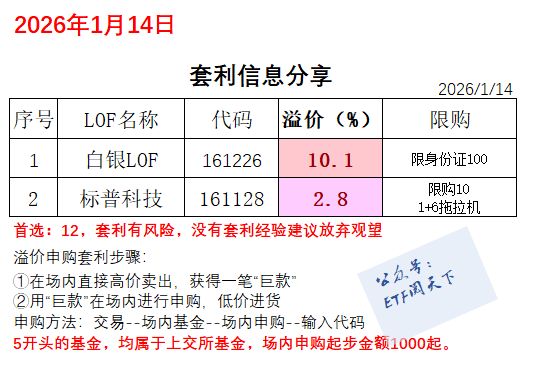
这些“战略资产”又集体暴动,白银最牛其次原油,石油价格一旦反转就要翻江倒海
Xin Lang Cai Jing· 2026-01-14 03:32
Core Viewpoint - The article discusses the recent performance of silver and oil LOF (Listed Open-Ended Fund) investments, highlighting significant profit opportunities and market dynamics affecting these commodities. Group 1: Silver LOF Performance - Silver LOF has shown impressive returns, with some investors reporting gains of over 1500+ from single accounts [3][4] - The current premium for silver LOF stands at 10.1%, indicating strong demand and potential for further profit [2] - The article suggests that the recent surge in silver prices, with a 4.28% increase in London silver, is a key driver for these returns [9] Group 2: Oil LOF Investment Opportunities - The article notes that oil LOF funds, such as Southern Oil LOF and Jiashi Oil LOF, have provided multiple arbitrage opportunities recently [11] - There is a potential for significant price increases in oil, with current prices showing a 2.89% rise for New York oil and 2.82% for Brent oil [9] - The article emphasizes that if oil prices surge, it could lead to a corresponding increase in the prices of gold and silver, creating further investment opportunities [13] Group 3: Market Dynamics and Economic Indicators - The U.S. economy is experiencing a mixed performance, with manufacturing slowing down while the service sector remains strong, impacting commodity pricing [14] - Upcoming U.S. CPI data is expected to show a rebound, which could influence global liquidity and commodity markets [19] - The article highlights that the recent rise in PPI (Producer Price Index) is driven by increasing prices in the metals sector, providing a solid fundamental support for the metals market [19] Group 4: Investment Strategy and Recommendations - The article suggests focusing on ETF investments in the metals sector, particularly those that cover a broad range of metals to mitigate individual commodity risks [22] - It recommends a phased approach to investing in metal ETFs during market fluctuations, while keeping an eye on key economic indicators and geopolitical events [23] - The overall strategy emphasizes capturing the benefits of a bull market while managing risks associated with high valuations and crowded sectors [21][23]
低费率创业板人工智能ETF华夏(159381)涨超4%,易点天下、中文在线20cm涨停
Mei Ri Jing Ji Xin Wen· 2026-01-12 03:26
消息面上,马斯克当地时间1月10日在社交媒体平台X发文称,将在一周内正式开源X平台最新的内容推 荐算法。这一举动被市场普遍解读为"马斯克也要涉足GEO"。GEO指生成引擎优化(Generative Engine Optimization)是AI搜索优化的多元拓展,聚焦于生成式AI环境下的内容整合与结构化数据应用,通过 生产或调整内容,当用户通过AI工具提问时,GEO确保品牌的核心信息被AI系统采纳,并直接融入答 案中。 AI+持续发酵,创业板人工智能ETF华夏(159381)助力布局创业板AI主业公司。资料显示,该ETF跟 踪指数一半权重在AI硬件算力(CPO),一半权重在AI软件应用(计算机、传媒、电子),具备较高 弹性和代表性。目前该ETF场内综合费率仅0.20%,位居同类最低。场外联接(A类:025505;C类: 025506)。 1月12日上午,AI+相关概念领涨市场,截至10点50分,同类费率最低创业板人工智能ETF华夏 (159381)涨超4%,持仓股易点天下、中文在线20cm涨停,汉得信息、蓝色光标、昆仑万维、拓尔 思、润泽科技等多股涨超10%。 (文章来源:每日经济新闻) ...
