证券交易所

Search documents
全球第一,港交所最新发声
Zhong Guo Ji Jin Bao· 2025-08-20 13:19
Core Viewpoint - Hong Kong Stock Exchange (HKEX) reported record-high revenue and other income for the first half of 2025, driven by significant increases in trading volumes across various markets and a surge in IPO fundraising, positioning it as a leading global exchange [1][4][9]. Financial Performance - HKEX's revenue and other income reached HKD 14.076 billion in the first half of 2025, a 33% increase compared to HKD 10.621 billion in the same period of 2024 [4][6]. - Major business revenue grew by 34% year-on-year to HKD 12.954 billion, with second-quarter revenue also reflecting a 34% increase [5][6]. - Net profit attributable to shareholders was HKD 8.519 billion, up 39% from HKD 6.125 billion in the previous year [5][6]. - EBITDA for the first half of 2025 was HKD 10.939 billion, representing a 43% increase year-on-year [5][6]. IPO and Fundraising Activity - In the first half of 2025, HKEX recorded 44 new listings, raising HKD 1,094 billion, which is over eight times the amount raised in the same period of 2024 [9][12]. - The number of IPO applications has reached a historical high, with approximately 230 companies currently in the pipeline [12]. Market Participation - There has been a notable increase in foreign participation in both primary and secondary markets, with retail investors accounting for about 10% of the secondary market and northbound capital averaging 23% of daily trading volume [13][14]. - The company anticipates continued interest from global long-term funds in upcoming IPOs, reflecting a positive trend in foreign investment [14]. Future Outlook - HKEX plans to implement measures to enhance market competitiveness and attractiveness, including shortening settlement cycles and optimizing IPO pricing regulations [14].

全球第一!港交所,最新发声
Zhong Guo Ji Jin Bao· 2025-08-20 13:05
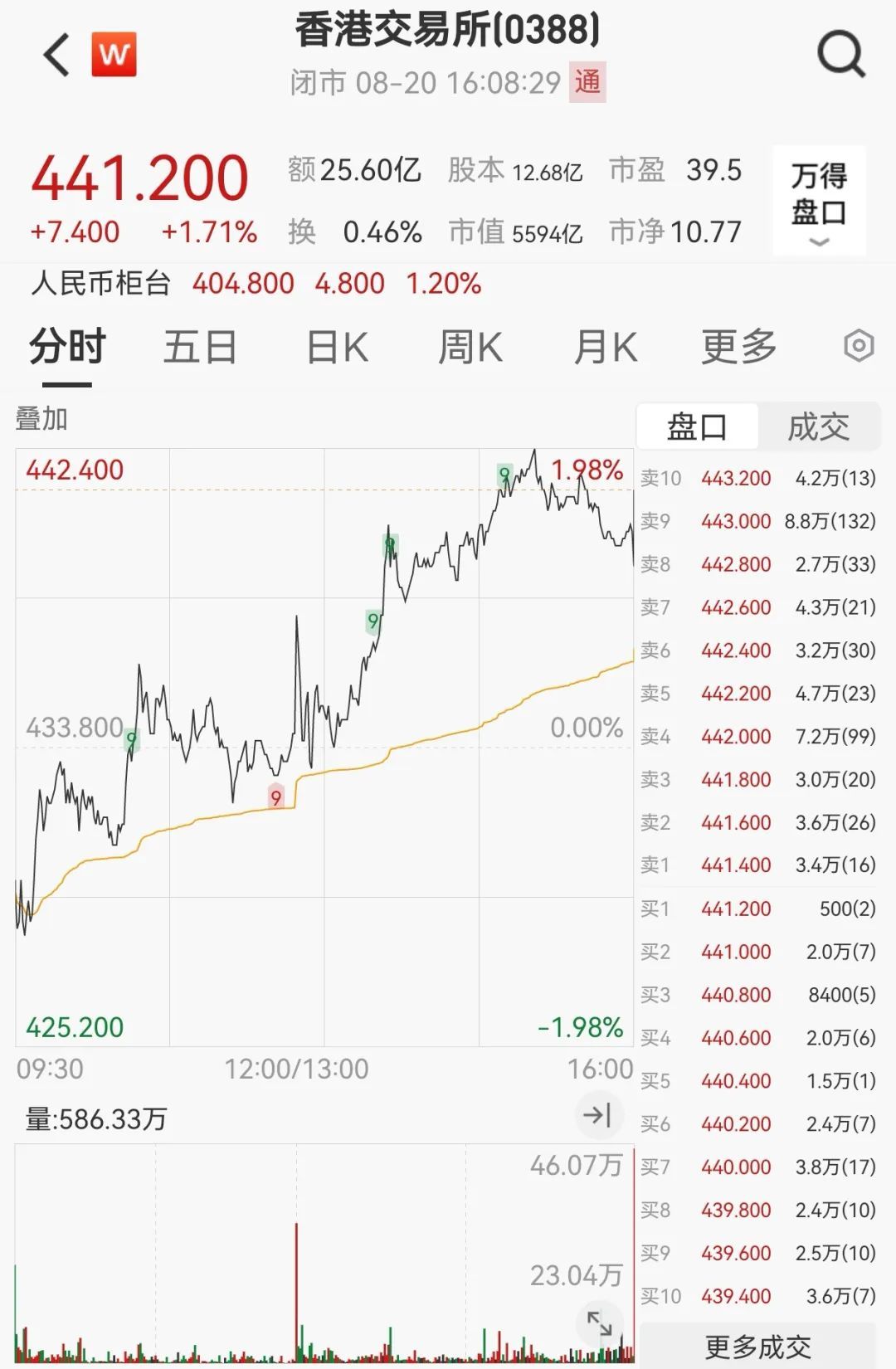
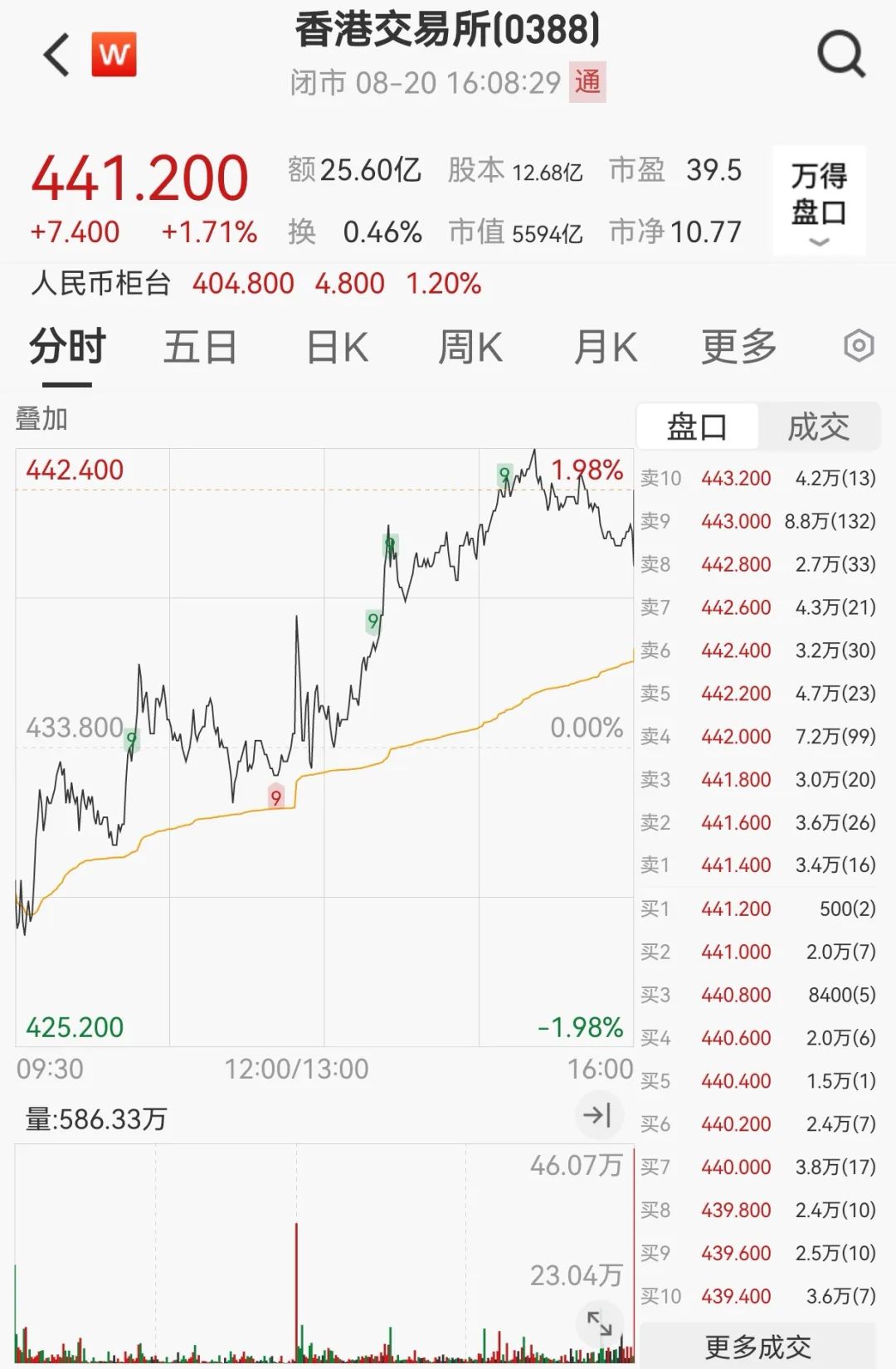
【导读】香港交易所:IPO重回全球榜首!外资参与度显著提升! 中国基金报记者 郭玟君 8月20日中午,香港交易所披露上半年业绩。香港交易所集团行政总裁陈翊庭表示,现货市场、衍生产品市场及沪深港通的成交量均创半年新高,新股市 场融资额重回全球交易所榜首,一级市场及二级市场外资参与度显著提升。 业绩披露后,香港交易所股价在下午交易时段由跌转涨,最高涨幅达1.98%,全天收于441.20港元/股,涨1.71%。 上半年收入创历史新高 香港交易所半年报显示,2025年上半年收入及其他收益创历来半年度新高,达140.76亿元,较2024年上半年增长33%。 香港交易所主要业务收入较2024年上半年增长34%,现货及股票期权市场成交量创历来半年度新高,存管费用增加以及保证金规模增加令投资收益净额上 升。 | | 載至 2025 年 | 截至 2024 年 | | | --- | --- | --- | --- | | | 6 月 30 日止 | 6月30日正 | | | | 六個月 | 六個月 | | | | 百萬元 | 白萬元 | 變唱 | | 收入及其他收益 | | | | | 主要業務收入 | 12,954 | 9 ...

全球第一!港交所,最新发声
中国基金报· 2025-08-20 13:01
Core Viewpoint - Hong Kong Stock Exchange (HKEX) has regained its position as the world's leading IPO market, with significant increases in foreign participation in both primary and secondary markets [2][12]. Financial Performance - HKEX reported a record high revenue and other income of HKD 14.076 billion for the first half of 2025, a 33% increase compared to HKD 10.621 billion in the same period of 2024 [4][7]. - Major business revenue grew by 34% year-on-year, driven by record trading volumes in the cash and stock options markets, as well as increased custody fees and margin sizes [4][6]. - Net investment income from company funds reached HKD 1.044 billion, up 16% from HKD 901 million in the previous year, attributed to non-recurring foreign exchange gains [6][7]. - Shareholder profit attributable to the company was HKD 8.519 billion, a 39% increase from HKD 6.125 billion in the first half of 2024 [6][7]. IPO Market Activity - In the first half of 2025, HKEX saw 44 new listings, raising HKD 1,094 billion, which is more than eight times the amount raised in the same period of 2024, marking the highest half-year record since 2021 [9][11]. - The number of IPO applications received has reached a historical high, with approximately 230 companies currently in the queue [8][11]. Foreign Participation - There has been a notable increase in foreign participation in both primary and secondary markets, with retail investors making up about 10% of the secondary market and northbound capital accounting for approximately 23% of daily trading volume [12][13]. - The HKEX is focusing on enhancing its market competitiveness and attractiveness by optimizing listing systems and expanding its product offerings to capture a larger share of global asset allocation [13]. Future Outlook - The company plans to implement measures to improve market competitiveness, including shortening the settlement cycle for the cash market and expanding the paperless listing mechanism [13].

港交所重磅发声!事关24小时交易→
Zheng Quan Shi Bao· 2025-08-20 12:48
Core Viewpoint - Hong Kong Stock Exchange (HKEX) reported record high revenue and profit for the first half of 2025, driven by a significant market recovery and a strong IPO pipeline [1][2]. Group 1: Financial Performance - HKEX's revenue and other income for H1 2025 reached HKD 14.076 billion, a 33% increase compared to H1 2024 [1] - Shareholder profit for H1 2025 was HKD 8.519 billion, up 39% from H1 2024 [1] - Daily trading volume in the cash market hit a half-year record, doubling compared to H1 2024 [1] Group 2: IPO Activity - HKEX completed over 50 IPOs in the first half of 2025, raising nearly USD 17 billion, maintaining a leading position globally [2] - There are currently around 230 companies in the IPO pipeline, indicating strong demand for listings [2] - The relationship between HKEX and mainland exchanges is characterized as complementary, with mutual benefits expected from the resurgence of IPOs in mainland China [2] Group 3: Investment Trends - Global investors are increasingly looking to diversify into Asian markets, particularly China, which is seen as a favorable investment opportunity [4] - High foreign participation in IPOs, especially among cornerstone investors, reflects strong interest from international capital [4] Group 4: Technology and Confidentiality - HKEX has seen 50 new applications from companies under the technology special listing regime, encouraging innovation [5] - The introduction of confidential submission for certain companies allows sensitive information to be protected during the approval process, ensuring transparency at the time of public offering [5] Group 5: Trading Hours and Market Accessibility - There is ongoing discussion about the potential for 24-hour trading to enhance market accessibility, though careful analysis is required to manage risks and operational pressures [6] - HKEX has been optimizing trading calendars and processes to improve service to the market, indicating a commitment to enhancing trading efficiency [6]
香港交易所集团行政总裁陈翊庭:年底前可以支持T+1结算周期
Zheng Quan Ri Bao Wang· 2025-08-20 12:48
Group 1 - The Hong Kong Stock Exchange (HKEX) is actively discussing the shortening of the settlement cycle for the cash market, with plans to support a T+1 settlement cycle by the end of this year [1] - HKEX CEO Charles Li noted the ongoing discussions regarding extending trading hours, referencing Nasdaq's plan to implement a 24-hour trading mechanism five days a week by the second half of 2026 [1] - The company will adopt a cautious and gradual approach, taking into account international experiences while considering local market conditions, with system upgrades and risk management frameworks being prerequisites for this process [1] Group 2 - Since the launch of the "Tech Company" special line, HKEX has received applications for IPOs from 50 companies under Chapter 18A and Chapter 18C listing rules [1]
港交所重磅发声!事关24小时交易→
证券时报· 2025-08-20 12:44
Core Viewpoint - The Hong Kong Stock Exchange (HKEX) has reported record-high performance in the first half of 2025, driven by a significant market recovery and a robust IPO pipeline, showcasing the effectiveness of its diversification strategy and strategic focus [2][3]. Group 1: IPO Trends - HKEX completed over 50 IPOs in the first half of 2025, raising nearly $17 billion, maintaining its leading position globally in IPO rankings [3]. - The IPO pipeline remains strong with approximately 230 companies currently in line for listing, indicating a healthy market environment [3]. Group 2: Dollar Asset Return - Global investors are increasingly looking to diversify their investments into Asian markets, particularly China, which is seen as a favorable opportunity for HKEX [5]. - The participation of foreign capital in the Hong Kong stock market is high, especially among cornerstone investors in IPOs, which includes long-term investment funds from various regions [5]. Group 3: Technology Company Initiatives - HKEX has seen the addition of 50 new applications from companies under the 18A and 18C categories since launching its technology-focused listing channel, reflecting a positive response [6]. - The introduction of confidential submission for certain companies allows for sensitive information to be protected during the approval process, ensuring transparency at the time of public offering [6]. Group 4: 24-Hour Trading Discussion - There is ongoing discussion about the feasibility of implementing 24-hour trading at HKEX, which could enhance market accessibility for investors [7]. - The exchange is considering the implications of extended trading hours on operational processes and risk management, emphasizing the need for thorough analysis before any changes are made [7].

刚刚,港交所宣布将研究24小时交易机制
Xin Hua Ri Bao· 2025-08-20 12:43
Core Viewpoint - Hong Kong Exchanges and Clearing Limited (HKEX) emphasizes its commitment to strategic investments to maintain global competitiveness, particularly in enhancing data platforms and upgrading trading and settlement systems [1] Group 1: Strategic Investments - HKEX's CEO, Charles Li, stated that the company will not hesitate to increase capital expenditures to optimize data platforms and upgrade trading and settlement systems [1] Group 2: Trading Hours and Market Adaptation - In response to discussions about extending trading hours, HKEX is considering a cautious and gradual approach, taking into account international peers' experiences and local market conditions [1] - The implementation of extended trading hours will depend on the upgrade of trading systems, improvement of risk management frameworks, and maturity of regulatory structures [1] Group 3: Settlement Cycle Discussions - HKEX is actively engaging with market participants to explore the possibility of shortening the settlement cycle for the cash market [1] - The technical systems of HKEX are expected to support a T+1 settlement cycle by the end of this year, but the actual implementation will require feedback from various market participants [1]
港交所中期业绩创历史新高:营收净利双增,IPO募资额重回榜首
2 1 Shi Ji Jing Ji Bao Dao· 2025-08-20 12:06
Core Insights - Hong Kong Stock Exchange (HKEX) reported record high interim results for the first half of 2025, with revenue and other income reaching HKD 14.076 billion, a 33% year-on-year increase, and shareholder profit rising 39% to HKD 8.519 billion [1] - The CEO of HKEX highlighted strong performance across various markets, including spot and derivatives, with significant increases in trading volumes and a resurgence in the IPO market [1][4] Revenue and Profit Growth - HKEX's core business revenue increased across the board, with main business revenue reaching HKD 12.954 billion, up 34% year-on-year, driven by record trading volumes in the spot and stock options markets [1] - The interim dividend was set at HKD 6.00 per share, reflecting a 38% increase compared to the previous year [1] Trading Volume Surge - The average daily trading volume in the securities market surged to HKD 240.2 billion, a remarkable 118% increase year-on-year, fueled by favorable market conditions and increased participation from international and mainland investors [2] - Northbound and southbound trading through the Stock Connect reached historical highs, with the Hong Kong Stock Connect averaging HKD 111 billion daily, a 196% increase year-on-year [2] IPO Market Recovery - The IPO market in Hong Kong saw a strong comeback, with 44 companies listed in the first half of 2025, raising a total of HKD 109.4 billion, a staggering increase of over 700% year-on-year [4] - Notably, CATL's IPO raised HKD 41 billion, marking the largest IPO in Hong Kong since February 2021 and the largest globally in 2023 [4] Listing Applications and Regulatory Changes - The number of listing applications being processed by HKEX surged to 207 by June 30, 2025, more than double the 84 applications at the end of 2024 [5] - HKEX and the Hong Kong Securities and Futures Commission launched a "Tech Company Fast Track" to attract more tech and biotech firms to list, allowing confidential submissions of applications [5][6] Future Outlook - HKEX plans to implement measures to enhance market competitiveness, including shortening the settlement cycle for the cash market and expanding paperless listing mechanisms [6]
港交所将研究24小时交易机制
第一财经· 2025-08-20 11:59
Core Viewpoint - The Hong Kong Stock Exchange (HKEX) is committed to strategic investments to maintain global competitiveness, focusing on optimizing data platforms and upgrading trading and settlement systems [1] Group 1: Strategic Investments - HKEX will not hesitate to increase capital expenditure, particularly in areas such as data platform optimization and trading settlement system upgrades [1] Group 2: Trading Hours Extension - The CEO mentioned the ongoing discussions regarding the extension of trading hours, noting that Nasdaq plans to implement a 24-hour trading mechanism by the second half of 2026 [1] - HKEX will adopt a cautious and gradual approach, studying international experiences while considering local market conditions before making changes [1] Group 3: Settlement Cycle - HKEX is actively engaging with market participants to discuss shortening the settlement cycle for the cash market [1] - The technical systems of HKEX will support a T+1 settlement cycle by the end of this year, but the implementation will depend on feedback from various market participants [1]

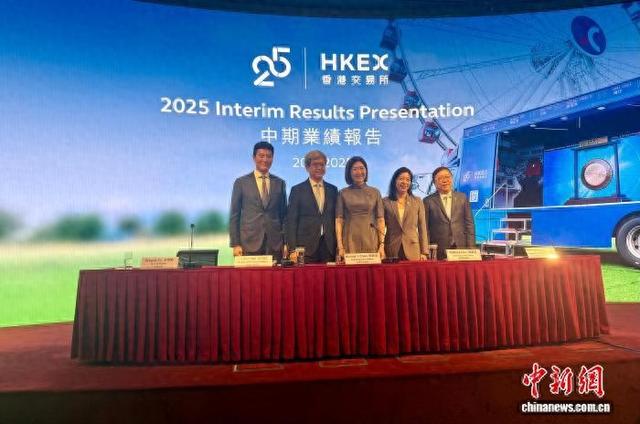
港交所上半年业绩创新高 新股集资额居全球首位
Zhong Guo Xin Wen Wang· 2025-08-20 11:33
港交所行政总裁陈翊庭表示,港交所今年开局良好。现货市场、衍生产品市场及沪深港通的成交量均创 半年新高。 陈翊庭称,香港新股市场在今年延续强劲增长,上半年集资额居全球首位。期内共迎来44家上市公司, 新股集资总额达1094亿元,同比增长716%。准备来香港上市的公司络绎不绝,截至今年6月30日,正在 处理的上市申请逾200宗。香港仍是中国内地企业首选的国际融资市场,国际发行人对于在香港市场上 市融资的兴趣亦有所增加。(完) 8月20日, 香港交易及结算所有限公司在港公布2025年中期业绩报告。 中新社记者 戴小橦 摄 中新社香港8月20日电 (记者 戴小橦)香港交易及结算所有限公司(港交所)20日在港公布的2025年中期业 绩报告显示,港交所今年上半年收入及其他收益和溢利创历来同期新高。 报告数据显示,港交所今年上半年收入及其他收益为140.76亿元(港元,下同),同比增长33%;股东应 占溢利为85.19亿元,同比增长39%。主要业务收入同比增长34%至129.54亿元,主要得益于现货及股票 期权市场成交量创历来半年度新高、存管费用增加以及保证金规模增加令投资收益净额上升等因素。 ...