
无线通信模组

Search documents
新股前瞻|无线通信模组龙头冲击“A+H”,AI与机器人成为广和通(300638.SZ)估值扩张关键?
智通财经网· 2025-05-06 01:04
Core Viewpoint - The A+H listing trend is gaining unprecedented momentum in China's financial market, driven by ongoing reforms and improved connectivity between mainland and Hong Kong markets [1][2]. Company Overview - As of now, over 20 companies have filed for A+H listings in Hong Kong this year, with several more expected to follow [2]. - Leading companies in various sectors, including CATL, Haitian Flavoring, Muyuan Foods, and Dongpeng Beverage, are participating in this trend, alongside Global No. 2 wireless communication module provider, Guanghetong [2]. Guanghetong's Market Position - Guanghetong has been a key player in the wireless communication module sector since 1999, becoming the second-largest supplier globally with a market share of 15.4% by 2024 [2][9]. - The company has established a comprehensive product system, including module products and customized solutions, covering various applications such as automotive electronics, smart homes, and consumer electronics [3][5]. Revenue Structure - In 2024, 96.1% of Guanghetong's revenue will come from module products, with data transmission modules and smart modules accounting for 43.7% and 52.4% of the revenue, respectively [5][6]. - The company's revenue from solutions is expected to grow to 3% in 2024, indicating a gradual increase in this segment [5]. Financial Performance - Guanghetong's revenue from continuing operations is projected to grow from 5.108 billion RMB in 2022 to 6.704 billion RMB in 2024, reflecting a compound annual growth rate (CAGR) of 14.46% [8]. - Net profit for the same period is expected to increase from 352.3 million RMB to 423.2 million RMB, with a CAGR of 9.5% [8]. Market Growth and Trends - The global wireless communication module market is expected to grow from 32.3 billion RMB in 2020 to 43.6 billion RMB in 2024, with a CAGR of 7.7% [9][10]. - The Chinese market is projected to grow from 17.4 billion RMB to 24.7 billion RMB during the same period, with a CAGR of 9.1% [9]. Future Outlook - The market for wireless communication modules is anticipated to accelerate further, with projections indicating growth from 48.6 billion RMB in 2025 to 72.6 billion RMB by 2029, at a CAGR of 10.6% [10]. - Emerging fields such as AI modules and robotics are expected to be critical for Guanghetong's future success, with AI modules projected to experience a CAGR of 49.3% [11][14]. Strategic Initiatives - Guanghetong has launched AI modules and various edge AI solutions, with initial deliveries expected in 2025 [14][15]. - The company is also developing robotics solutions, including lawnmower and embodied intelligent robots, with initial orders anticipated in 2025 [15].


广和通递表港交所 为全球第二大无线通信模组提供商
Zhi Tong Cai Jing· 2025-04-27 08:56
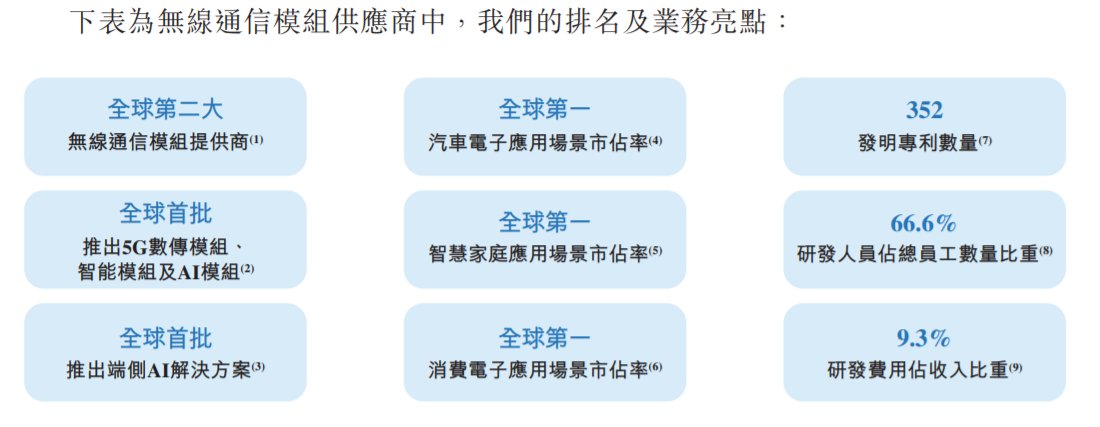
Core Viewpoint - Guanghe Tong is a leading global provider of wireless communication modules, with a strong market presence and a focus on customized solutions for various applications [4][5]. Group 1: Company Overview - Guanghe Tong's module products include data transmission modules, smart modules, and AI modules, which are tailored to specific customer needs [4]. - The company has a significant market share in various sectors, ranking first in automotive electronics (24.6%), smart home (36.6%), and consumer electronics (75.9%) as of 2024 [4][5]. Group 2: Market Position - According to Frost & Sullivan, Guanghe Tong holds a 15.4% share of the global wireless communication module market, making it the second-largest player worldwide [4]. - The company leads in multiple downstream application scenarios, particularly in automotive electronics and smart home sectors [4]. Group 3: Strategic Initiatives - The company plans to deepen its focus on the wireless communication module sector, enhance investments in edge AI and robotics solutions, and strengthen its global operational capabilities [5]. - Guanghe Tong aims to expand its business layout through investments and acquisitions [5]. Group 4: Financial Performance - For the fiscal years 2022, 2023, and 2024, Guanghe Tong reported revenues of approximately RMB 5.203 billion, RMB 5.652 billion, and RMB 6.971 billion, respectively [5]. - The net profit for the same years was approximately RMB 365 million, RMB 565 million, and RMB 678 million, indicating a positive growth trajectory [5][7].
关税豁免下的出口光模块反弹机会和通信超跌环节推荐
2025-04-15 00:58
Summary of Conference Call Notes Industry Overview - The conference call primarily discusses the **communication industry** and its response to recent changes in **U.S. tariff policies** affecting various products including optical modules, wireless communication modules, and IP phones [3][4]. Key Points and Arguments 1. **U.S. Tariff Exemption Impact**: - The recent U.S. tariff exemption list includes products related to the communication industry, allowing companies to revert to a 27.5% tariff level, with potential for zero tariffs if products are routed through Thailand [3][4]. - This exemption significantly reduces tariff costs for related companies, providing a favorable environment for growth [4]. 2. **Domestic Semiconductor Certification Rules**: - New domestic semiconductor product origin certification rules mainly affect IDM model analog chip manufacturers, but the overall impact on the communication industry is considered limited [5]. 3. **NVIDIA Export Policy**: - The Trump administration's slowdown in restricting NVIDIA H20 exports to China is seen as beneficial for domestic HH20 server manufacturers and downstream companies, promoting capital expenditure and investment certainty [6]. 4. **Optical Device and Module Sector**: - Leading companies like Zhongtian Technology benefit from tariff exemptions, while companies like Xuchuang are relocating high-end production to Thailand to mitigate risks associated with direct exports to the U.S. [7]. - The core chips used in optical modules are primarily sourced from Taiwan, limiting the impact of import tariffs [7]. 5. **Wireless Communication Module Sector**: - Companies such as Guanghetong, Yiyuan Communication, and Meige Intelligent benefit from the tariff exemptions, with most of their imported chips sourced from regions outside the U.S., resulting in minimal cost increases [8]. 6. **Enterprise Communication Terminal Sector**: - Companies like Yidian Network, which have around 30-40% of their products on the exemption list, are gradually shifting production to Southeast Asia and sharing costs with downstream distributors to mitigate tariff impacts [9]. 7. **Short-term Tariff Impact Mitigation**: - Companies have been building inventory in overseas warehouses to buffer against short-term tariff impacts and are increasing the pace of domestic chip substitution [10]. 8. **Data Center Temperature Control Market**: - The majority of revenue in this segment still comes from domestic markets, with limited impact from tariffs due to low cost contribution from risk control measures [11][12]. 9. **Smart Controller Sector**: - Major manufacturers have established global production bases to buffer against tariff impacts, with direct exports to the U.S. being minimal [13]. 10. **Communication Industry Performance**: - The domestic demand sector is performing well, while export-oriented sectors like optical devices and modules are facing significant challenges, with some companies experiencing over a 15% decline in stock prices [14]. 11. **Future Demand for Optical Modules**: - Expectations for 2025 and 2026 indicate a higher demand for 1.6T optical modules, with potential growth driven by Ethernet customers and cloud computing applications [15]. 12. **Investment Strategy for the Communication Industry**: - Short-term impacts from tariffs are expected to be minimal, with a focus on individual demand changes and Southeast Asian policy developments. Recommended stocks include Zhongji Xuchuang, Yiseng, Tianfu Communication, and others [16][17]. Additional Important Insights - The communication industry is advised to focus on segments benefiting from tariff exemptions, such as optical modules and IoT modules, while also considering sectors with low overseas demand impact [17]. - There is a notable emphasis on accelerating domestic substitution of communication chips in response to import tariff impacts [17].