
Auto Parts Retail

Search documents
AutoZone Posts Weaker-Than-Expected Q4 Profit
Yahoo Finance· 2025-09-23 14:09
Core Insights - AutoZone reported a weaker-than-expected profit for its fiscal fourth quarter, with net income dropping 7.2% to $837.0 million and diluted earnings per share at $48.71, missing analyst expectations [2][4] - Revenue increased by 0.6% to $6.24 billion, aligning closely with forecasts, while same-store sales grew by 4.5%, slightly exceeding estimates [2][3] Financial Performance - The company's operating, selling, general, and administrative expenses rose by 3.0% to $2.02 billion due to the addition of 141 new stores and a 14.1% increase in inventory [3] - Analysts had anticipated a net income of $867.5 million and earnings per share of $50.89, indicating a significant shortfall in performance [2] Strategic Outlook - CEO Phil Daniele indicated that AutoZone plans to continue its aggressive expansion strategy in the upcoming year, with expectations of increasing earnings and cash flow to enhance shareholder value [3][4] - The company's stock remained flat in morning trading but had previously increased by 29% year-to-date prior to the earnings announcement [3]

AutoZone Plans Aggressive Store Expansion To Capture Market Share
Yahoo Finance· 2025-09-23 14:02
Financial Performance - AutoZone reported fourth-quarter earnings per share of $48.71, missing the analyst consensus estimate of $50.91 [1] - Quarterly sales were $6.242 billion, a 0.6% year-over-year increase, but fell short of the expected $6.245 billion [1] - Adjusted sales, excluding an additional week from the previous year, increased by 6.9% [2] - Total company same-store sales rose by 5.1%, with domestic same-store sales increasing by 4.8% [2] - Gross margin decreased to 51.5%, down 98 basis points year-over-year, impacted by a non-cash LIFO headwind [2] - Operating profit decreased by 7.8% to $1.2 billion, and net income for the quarter was $837.0 million compared to $902.2 million in the prior year [3] Shareholder Actions - The company repurchased 117,000 shares in the fourth quarter at an average price of $3,821, totaling a buyback outlay of $446.7 million [3] - AutoZone exited the quarter with cash and equivalents amounting to $271.803 million [5] Expansion and Strategy - In the quarter ended August 30, 2025, AutoZone opened 91 new stores in the U.S., 45 in Mexico, and 6 in Brazil, totaling 141 net new stores [4] - The international unit reported constant-currency same-store sales growth of 7.2% [4] - The company plans to aggressively open more stores in the upcoming year to enhance market share [5]
KVUE Rebounds Against Trump Admin, BA International Boost, AZO Earnings Miss
Youtube· 2025-09-23 14:00
Company Overview - Can View's stock is rallying approximately 6.5% following the company's pushback against claims linking Tylenol to autism made by the Trump administration [1][2] - The parent company asserts that independent science shows no causal link between acetaminophen and autism, countering the FDA's recent commentary on the potential association [2][3] FDA Commentary - The FDA acknowledged studies suggesting a possible association between acetaminophen use during pregnancy and neurological conditions but emphasized that a causal relationship has not been established [3][6] - Medical professionals have also rejected the claims made regarding Tylenol and autism, supporting the company's position [3][6] Market Impact - Tylenol's stock had previously slumped to its lowest level of the year, but analysts suggest limited judicial risk following the announcement, although public opinion may impact Tylenol consumption [4][5] - Ken View's stock has decreased by approximately 16.5% over the past month, indicating market volatility surrounding the brand [5] Boeing Orders - Boeing's shares increased by 1.5% due to an $8 billion deal with Uzbekistan Airways for 14 Dreamliners, marking the airline's largest order ever [7][9] - This order is expected to support nearly 35,000 jobs in the US and is part of Uzbekistan's plan to expand its international routes [9] AutoZone Performance - AutoZone reported its fifth consecutive earnings miss, with EPS at $48.71, below the expected $50, and revenue just shy of $6.4 billion against a $6.25 billion expectation [10][11] - Despite the misses, AutoZone's stock is up over 20% year-to-date, indicating resilience in the face of tariff impacts and rising costs [11][12] - The company plans to aggressively open new stores in the upcoming year, although it did not provide a 2026 outlook [13]




AutoZone tops same-store sales expectations, plans to 'aggressively' open new stores (AZO:NYSE)
Seeking Alpha· 2025-09-23 11:20
Core Viewpoint - AutoZone reported its fourth-quarter earnings, missing profit estimates despite a rise in same-store sales, leading to a decline in early trading [2] Financial Performance - Same-store sales increased by 4.5% during the quarter, surpassing the consensus estimate of 4.4% [2] - Domestic same-store sales rose by 4.8%, compared to a consensus of 4.3% [2]
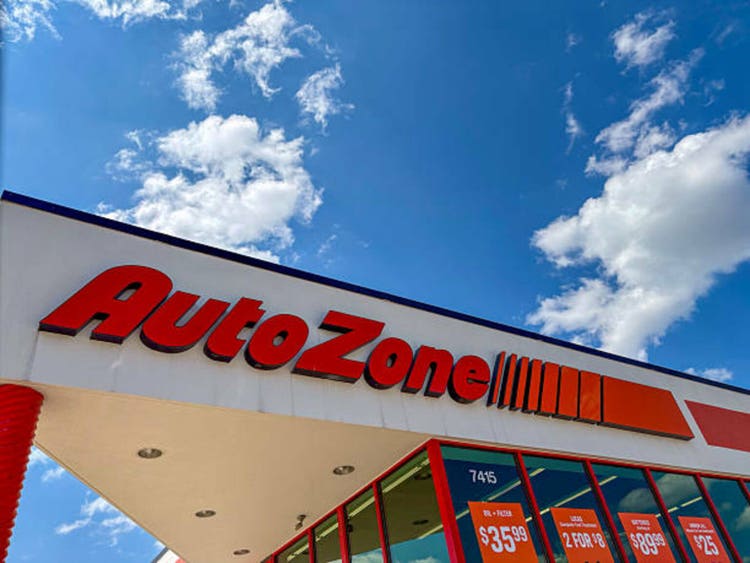
Will AutoZone Stock Drop On Its Upcoming Earnings?
Forbes· 2025-09-22 10:06
Group 1 - AutoZone is expected to announce earnings on September 23, 2025, with forecasted revenue of approximately $6.25 billion, reflecting a 1% increase from the previous year [2] - Projected earnings per share are around $51, which is roughly unchanged from last year, indicating stable performance [2] - The company has a market capitalization of $71 billion, with total revenue over the past twelve months at $19 billion, operating profits of $3.7 billion, and net income of $2.6 billion [2] Group 2 - Historical data shows that AutoZone has recorded 20 earnings data points over the last five years, with 7 positive and 13 negative one-day returns, resulting in a 35% chance of positive returns [6] - The percentage of positive one-day returns drops to 25% when considering the last three years, indicating a potential decline in performance [6] - The median of positive returns is 3.7%, while the median of negative returns is -2.8%, highlighting the variability in post-earnings performance [6]

Micron has had a big run, it needs to cool before I can recommend it, says Jim Cramer
Youtube· 2025-09-20 00:03
Market Overview - The market is experiencing record highs with the Dow gaining 173 points, S&P advancing 49%, and NASDAQ climbing 72% [2] - The rally is broad-based, encompassing various sectors including banks, transports, tech, and utilities [3] - Speculative stocks remain a significant part of the market, continuing to attract attention despite concerns from professionals [3][4] Company Insights - AutoZone is highlighted for its aggressive stock buyback strategy, which has been consistent for two decades [10] - Micron is noted for its volatile performance, with the CEO emphasizing the importance of prudent management in a fluctuating market [12][13] - Cintas is expected to potentially surprise with positive results, reflecting its strong service offerings to small and medium-sized businesses [16] Economic Indicators - New home sales data is anticipated, with concerns that rising bond yields may hinder significant sales growth [14] - The housing market is facing challenges due to high mortgage rates, which are expected to persist until the Federal Reserve signals a shift in its inflation strategy [18] - The personal consumption expenditures price index will be monitored as it is crucial for understanding inflation trends and the Fed's future actions [22] Stock Performance - FedEx exceeded Wall Street's expectations in its latest earnings report, indicating strong performance in the logistics sector [27] - Visa is experiencing downward pressure due to competitive threats from stable coins and blockchain technology, creating potential buying opportunities [24] - Adobe's stock is under scrutiny for its growth metrics, with a focus on organic growth rather than price-driven increases [26]

Autozone (AZO) Fell as the Market Favored More Offensive Securities
Yahoo Finance· 2025-09-19 12:28
Group 1 - Macquarie Asset Management's "Macquarie Core Equity Fund" reported a return of 11.94% in Q2 2025, outperforming the S&P 500 Index which rose by 10.94% [1] - The strong performance of the equity market was attributed to reduced concerns over potential tariffs from President Trump, leading to a pause in tariff implementation [1] - The fund's relative performance was primarily driven by sector selection (80%) and individual security selection (20%) [1] Group 2 - AutoZone, Inc. (NYSE:AZO) had a one-month return of 0.54% and a 52-week gain of 36.82%, with a market capitalization of $69.137 billion as of September 18, 2025 [2] - Despite its defensive nature, AutoZone's shares lagged behind the benchmark returns during the quarter as investors shifted towards more offensive securities [3] - AutoZone was held by 65 hedge fund portfolios at the end of Q2 2025, a decrease from 67 in the previous quarter, indicating a slight decline in popularity among hedge funds [3]
AutoZone, Inc. (NYSE:AZO) Quarterly Earnings Preview
Financial Modeling Prep· 2025-09-18 11:00
Core Viewpoint - AutoZone is a leading retailer and distributor of automotive replacement parts in the U.S., with a significant market presence and competition from other major players in the industry [1] Financial Performance Expectations - AutoZone is expected to release its quarterly earnings on September 23, 2025, with Wall Street estimating earnings per share (EPS) of $51.10 and projected revenue of approximately $6.25 billion, indicating a potential year-over-year increase in earnings driven by higher revenues for the quarter ending August 2025 [2] - The stock's movement will depend on the actual results compared to these estimates, with potential stock price increases if earnings surpass expectations, and declines if results fall short [3] Market Valuation Metrics - AutoZone has a price-to-earnings (P/E) ratio of approximately 27.65, indicating how the market values its earnings [4] - The price-to-sales ratio stands at about 3.75, reflecting the market's valuation of its revenue [4] - The enterprise value to sales ratio is around 4.38, suggesting how the market values the company in relation to its sales, including debt [4] - The enterprise value to operating cash flow ratio is approximately 25.57, indicating how the market values its cash flow from operations [5] - AutoZone's earnings yield is about 3.62%, providing insight into the earnings generated per dollar invested [5] - The debt-to-equity ratio of approximately -3.07 highlights its capital structure and leverage [5] - The current ratio of around 0.84 indicates its ability to cover short-term liabilities with short-term assets [5]

AutoZone (AZO) Earnings Expected to Grow: Should You Buy?
ZACKS· 2025-09-16 15:00
Core Viewpoint - Wall Street anticipates a year-over-year increase in AutoZone's earnings driven by higher revenues, with a focus on how actual results will compare to estimates to influence stock price [1][2]. Earnings Expectations - AutoZone is expected to report quarterly earnings of $51.10 per share, reflecting a year-over-year increase of 6.2% [3]. - Revenue projections stand at $6.23 billion, indicating a 0.4% increase from the previous year [3]. Estimate Revisions - The consensus EPS estimate has remained unchanged over the last 30 days, suggesting stability in analyst expectations [4]. - The Most Accurate Estimate for AutoZone is lower than the Zacks Consensus Estimate, resulting in an Earnings ESP of -1.89%, indicating a bearish outlook from analysts [12]. Earnings Surprise Prediction - The Zacks Earnings ESP model suggests that a positive or negative reading indicates the likelihood of actual earnings deviating from consensus estimates, with positive readings being more predictive of earnings beats [9][10]. - AutoZone's current Zacks Rank is 4, which complicates the prediction of an earnings beat [12]. Historical Performance - In the last reported quarter, AutoZone was expected to post earnings of $36.78 per share but delivered only $35.36, resulting in a surprise of -3.86% [13]. - The company has not beaten consensus EPS estimates in any of the last four quarters [14]. Conclusion - While AutoZone does not appear to be a strong candidate for an earnings beat, investors should consider other factors before making investment decisions [17].
Barclays Raises AutoZone (AZO) PT to $4,510 on Anticipation of Higher Earnings
Yahoo Finance· 2025-09-14 05:02
Core Insights - AutoZone Inc. is highlighted as a stock to consider investing in prior to its anticipated stock split, with Barclays raising its price target to $4,510 from $3,916, maintaining an Overweight rating [1] - The company reported total sales of $4.5 billion in FQ3 2025, reflecting a 5.4% year-over-year increase, with domestic same-store sales growing by 5% and international same-store sales increasing by 8.1% [2][3] - Domestic commercial sales for AutoZone saw a significant growth of 10.7% year-over-year, marking the first double-digit growth since FQ2 2023 [3] - AutoZone continued its expansion strategy by opening 54 net new domestic stores and 30 new international stores, bringing the total number of international locations to 979 [3]