
不动产租赁

Search documents
【热点问答】增值税法将实施,利好哪些行业?
Sou Hu Cai Jing· 2025-12-31 02:48
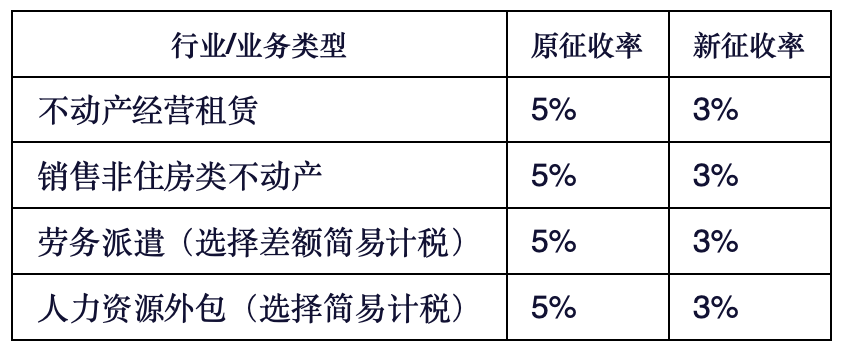
Core Viewpoint - The implementation of the new Value-Added Tax (VAT) Law in China on January 1, 2026, introduces significant changes aimed at streamlining the VAT system and improving cash flow for businesses. Group 1: Changes in VAT Law - The VAT Law does not fundamentally change taxpayers, tax rates, or calculation methods compared to the previous VAT Provisional Regulations, but it does reduce the circumstances of deemed sales and standardizes mixed sales [2] - The VAT Law significantly simplifies the scope of deemed sales, formalizes the refund of input tax credits, lowers the collection rate for simplified tax calculation methods, and expands the scope of input tax deductions [2] Group 2: Impact of Simplified Tax Calculation Rate - The new simplified tax calculation rate is set at 3%, benefiting various business types [3] - The following business types will see a reduction in the tax rate from 5% to 3% under the new law: - Real estate leasing - Sale of non-residential real estate - Labor dispatch (choosing differential simplified taxation) - Human resource outsourcing (choosing simplified taxation) [4] Group 3: Input Tax Credit Refund System - The VAT Law allows taxpayers to choose to carry forward or apply for a refund of input tax credits when the input tax exceeds the output tax for the period, which can improve cash flow for businesses [5] - Industries that will benefit from the optimized input tax credit refund measures include manufacturing, scientific research and technical services, software and information technology services, ecological protection and environmental governance, transportation, warehousing and postal services, and the energy sector, as these industries often have significant upfront investments leading to higher input tax credits [5]

上海交易集团不动产租赁平台与赢商股份签署战略合作协议
Zheng Quan Shi Bao Wang· 2025-09-30 09:58
Core Viewpoint - Shanghai Trading Group's real estate leasing platform has signed a strategic cooperation agreement with Winshang Co., focusing on three main directions to enhance the real estate market's efficiency and service value [1] Group 1: Strategic Focus Areas - The first focus area is leveraging Winshang's extensive commercial database to address the challenges of aligning state-owned real estate with market demand, aiming for precise resource matching [1] - The second area involves utilizing new media communication and digital operation monitoring to extend the value boundaries of real estate services, thereby creating a closed commercial ecosystem [1] - The third focus is on developing an integrated cooperation model of "resources + platform + services," which aims to establish a replicable industry benchmark [1]