劳务派遣

Search documents
劳务派遣5%差额简易计税政策取消,税负会上涨吗?
Di Yi Cai Jing· 2026-02-04 03:48
Core Viewpoint - The recent announcement by the Ministry of Finance and the State Administration of Taxation introduces changes to the VAT calculation methods for labor dispatch companies, allowing general taxpayers to use a differential general taxation method at a 6% tax rate, replacing the previous simplified method at a 5% rate [1][2]. Group 1: Taxation Changes - The new announcement states that general taxpayers providing labor dispatch services can deduct wages, benefits, and social insurance contributions from the taxable sales amount [1][2]. - Previously, labor dispatch companies could choose a simplified taxation method with a 5% rate, which has now been eliminated [1][2]. - The differential method allows for the deduction of certain expenses, which may lead to a lower overall tax burden for some companies despite the increase in the tax rate from 5% to 6% [3]. Group 2: Impact on Labor Dispatch Industry - The change in taxation method is expected to have uncertain impacts on labor dispatch companies, as it may increase financial processing complexity but also promote more regular business operations [3]. - Companies with limited input tax credits may see an increase in tax burden, while those able to issue VAT special invoices may benefit from reduced overall tax burdens across the industry [3]. - Small-scale taxpayers are significantly affected, as they can only use a simplified method at a 3% rate, currently reduced to 1% until the end of 2027 [4]. Group 3: Definition and Scope - Labor dispatch services are defined as services provided by companies with a labor dispatch business license, meeting the flexible employment needs of client companies [5].
“十四五”青海转移就业农牧区劳动力547万人次
Xin Lang Cai Jing· 2026-01-01 19:47
Core Insights - During the "14th Five-Year Plan" period, Qinghai has focused on creating the "Qinghai e-employment" brand to enhance labor service brands, expand employment scale, and improve employment quality, resulting in 324,000 new urban jobs and 5.472 million rural labor transfers [1][2] Group 1: Employment Growth - Qinghai's labor brand development has shown significant results, with "Qinghai Noodle" supporting nearly 200,000 jobs through 37,700 stores across over 330 cities, generating an annual wage income of 8 billion yuan [1] - "Qing Embroidery" has enabled 44,000 embroiderers to achieve an average monthly income of over 4,000 yuan, with products being used as foreign gifts [1] - A total of 43 provincial and municipal labor brands have been cultivated, leading to an average of over 480,000 rural labor transfers annually [1] Group 2: Policy and Financial Support - Qinghai has implemented multiple employment support policies, allocating a total of 4.4 billion yuan in employment subsidies over the past five years [2] - The province has distributed 771 million yuan in stable job retention funds and provided one-time unemployment insurance expansion subsidies of 44.31 million yuan to 2,926 insured enterprises [2] - A unified electronic labor contract information system has been established, and a credit rating evaluation method for labor dispatch units has been introduced to promote healthy development in the labor dispatch industry [1]
【热点问答】增值税法将实施,利好哪些行业?
Sou Hu Cai Jing· 2025-12-31 02:48
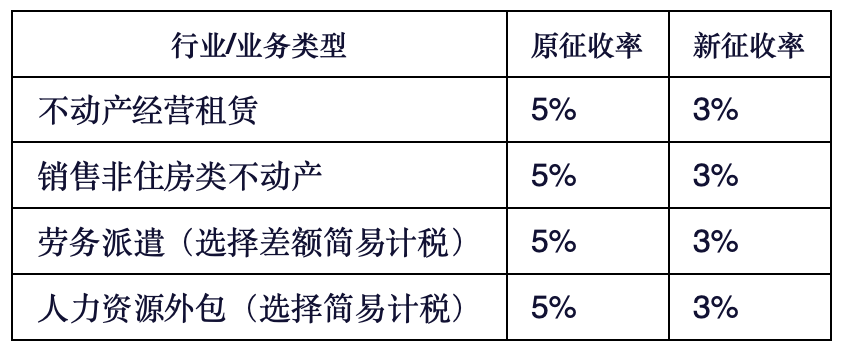
Core Viewpoint - The implementation of the new Value-Added Tax (VAT) Law in China on January 1, 2026, introduces significant changes aimed at streamlining the VAT system and improving cash flow for businesses. Group 1: Changes in VAT Law - The VAT Law does not fundamentally change taxpayers, tax rates, or calculation methods compared to the previous VAT Provisional Regulations, but it does reduce the circumstances of deemed sales and standardizes mixed sales [2] - The VAT Law significantly simplifies the scope of deemed sales, formalizes the refund of input tax credits, lowers the collection rate for simplified tax calculation methods, and expands the scope of input tax deductions [2] Group 2: Impact of Simplified Tax Calculation Rate - The new simplified tax calculation rate is set at 3%, benefiting various business types [3] - The following business types will see a reduction in the tax rate from 5% to 3% under the new law: - Real estate leasing - Sale of non-residential real estate - Labor dispatch (choosing differential simplified taxation) - Human resource outsourcing (choosing simplified taxation) [4] Group 3: Input Tax Credit Refund System - The VAT Law allows taxpayers to choose to carry forward or apply for a refund of input tax credits when the input tax exceeds the output tax for the period, which can improve cash flow for businesses [5] - Industries that will benefit from the optimized input tax credit refund measures include manufacturing, scientific research and technical services, software and information technology services, ecological protection and environmental governance, transportation, warehousing and postal services, and the energy sector, as these industries often have significant upfront investments leading to higher input tax credits [5]

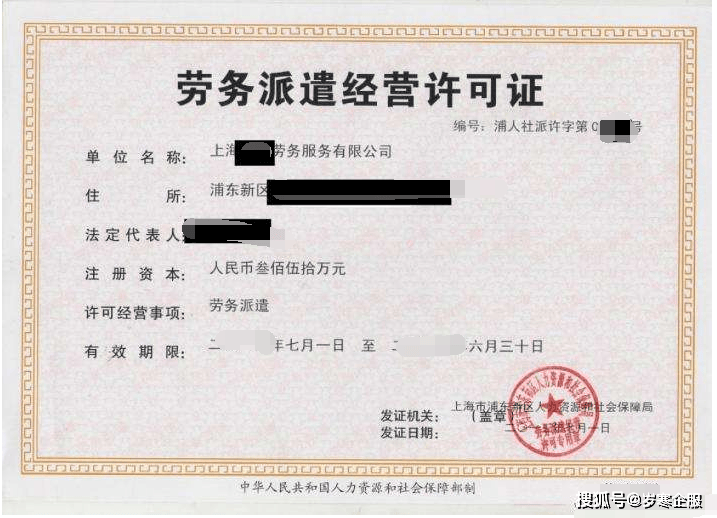
上海劳务派遣经营许可证延期办理全指南:流程、材料与关键节点
Sou Hu Cai Jing· 2025-11-02 13:30
Core Concept and Application Authority - The "Labor Dispatch Business License" is essential for companies engaged in labor dispatch in Shanghai, with a validity of three years [1] - Companies must apply for an extension 60 days before the license expires to avoid illegal operations and severe penalties [1][3] - The application must be submitted to the Shanghai Municipal Human Resources and Social Security Bureau or its designated district-level agencies [3] Core Conditions for Extension Application - Companies must meet several conditions for license renewal, including: - Registered capital must be no less than RMB 2 million, supported by a capital verification report or recent audit report [3] - A fixed business location and facilities appropriate for operations, with rental or property proof [3] - Compliance with labor laws over the past three years, with no major violations [3] - Established labor dispatch management systems in accordance with legal requirements [3] Step-by-Step Application Process - The application process is standardized through Shanghai's "One Network for All" platform [5] - Key steps include: 1. Preliminary planning and self-check [6] 2. Preparation and submission of application materials [5] 3. Acceptance and review of materials by the approval authority [5] Key Materials Required - Essential documents for the application include: - Application form for license extension [6] - Original copies of the current Labor Dispatch Business License [6] - Business license photocopy [6] - A comprehensive report on the past three years of operations, detailing employee numbers, labor contracts, and compliance with labor laws [6] - Proof of registered capital and business premises [6] Important Considerations and Common Pitfalls - Companies must avoid late applications, as submitting after the 60-day deadline results in automatic license invalidation [12] - The operational report is crucial and must be detailed and accurate to withstand scrutiny [12] - Ensuring timely and full payment of social insurance and wages for dispatched employees is critical [12] - Labor dispatch management systems must be updated to reflect the latest legal standards [12] - Seeking professional assistance for compliance checks can enhance the likelihood of successful renewal [12]
上海劳务派遣经营许可证延期办理
Sou Hu Cai Jing· 2025-10-30 12:52
Core Points - The validity period of the labor dispatch business license is three years, and companies in Shanghai must apply for renewal at least 60 days before expiration to avoid legal operation risks [1][5] - Early planning and smooth processing of the renewal application are crucial for the continuous and stable operation of the business [1][14] Group 1: Application Process - The renewal process consists of four stages: preparation, submission, review, and certificate collection [5] - Companies should start preparing materials 3-4 months in advance to address any unexpected issues [5][14] - The application must be submitted to the local Human Resources and Social Security Bureau based on the company's registered location [5][11] Group 2: Required Materials - Companies must ensure that the registered capital is at least 2 million RMB and that they have a suitable operating location and facilities [6] - A comprehensive list of application materials includes the renewal application form, original and photocopies of the current license, business license, financial audit report, proof of operating location, and labor dispatch management system documents [12] - All submitted documents must be stamped with the company seal [10] Group 3: Important Considerations - Companies must avoid submitting applications after the expiration date, as this will result in automatic invalidation of the license [15] - The authenticity and consistency of all submitted materials are critical, as any false information may lead to rejection of the application [15] - Companies should stay updated on policy changes related to labor dispatch regulations and consider seeking professional assistance if unfamiliar with the process [15]

《风险诊断室》企业间互相提供服务应如何开具发票?如何进行税前扣除?
蓝色柳林财税室· 2025-10-24 01:28
Core Viewpoint - The article emphasizes the importance of separating different business activities for tax purposes to avoid financial and tax risks, using a case study of Company H and its interactions with a labor dispatch company as an example [6][10]. Group 1: Tax Risk Analysis - The article discusses the common tax risks faced by companies during tax audits and self-checks, highlighting the need for in-depth analysis of tax risk cases [2]. - It presents a dialogue between the HR manager and accountant of Company H regarding the tax implications of providing housing for dispatched employees, illustrating the complexities of tax deductions [3][4]. Group 2: Case Study of Company H - Company H is involved in both labor dispatch and housing rental services, which require separate invoicing and tax deduction processes to comply with regulations [6][9]. - The tax authority determined that Company H failed to separate the accounting for these two services, leading to potential tax compliance issues [7]. Group 3: Recommendations for Compliance - It is recommended that Company H issue separate invoices for the housing rental and labor dispatch services to ensure proper tax deductions and compliance with tax regulations [10]. - The article stresses that Company H must fully pay the labor dispatch fees and separately handle the housing rental payments to avoid missing out on labor cost deductions [9][10].

警惕“招转培”“无证中介”,北京发布侵害就业权益典型案例
Xin Jing Bao· 2025-10-20 06:03
Core Viewpoint - Beijing's Human Resources and Social Security Bureau, in collaboration with various government departments, has initiated a special action to clean up and regulate the human resources market, exposing multiple violations of labor rights and urging workers to be vigilant against employment traps [1] Group 1: Violations and Cases - A Beijing human resources company conducted unauthorized recruitment activities without a license, resulting in a fine of 10,000 yuan and the confiscation of illegal earnings of 9,501 yuan [2] - A labor dispatch company continued operations after its license expired, leading to a penalty of three times its illegal earnings, totaling 279,647.6 yuan [3] - A technology company misrepresented its recruitment process by charging for training services, resulting in fines of 10,000 yuan and 19,000 yuan for two involved entities [4] - An enterprise management consulting company illegally organized training without proper accreditation, leading to a penalty of double its illegal earnings of 980,011 yuan [6] Group 2: Warnings and Recommendations - Job seekers are advised to verify the legitimacy of recruitment agencies by checking for a human resources service license [2] - Engaging in unauthorized labor dispatch activities can severely disrupt market order and complicate workers' rights protection [3] - The "recruitment-to-training" scam preys on job seekers' anxieties and desires for high salaries, and any mention of fees should be met with refusal [4] - Illegal training institutions often lure students with promises of guaranteed success and low prices, posing risks to both financial and personal safety [6]
上海人力资源市场:劳务派遣经营许可证全攻略
Sou Hu Cai Jing· 2025-10-12 15:03
Core Requirements - Companies must meet four core requirements to apply for the Labor Dispatch Business License: a registered capital of at least RMB 2 million, a fixed operating location, a compliant internal management system, and other legal conditions [3][4] - The registered capital must be actual paid-in capital, verified by an accounting firm, and the commitment capital under the subscribed system is not applicable [3] - A fixed operating location must be provided, along with proof of ownership or a rental agreement for at least one year [4] Internal Management System - Companies must establish a comprehensive internal management system, including labor dispatch management, labor contract management, wage payment, social insurance contributions, working hours, and dispute resolution [4][11] Application Process - The application process involves several steps: preparation of materials, online submission through the "One Network for All" platform, acceptance and review by the approval department, and issuance of the license [6][7][9] - The approval department will conduct a preliminary review of the submitted materials and may perform on-site inspections to verify compliance [9] Important Considerations - Companies must adhere to the "one address, one license" principle, submit annual reports by March 31, and apply for license renewal 60 days before expiration [11][13] - Operating without a license can result in severe penalties, including fines and confiscation of illegal gains [13]

上海劳务派遣经营许可证办理全攻略:条件、流程与注意事项
Sou Hu Cai Jing· 2025-10-06 07:26
Core Points - The article discusses the process of obtaining a Labor Dispatch Business License in Shanghai, emphasizing the importance of compliance with legal requirements and the necessary documentation for businesses wishing to engage in labor dispatch services [1] Group 1: Legal Requirements - Companies must meet specific statutory conditions, including a minimum registered capital of 2 million RMB, which must be verified by an accounting firm [3] - A fixed business location and appropriate facilities are required, along with a comprehensive management system that complies with relevant labor laws [4][5] Group 2: Application Materials - A checklist of required documents includes the Labor Dispatch Business License application form, a valid business license, the company's articles of association, a capital verification report, proof of business premises, and management system documents [7][8][9][10][11] Group 3: Application Process - The application process can be initiated online through the "Shanghai One-Stop Service" platform, which streamlines the submission and review of applications [13][14] - After submitting the application, the human resources department will conduct a preliminary review within 5 working days, followed by a comprehensive review within 20 working days [17] Group 4: Important Considerations - Companies must ensure that the registered capital is genuinely deposited and that the business address is valid to avoid application rejection [17] - The Labor Dispatch Business License is valid for three years, and companies must apply for renewal 60 days before expiration [17] - Annual reports on labor dispatch operations must be submitted by March 31 each year for public disclosure [17]

提供劳务派遣服务的小规模纳税人如何填写增值税申请表?
蓝色柳林财税室· 2025-08-27 13:46
Core Viewpoint - The article discusses the tax implications and calculations for a company providing labor dispatch services under the new VAT regulations, specifically focusing on the choice between simplified taxation methods and the calculation of taxable amounts based on the difference between total income and employee compensation [2][3][5]. Group 1: VAT Calculation Methods - Small-scale taxpayers providing labor dispatch services can choose to calculate VAT based on total income or opt for a differential taxation method, deducting employee wages and benefits from total income [2][3]. - The differential taxation method allows for a lower taxable base, calculated as the total income minus employee-related expenses, with applicable VAT rates of 3% or 5% depending on the situation [2][3]. Group 2: Taxable Amount Calculation - For the VAT special invoice, the taxable amount is calculated as follows: (1,250,000 - 1,160,000) / (1 + 5%) = 85,714.29 yuan [2]. - For the VAT ordinary invoice, the taxable amount is calculated as: (2,000,000 - 1,750,000) / (1 + 5%) = 238,095.24 yuan [2]. - The total taxable amount for the quarter, after applying the differential method, is (3,250,000 - 2,910,000) / (1 + 5%) = 323,809.52 yuan, which exceeds the exemption threshold of 300,000 yuan [2][5]. Group 3: Tax Reporting - The company must report the calculated amounts in the VAT and additional tax declaration form, detailing the exempt sales amount based on the differential taxable sales [3][4][5]. - The total VAT payable for the period is calculated as 323,809.52 * 5% = 16,190.48 yuan, which must be reported in the appropriate sections of the tax declaration form [5].