光学研究

Search documents
法拉第效应中光的磁场作用被揭示
Ke Ji Ri Bao· 2025-11-24 09:57
Core Findings - A research team from Hebrew University of Jerusalem published a paper revealing that the magnetic field of light plays a direct role in the Faraday effect, challenging the long-held belief that only the electric field of light is significant [1][2] - The study confirms that the oscillating magnetic field of light directly contributes to the formation of the Faraday effect, indicating that light can influence matter through its magnetic properties [1] Summary by Sections Faraday Effect - The Faraday effect describes the rotation of the polarization direction of light as it passes through a material in a constant magnetic field, first discovered by Michael Faraday in 1845 [1] - Traditionally, this effect has been attributed solely to the interaction between the electric field of light and the internal charges of the material [1] New Findings - The new research highlights the previously overlooked contribution of the magnetic field of light, which has a measurable impact on the Faraday effect [1][2] - The research utilized the Landau-Lifshitz-Gilbert equation to conduct precise calculations, demonstrating that the magnetic field of light can induce magnetic moments within materials, similar to a static magnetic field [1] Experimental Predictions - Calculations indicate that using magnetic materials like gadolinium gallium garnet in repeated Faraday experiments could show that the magnetic contribution of light to the Faraday effect could reach 17% for visible light and up to 70% for infrared light [2] - This suggests that the interaction between light and matter involves both electric and magnetic fields, which have not been fully recognized until now [2] - Igor Rozhansky from the University of Manchester commented that the results are compelling and warrant further experimental verification [2]
“光耀南美”国际会议聚焦促进光学领域国际交流
Xin Hua She· 2025-10-18 04:33
Core Insights - The "Light Shining in South America" international conference, supported by the Chinese Academy of Sciences and the Brazilian Academy of Sciences, concluded in Rio de Janeiro, focusing on optical and photonic research and technology innovation [1][2] Group 1: Conference Overview - The conference lasted for five days and included various specialized sessions on topics such as "Artificial Intelligence and Photonics," "Biophotonics," "Optical Materials," and "Quantum Science and Technology" [1] - The event provided a significant opportunity for academic exchange, particularly for Brazil, which has a limited number of published papers in the field [1][2] Group 2: Outcomes and Collaborations - Specific outcomes included a partnership between São Paulo University and the Changchun International Optoelectronic Expo, aiming to showcase an AI-driven soybean growth enhancement machine in China next year [1] - Several South American scholars and students expressed intentions to jointly apply for the Chinese Academy of Sciences' international talent program [1] Group 3: Future Plans - The conference is set to occur biennially, with the next meeting scheduled to take place in Buenos Aires, Argentina [3]
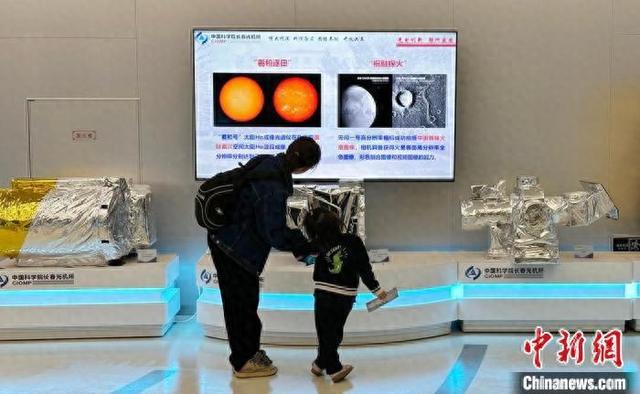
从“羲和号”到AI心理测评 新中国“光学摇篮”展示前沿成果
Huan Qiu Wang Zi Xun· 2025-05-17 08:22
Group 1 - The "Xihe" satellite, "Tianwen-1" camera, "Qiao Qiao II" extreme ultraviolet camera, and dual-wing vertical take-off and landing fixed-wing drones were showcased to the public at the Changchun Institute of Optics, Fine Mechanics and Physics [1][3] - The Changchun Institute of Optics, established in 1952, is recognized as the first optical research institution in New China, significantly contributing to the optical industry and talent cultivation [3][4] - The institute opened its key laboratories to the public, demonstrating advanced technologies such as in-orbit assembly of optical systems, which are not widely known [3][4] Group 2 - Volunteers at the institute performed science popularization activities, including experiments that illustrate scientific principles, aiming to inspire children’s interest in science [3][4] - The institute's affiliated enterprises presented various interactive technological products, including a "special visual inspection instrument" and an "AI psychological assessment device," which amazed visitors with its capabilities [3][4] - Researchers conducted multiple science popularization reports, emphasizing the importance of cultivating scientific spirit and culture among the youth [4]