制药和生物技术

Search documents
追踪研发领导力:美国优势缩小,中国步步为营
ITIF· 2026-02-11 08:43
R&D Investment Overview - In 2024, U.S. companies invested $675 billion in R&D, accounting for 52% of global investment, while Chinese companies invested $165 billion, representing 13% of the total[3] - Over the past decade, China has rapidly closed the gap, with four out of nine advanced industries now seeing higher R&D investments from Chinese firms compared to U.S. firms[3] Cost and Efficiency - China's R&D costs are approximately 20% lower than those in the U.S. when adjusted for wages[5] - Excluding software and biopharmaceuticals, Chinese companies' R&D investments in seven advanced industries have surpassed those of U.S. companies by 6%[6] Legislative Recommendations - To maintain competitiveness in advanced industries, Congress should triple funding for industry-academic research collaborations and increase simplified R&D tax credits from 14% to at least 28%[7] Global R&D Trends - The global R&D investment growth from 2014 to 2024 was 102%, with U.S. investments increasing by 150% and Chinese investments soaring by 537%[13] - The concentration of global R&D is shifting towards a binary world dominated by U.S. and Chinese firms, leaving other regions stagnant[4] Sector-Specific Insights - In the pharmaceutical and biotechnology sector, U.S. companies lead with 181 firms, while China has 149 firms in the electronics and electrical equipment sector[15] - By 2024, U.S. companies' share of global R&D in the automotive sector is projected to be 19%, while Chinese firms will account for 15%[82] Adjusted Investment Metrics - When controlling for GDP, U.S. companies invested $15.41 per $1,000 GDP in R&D, while Chinese companies increased their investment from $5.59 to $23.48 per $1,000 GDP from 2014 to 2024[20][24] - The location quotient (LQ) for Chinese companies in advanced industries rose from 0.7 to 1.5, while U.S. companies' LQ decreased from 1.8 to 1.7[12][42]
赛默飞世尔科技2026财年年报业绩会议总结
仪器信息网· 2026-01-15 08:59
Core Insights - The article discusses the performance and future outlook of Thermo Fisher Scientific, highlighting its strong market position and growth strategies for 2026 and beyond [3][19]. Financial Performance Analysis - No specific financial data is disclosed; the company plans to release its 2025 performance and 2026 guidance at the end of the month [4]. Key Growth Drivers - Revenue growth is driven by new product launches such as the Astral Zoom mass spectrometer and next-generation cryo-electron microscopes, alongside market share gains in the pharmaceutical and biotechnology sectors [5]. - Cost control measures through the PPI business system have led to exceeding a $300 million cost reduction target in 2025 [5]. - Capital deployment includes the acquisition of Solventum's purification and filtration business, the acquisition of Sanofi's production facility, and a $9 billion acquisition of Clario, with $3.6 billion returned to shareholders through buybacks and dividends [6]. Business Operations Overview - The pharmaceutical and biotechnology segment, which accounts for 56% of revenue, achieved mid-single-digit organic growth in the first nine months of 2025, outperforming industry standards [7]. - The bioproduction segment saw mid-teens organic growth, with strong demand for culture media and single-use technologies [7]. - The clinical research segment, as the second-largest CRO, experienced strong growth driven by accelerated drug development capabilities [7]. - The analytical instruments segment had low single-digit organic growth in 2025, with strong demand for core products like the Astral Zoom mass spectrometer [7]. Market Expansion - The U.S. market benefits from a trend of pharmaceutical reshoring, with the acquisition of Sanofi's New Jersey facility expanding sterile filling capacity [8]. - Increased confidence among pharmaceutical and biotechnology clients, along with improved funding in biotechnology, is driving industry demand growth [8]. R&D Investments and Outcomes - The company invests approximately $1.4 billion annually in R&D, launching several innovative products including the Astral Zoom mass spectrometer and scalable bioreactors [9]. Operational Efficiency - The PPI business system enhances cost reduction and productivity, successfully exceeding a $300 million cost reduction target in 2025 [10]. Future Outlook and Planning - Short-term goals for 2026 include executing growth strategies, launching impactful innovative products, and leveraging PPI and AI capabilities to enhance operational efficiency [12]. - Long-term strategies anticipate industry fundamentals improving, with organic growth expected to recover to over 7% by 2028 and beyond, driven by factors such as aging populations and advancements in life sciences [13]. Q&A Highlights - The company positions itself for 2026 as a year of significant opportunity, with a clear strategy and wise capital deployment [14]. - The CDMO business is expected to grow at a high single-digit rate, benefiting from reshoring and strong execution [16]. - The acquisition of Solventum is expected to enhance the product portfolio and contribute to mid-high single-digit organic growth [17]. - The basis for projected organic growth of 3%-6% in 2026-2027 is grounded in steady market improvements and market share growth [18]. Summary Remarks - The management emphasizes a focus on executing growth strategies through innovative products and operational efficiency improvements via the PPI business system and AI capabilities [19].



2025全球研发投入百强企业,华为、腾讯、阿里、比亚迪等中国企业上榜
Xin Lang Cai Jing· 2026-01-04 12:03
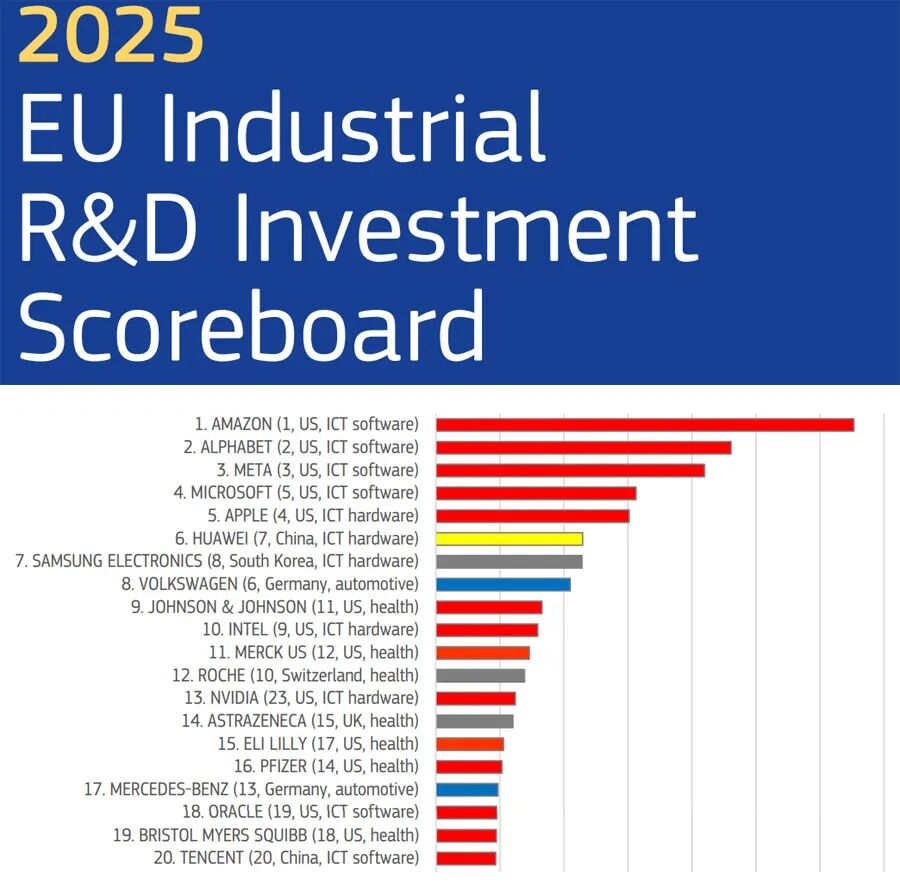
Group 1 - The European Commission released the "2025 EU Industrial R&D Investment Scoreboard," with Amazon ranking first for the first time, investing €65.318 billion in R&D for the 2024 fiscal year [1][8] - The top ten companies also include Alphabet, Meta, Microsoft, Apple, Huawei, Samsung, Volkswagen, Johnson & Johnson, and Intel [1][8] - The survey covered the 2,000 companies with the highest R&D investments globally, totaling €1,446.2 billion, with the US, China, EU, and Japan having the most companies on the list [1][8] Group 2 - The top 50 companies accounted for €633 billion in R&D spending, representing 44% of the total R&D investment [1][8] - Amazon's R&D investment as a percentage of net sales is 10.64%, while Alphabet's is 13.69%, and Meta's is 26.52% [4][12] - Huawei's R&D investment is €22.941 billion, with a net sales ratio of 20.18%, indicating a strong commitment to innovation [4][12]