
半导体储存

Search documents
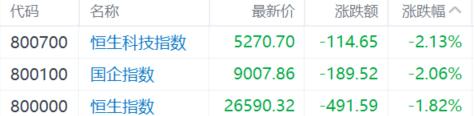
港股收评:三指齐跌!恒科指跌2.13%,权重科技股全线下挫
Ge Long Hui· 2026-02-24 08:43
Market Overview - The Hong Kong stock market experienced significant declines, with the Hang Seng Index dropping by 1.82% and the Hang Seng Tech Index falling by 2.13% due to fears of tariffs and geopolitical tensions, influenced by a sharp decline in US stocks [1][2] - Major financial stocks, including banks and insurance companies, showed weak performance, particularly in the insurance sector, which saw notable declines [2][3] Sector Performance - The financial sector, particularly insurance stocks, faced substantial losses, with China Life down over 6% and New China Life down over 5% [12][13] - The entertainment and tourism sectors also suffered, with China Duty Free Group experiencing a drop of over 10% following the loss of some operating rights at Shanghai Airport [10][11] - Conversely, the semiconductor sector saw gains, with companies like Zhaoyi Innovation rising by nearly 12% due to strong demand driven by AI [8][9] Specific Company Movements - Major tech stocks such as Meituan and Tencent saw declines of over 4% and 3.35% respectively, contributing to the overall market downturn [3] - In the oil and gas sector, companies like Shandong Molong and Sinopec Oilfield Services saw increases of over 11% and 5% respectively, driven by concerns over potential disruptions in global oil supply due to geopolitical tensions [4][5] Future Outlook - Analysts predict that the insurance sector may face pressure in Q4 due to a temporary pullback in growth stocks, although a recovery is expected as growth styles strengthen in 2026 [12][13] - The commercial vehicle market is anticipated to grow significantly, with a reported 19% year-on-year increase in sales in January 2025, driven by the rise of new energy vehicles [6]

大湾区大交通激活融合新范式 跨海上班 拥抱“深中同城”生活圈
Nan Fang Ri Bao Wang Luo Ban· 2025-12-19 08:17
Core Insights - The opening of the Shenzhen-Zhongshan Channel has significantly reduced commuting times, creating a new "Shenzhen living, Zhongshan working" lifestyle for many residents [1][2] - The channel has facilitated the establishment of a "deep integration" between Shenzhen's innovation-driven economy and Zhongshan's manufacturing base, fostering a new collaborative ecosystem [4][6] Group 1: Commuting and Lifestyle Changes - The Shenzhen-Zhongshan Channel has reduced commuting time from 2 hours to approximately 50 minutes, enhancing the feasibility of living in one city while working in another [1] - The channel has led to the emergence of a "Shenzhen living, Zhongshan working" demographic, with daily traffic exceeding 42 million vehicle trips by October 2025 [1] - Public transportation options have expanded, with two cross-city bus lines launched on the day the channel opened, averaging 15-20 minutes between buses and serving around 8,000 passengers daily [2] Group 2: Business Development and Innovation - Companies like Guochangrong and Jiangbolong have established new bases in Zhongshan, leveraging the channel for operational efficiency and strategic growth [2][4] - Jiangbolong's Zhongshan storage industrial park has become a critical part of its strategy, improving operational efficiency by approximately 30% since the channel's opening [4] - The collaboration between Shenzhen's tech firms and Zhongshan's manufacturing sector is fostering innovation, exemplified by the establishment of joint innovation labs [6] Group 3: Public Services and Community Integration - The "Shenzhen-Zhongshan service integration" initiative has streamlined public services, allowing residents to access over 620 cross-city administrative services, including healthcare and social security [7][8] - The establishment of community services in areas like Cuihu Community aims to enhance the living experience for new residents from Shenzhen and Hong Kong, promoting a sense of belonging [8]