
干电池制造

Search documents
【干货】干电池产业链全景梳理及区域热力地图
Qian Zhan Wang· 2026-02-26 03:08
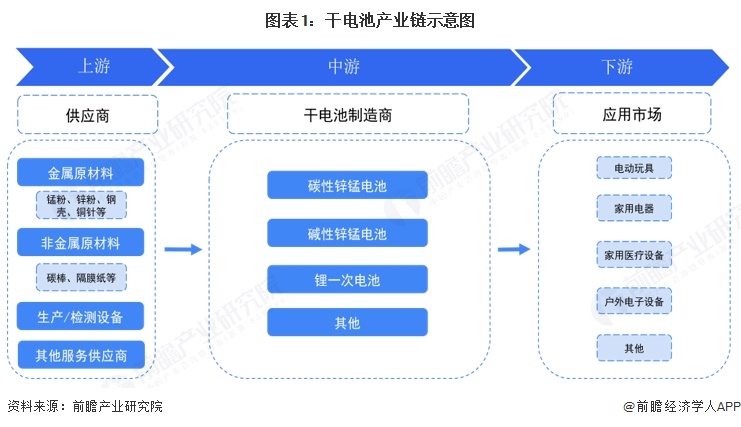
Core Insights - The article discusses the dry battery manufacturing industry in China, focusing on the supply chain structure, regional distribution of companies, and product offerings of key players in the market. Industry Overview - The dry battery supply chain consists of upstream suppliers of raw materials such as manganese dioxide powder, zinc powder, separator paper, steel shells, carbon rods, zinc tubes, and copper pins [1] - The downstream market for dry batteries is characterized by standardized products, with zinc-manganese batteries being widely used in everyday consumer electronics due to their affordability, safety, and reliability [1] Company Distribution - The dry battery industry is primarily concentrated in Guangdong and East China, with Guangdong having 1,841 related companies as of January 2026 [7] - Key manufacturers of dry batteries are mainly located in Eastern China, particularly in Guangdong and Zhejiang provinces, while raw material suppliers are more concentrated in Western China [8] Key Players and Products - Representative companies in the dry battery sector include Anfu Technology, Yema Battery, Zhejiang Hengwei, and Changhong Energy, with varying product offerings and sales strategies [11] - Yema Battery and Zhejiang Hengwei focus heavily on overseas markets, with foreign revenue accounting for 86.15% and 87.05% of their total income, respectively [13] - Anfu Technology and other companies have a more domestic focus, with Anfu's domestic revenue reaching 82.90% [13] Investment Trends - Recent investment activities in the dry battery manufacturing sector have been limited, primarily focusing on battery recycling and material optimization [14]



郁南县“十四五”发展成就新闻发布会举行
Nan Fang Nong Cun Bao· 2026-02-02 13:01
Core Viewpoint - The press conference highlighted the significant achievements of Yunan County during the "14th Five-Year Plan" period, emphasizing economic growth, social development, and infrastructure improvements [2][8]. Economic Development - Yunan County's total economic output increased by over 30% during the "14th Five-Year Plan" period, with per capita GDP projected to rise from 34,300 yuan in 2020 to approximately 45,000 yuan by 2025 [9][10]. - Industrial investment experienced an average annual growth rate exceeding 45%, and the total fixed asset investment doubled [10]. - The number of large-scale enterprises grew by over 30%, and local public budget revenue reached 6.134 billion yuan, nearly 1.5 times higher than during the "13th Five-Year Plan" [11][12]. Industrial Growth - The county focused on building an industrial development framework consisting of "one park, three areas, and one belt," aiming to cultivate five industrial clusters each worth over 10 billion yuan [14]. - The industrial output value in the Yunan Industrial Park increased by 310%, with three main industries (green building materials, chemicals, and dry batteries) accounting for over two-thirds of the total [15]. - The successful transfer of mining rights in the Chongwangling and Yuanzhu mining areas attracted over 27.2 billion yuan in total investment [16]. Social Development - The "Hundred-Thousand-Ten Thousand Project" significantly improved urban and rural development, with the county recognized as an "excellent" county for this initiative in 2023 [21][22]. - Infrastructure projects, including sewage treatment facilities, were advanced, enhancing the quality of life in the county [23]. - The county's forest coverage reached 73.15%, and air quality maintained a good rate of over 99.6% annually [29][30]. Innovation and Reform - Yunan County was selected as a pilot for county-town management system reform, enhancing grassroots governance efficiency [36][37]. - The county's innovation company became the first county-level industrial investment AA enterprise in Yunfu, raising 940 million yuan in social investment through the issuance of a 600 million yuan rural revitalization bond [38][39]. Public Welfare - Public spending on livelihoods increased by over 40% during the "14th Five-Year Plan," with 13,000 new school places created and significant improvements in rural education facilities [42][43]. - The county's healthcare model was promoted nationally, with the hospitalization rate rising to 86.5% [44].
