建筑设计与施工

Search documents
时空科技(605178.SH):收到1.41亿元中标通知书
Ge Long Hui A P P· 2025-12-18 10:40
Group 1 - The company, along with its partner Sichuan Yuanjing Architectural Landscape Design Research Institute, has won a bid for the "Xiushan Hong'an Biancheng Cultural and Tourism Integration Project" with a contract amount of 141 million yuan [1] - The total construction period for the project is set at 150 calendar days [1] - This project falls under the company's main business operations and is currently in the bidding stage awaiting contract signing, with significant uncertainty regarding its impact on the company's performance in 2025 and future accounting periods [1]

广东建科(301632.SZ):关联方中标子公司项目
Ge Long Hui A P P· 2025-11-21 09:34
Core Viewpoint - Guangdong JianKe (301632.SZ) announced that its wholly-owned subsidiary, Innovation Research Institute, has selected the design and construction general contractor for the "YueJianKe·Zhongshan Smart Hub Phase II Construction Project" through a public bidding process, adhering to principles of openness, fairness, and justice [1] Group 1: Project Details - The public bidding process followed legal procedures and the candidates were publicly announced, with no objections received during the announcement period [1] - The winning bid was awarded to a consortium led by JianGong Group and JianKe Design Institute, with a total bid price of 416.2175 million yuan (approximately 41.62 million) [1] - The bid includes a design fee of 7.548 million yuan and a construction fee of 408.6695 million yuan [1] Group 2: Related Parties - JianGong Group and JianKe Design Institute are subsidiaries of the company's controlling shareholder, Guangdong Provincial Construction Engineering Group Holdings Co., Ltd. (referred to as "JianGong Holdings") [1] - This transaction is classified as a related party transaction according to the Shenzhen Stock Exchange's rules for the Growth Enterprise Market [1]
激活乡村建筑的文化基因(侨界关注)
Ren Min Ri Bao Hai Wai Ban· 2025-11-07 01:08
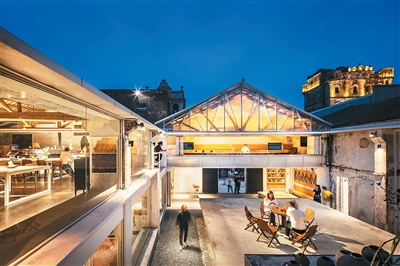
Core Viewpoint - The article highlights the journey of architect Chen Guodong, who, after studying and living in Japan, returned to China to focus on rural architecture, emphasizing the integration of traditional and modern building practices in rural revitalization efforts [1][2][3]. Group 1: Background and Education - Chen Guodong spent eight years in Japan, where he founded the architectural firm "Nameless Construction Society" in Kyoto [1]. - His interest in traditional architecture was sparked during high school, leading him to pursue further studies in Japan, where he focused on the fusion of traditional and modern architecture [2]. - He conducted extensive research on Japanese rural wooden structures and their applications in disaster recovery and rural revitalization [2]. Group 2: Transition to Rural Architecture - In 2017, Chen was inspired by the "Maogong Project," which aimed to preserve local culture and ecology while developing collective economies in rural areas [3]. - He accepted an invitation to work in the Miao and Dong Autonomous Prefecture of Qiandongnan, where he found a strong alignment with his research interests [3]. Group 3: Project Implementation and Challenges - Upon arriving in Maogong Town, Chen faced tight deadlines and limited resources, leading to a hands-on approach in designing and constructing buildings [4]. - He initiated the "Zhang Mo Master Plan" to collaborate with local craftsmen, enhancing the understanding of traditional wooden construction techniques [5]. Group 4: Community Engagement and Social Impact - The "For the People" initiative was launched to provide free housing designs for villagers, addressing the risk of losing traditional wooden structures to modern construction methods [5][6]. - The "Gui Liuyang House" project exemplified the integration of modern living needs with traditional architectural aesthetics, successfully enhancing the comfort of wooden structures [6]. Group 5: Expansion and New Opportunities - In 2020, Chen expanded his work to Tangkou Town in Guangdong, where he transformed an old grain station into a multifunctional workspace [7]. - The team discovered and collaborated with local artisans skilled in traditional crafts, such as "gray sculpture," to enhance their projects [7]. Group 6: Future Directions and Vision - The firm is currently working on a market renovation project aimed at balancing traditional functions with modern needs [8]. - Chen emphasizes the importance of creating spaces that attract young people and stimulate local economies, such as the "Youth Business Community" project [9]. - The company aims to establish a wooden construction industry base, inviting local craftsmen to participate and promote the global reach of Chinese wooden architecture [9].

让现代建筑更加体现中华美学精神
Ren Min Ri Bao· 2025-09-14 22:03
Core Viewpoint - The integration of Chinese aesthetics into modern urban architecture is essential for reflecting cultural identity and contemporary trends, as emphasized by Xi Jinping's remarks on architectural design management [1][2]. Group 1: Chinese Aesthetics and Urban Architecture - Chinese aesthetics, rooted in over 5,000 years of civilization, embodies unique philosophical and cultural values, influencing architectural styles in China [1]. - The goal is to combine the spirit of Chinese aesthetics with contemporary aesthetic pursuits, ensuring modern urban architecture retains historical charm while showcasing modern vitality [1][2]. Group 2: Innovative Design and Technology - The creative transformation and innovative development of Chinese aesthetics are crucial for urban architecture, requiring a deep understanding of its core values while avoiding superficial imitation of traditional forms [2]. - Modern technologies such as parametric design and intelligent construction should be utilized to integrate Chinese aesthetic elements with contemporary architectural functions, exemplified by the design of Beijing Daxing International Airport [2]. Group 3: Regional Cultural Integration - Urban architecture should reflect regional cultural characteristics, promoting local advantages while preserving the essence of Chinese aesthetics [3]. - Examples include the design philosophy of the 2022 Beijing Winter Olympics, which harmonized architecture with natural landscapes, showcasing the integration of architecture and environmental sustainability [3]. Group 4: International Exchange and Learning - An open and inclusive mechanism for cultural exchange is necessary to enhance the dialogue between Chinese architectural aesthetics and global architectural practices [4]. - Projects like the China-Laos Railway Vientiane Station illustrate the successful fusion of Chinese architectural elements with local cultural characteristics, reflecting cultural confidence and providing insights for future urban architecture [4].
海控·江东广场项目初露真容
Hai Nan Ri Bao· 2025-08-13 01:31
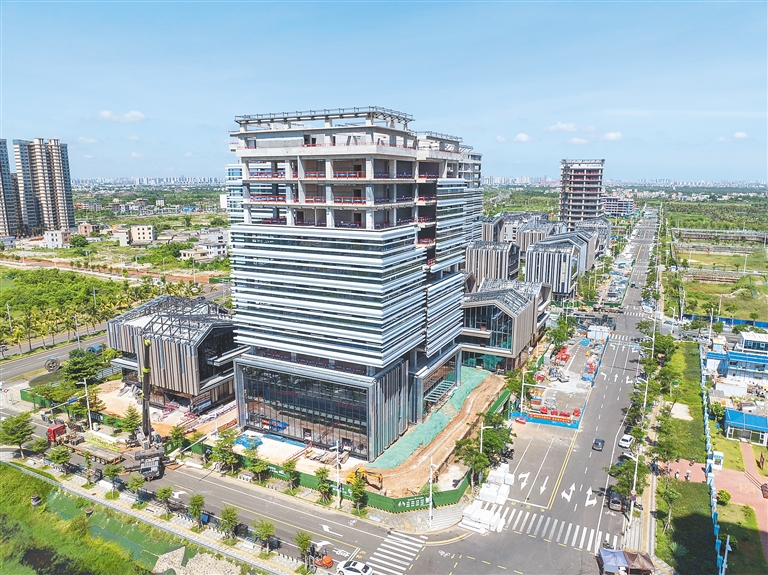
Core Insights - The Haikou Jiangdong Square project is rapidly progressing with curtain wall and electromechanical installations, showcasing its initial form [2] - The project covers a total construction area of approximately 138,000 square meters, with 85,000 square meters of above-ground space, including 21 multi-story office buildings and 4 high-rise standard office buildings [2] - Designed by the renowned German architectural firm GMP, the project adheres to international green low-carbon building standards, featuring ultra-low energy and nearly zero energy building designs [2] - The project incorporates advanced technologies such as rooftop photovoltaic power generation and high-performance curtain walls, aiming to create a "breathable building" and a green office experience, and has received the China Green Building Three-Star certification [2]