智慧医院

Search documents
从信息化到生态化:智慧医院行业商业模式创新与市场前景
2025-12-15 01:55
Summary of Key Points from Conference Call Records Industry Overview - The Chinese smart hospital industry is transitioning from a tool revolution to an ecological revolution driven by AI technology, which enhances medical service intelligence but faces challenges such as data acquisition difficulties and regional application imbalances [1][4] - The global smart hospital industry relies on deep penetration of AI technology to empower the healthcare sector, aiming to improve diagnostic efficiency and service quality while addressing resource shortages and aging populations [2] Core Insights and Arguments - AI large models have restructured the traditional AI medical framework, evolving from a simple structure to a multi-modal era that integrates various data types for comprehensive medical assistance [1][6] - The penetration rates of AI applications in economically developed regions significantly exceed those in less developed areas, with outpatient dispensing machines at 57.18% in developed regions compared to 28.38% in moderately developed regions [4] - The automated pharmacy market in China is projected to grow from 196.7 billion yuan in 2022 to 458 billion yuan by 2027, driven by new healthcare infrastructure policies and the pursuit of operational efficiency [13][14] Market Dynamics - The automated pharmacy market is segmented into hospital end, chain pharmacies, and centralized compounding centers, with the hospital end being the core segment, expected to reach 319.69 billion yuan by 2027 [15] - The penetration rates of automated pharmacies vary significantly across hospital tiers, with tertiary hospitals expected to reach 65% penetration by 2027, while secondary and primary hospitals lag behind [16] Competitive Landscape - The hospital information technology sector is highly competitive, with companies like Weining Health and Yilianzhong leading the market, focusing on various core areas such as HIS systems and public health management [17] - In the automated pharmacy sector, companies like Jianhui Information and Ailong Technology dominate, leveraging comprehensive coverage and customized solutions to maintain competitive advantages [18] Challenges and Opportunities - The smart hospital industry faces challenges in acquiring standardized and structured data, which remains a core pain point [2][4] - Despite a decline in overall investment enthusiasm since 2022, the AI healthcare sector continues to attract significant capital, indicating a focus on actual profitability and technological implementation [5] Additional Insights - Self-service terminals in hospitals have high usage rates for functions like report printing (84%) and payment (82.3%), significantly improving patient experience and operational efficiency [9] - Smart medical record management enhances service efficiency by digitizing traditional paper records, reducing resource consumption and improving data accessibility [11] Future Directions - The automated pharmacy industry is expected to evolve towards standardization and intelligence, with companies focusing on product innovation and expanding channel systems to maintain market share [19][20]
2025年中国智慧医院行业洞察:从工具革命到生态革命,卫宁健康、东华软件竞逐数字医院解决方案新蓝海
Tou Bao Yan Jiu Yuan· 2025-12-08 12:56
Investment Rating - The report does not explicitly state an investment rating for the smart hospital industry in China Core Insights - The smart hospital industry in China is transitioning from a tool revolution to an ecosystem revolution, with companies like Weining Health and Donghua Software competing in the digital hospital solution market [1] - The AI healthcare ecosystem is supported by infrastructure development and data collection, enhancing diagnostic efficiency and service quality to address issues like resource shortages and aging populations [4] - Despite a slowdown in overall healthcare investment since 2022 due to geopolitical tensions and more realistic technology expectations, the "AI + healthcare" sector continues to attract significant investment driven by demand and technology [4][10] Summary by Sections Research Purpose and Overview - The report aims to explore the market hotspots, sub-industry conditions, and competitive landscape of the smart hospital industry in China [2][3] Global and Chinese Smart Hospital Industry Development - The global smart hospital industry is experiencing rapid advancements in AI technology, leading to a shift towards intelligent, digital, and information-driven healthcare [5] - The Chinese smart hospital industry is characterized by a diverse range of players and significant potential for growth, particularly in AI integration and digital infrastructure [24] AI Healthcare Investment Environment - Investment in the AI healthcare sector peaked in 2021 with a total financing amount of 97.41 billion yuan and 380 financing events, but saw a decline in 2022 due to various global challenges [10][8] - The financing rounds for AI healthcare in China are primarily concentrated in early stages, with a shift towards later rounds as investors seek more certainty [12] Smart Hospital Information Technology Applications - New application technologies in hospitals, such as outpatient dispensing machines and AI in medical imaging, show significant regional disparities, with developed areas exhibiting over twice the application rates compared to less developed regions [14][15] - The integration of AI in hospital information systems is expected to increase, with software and service investments likely to rise as digital infrastructure improves [24] Automated Pharmacy Market - The penetration rate of automated pharmacies in China is currently low, but there is substantial potential for growth as healthcare infrastructure expands and AI technologies are further integrated [20][21] - Leading companies in the automated pharmacy sector are leveraging diverse product offerings and channel expansion to maintain market positions [26] Company Comparisons in Hospital Information Technology - The report provides a comparative analysis of key players in the hospital information technology sector, highlighting their strengths and areas of focus, such as Weining Health's comprehensive solutions in HIS systems and AI [24] Company Comparisons in Automated Pharmacy - A competitive landscape analysis of automated pharmacy companies reveals varying strengths, with companies like Jianhui Information and Ailong Technology leading in integrated solutions and market presence [26]


趋势研判!2025年中国智慧医院行业发展现状及整体形势分析:智慧医院已成为现代医疗体系的重要组成部分,市场规模保持增长趋势[图]
Chan Ye Xin Xi Wang· 2025-04-15 01:35
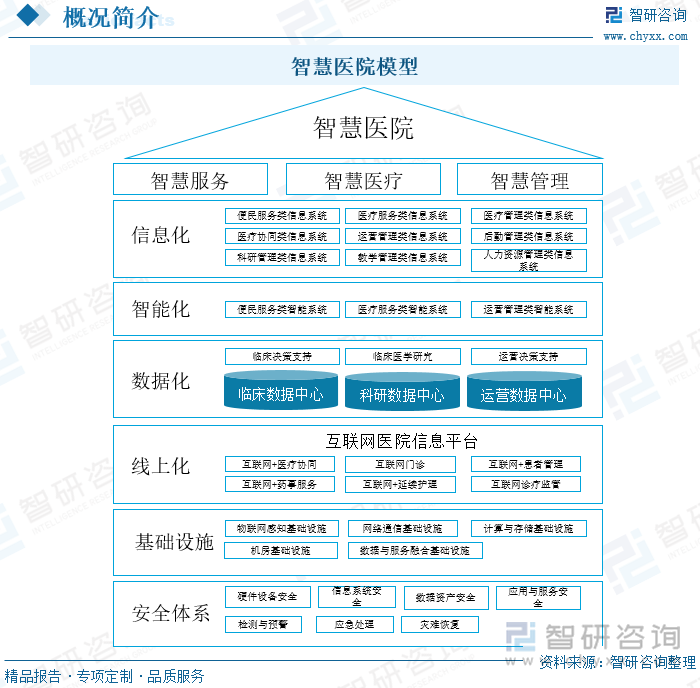
Core Insights - The core viewpoint of the articles emphasizes the significance of smart hospitals, which leverage advanced technologies such as cloud computing, big data, IoT, mobile internet, and artificial intelligence to enhance healthcare services and management efficiency [1][2][10]. Industry Overview - Smart hospitals integrate various technologies to create a connected and intelligent healthcare environment, optimizing medical resources and improving patient care [2][3]. - The market size for smart hospitals in China is projected to grow from 1.058 billion yuan in 2019 to 10.248 billion yuan in 2024, with an expected reach of 17 billion yuan by 2025 [10]. Industry Development Status - The healthcare sector in China is evolving from providing singular medical services to comprehensive health management platforms, driven by increasing patient demands and technological advancements [8][10]. - The construction of smart hospitals is crucial for the high-quality development of public hospitals and the reform of the healthcare system [10]. Industry Development Trends - The construction of smart hospitals is becoming essential for hospital transformation, requiring top-level planning, data integration, information security, and innovation [25]. - Future advancements in technology will further enhance the quality of medical services and improve patient experiences [25]. Industry Competitive Landscape - Key players in the smart hospital solutions market include companies like Weining Health, Shenzhen BlueLing Software, and several others, focusing on providing integrated digital solutions for healthcare [18][21][23]. - The industry is characterized by a variety of operational models, including single hospitals, multi-site management, and cloud-based smart hospitals, each tailored to specific organizational needs [5][7]. Industry Value Chain - The upstream of the smart hospital industry involves hardware like medical devices and software technologies such as AI, big data, and IoT, while the midstream focuses on solution integration, and the downstream includes application scenarios in various healthcare institutions [12].