智慧应急

Search documents
长江通信(600345.SH):公司不从事商业航天运营
Ge Long Hui A P P· 2025-12-26 15:21
Core Viewpoint - The company, Changjiang Communication (600345.SH), has reported unusual stock trading fluctuations, attributed to increased market interest in "commercial aerospace" and "satellite internet" concepts, leading to significant stock price increases in related sectors [1] Group 1: Company Overview - The company specializes in information technology services, focusing on smart emergency industries represented by public security and firefighting [1] - It provides digital application products and solutions, system integration, operation maintenance, and technical services [1] Group 2: Financial Impact - Revenue from the satellite internet sector constitutes a low percentage of the company's overall revenue, indicating no significant impact on the company's performance [1] - The company does not engage in commercial aerospace operations [1]

2连板长江通信:在卫星互联网领域的收入占整体营业收入的比例较低 不从事商业航天运营
Xin Lang Cai Jing· 2025-12-26 13:54
Group 1 - The core viewpoint of the article highlights that the recent capital market has shown increased attention to concepts such as "commercial aerospace" and "satellite internet," leading to significant stock price increases in related sectors [1] - The company primarily operates in the information technology services industry, focusing on smart emergency sectors represented by public security and firefighting, providing digital application products and solutions, system integration, operation maintenance, and technical services [1] - The company's revenue from the satellite internet sector constitutes a low percentage of its overall revenue, indicating that it does not have a significant impact on the company's performance [1] - The company does not engage in commercial aerospace operations [1]
2连板长江通信:不从事商业航天运营
Ge Long Hui A P P· 2025-12-26 13:37
Core Viewpoint - Changjiang Communication (600345.SH) has announced unusual stock trading fluctuations, with increased market attention on "commercial aerospace" and "satellite internet" concepts, leading to significant stock price increases in related sectors [1] Company Overview - The company primarily operates in the information technology services industry, focusing on smart emergency sectors represented by public security and firefighting [1] - It provides digital application products and solutions, system integration, operation maintenance, and technical services [1] Revenue Impact - The revenue from the satellite internet sector constitutes a low percentage of the company's overall operating income, indicating that it does not have a significant impact on the company's performance [1] - The company does not engage in commercial aerospace operations [1]
两连板长江通信:在卫星互联网领域的收入占整体营业收入的比例较低 不从事商业航天运营
Mei Ri Jing Ji Xin Wen· 2025-12-26 13:32
Core Viewpoint - The recent announcement by Changjiang Communication (600345) regarding abnormal stock trading fluctuations is linked to heightened market interest in "commercial aerospace" and "satellite internet" concepts, which have led to significant stock price increases in related sectors [1] Company Overview - Changjiang Communication primarily operates in the information technology services industry, focusing on smart emergency sectors represented by public security and firefighting [1] - The company provides digital application products and solutions, system integration, operation maintenance, and technical services [1] Financial Impact - Revenue from the satellite internet sector constitutes a low percentage of the company's overall operating income, indicating that it does not have a significant impact on the company's performance [1] - The company does not engage in commercial aerospace operations, further clarifying its business focus [1]
研判2025!中国智慧应急行业产业链、相关政策及市场规模分析:智慧应急乘数字化东风强势崛起,中国方案借"一带一路"赋能全球安全治理[图]
Chan Ye Xin Xi Wang· 2025-08-23 02:06
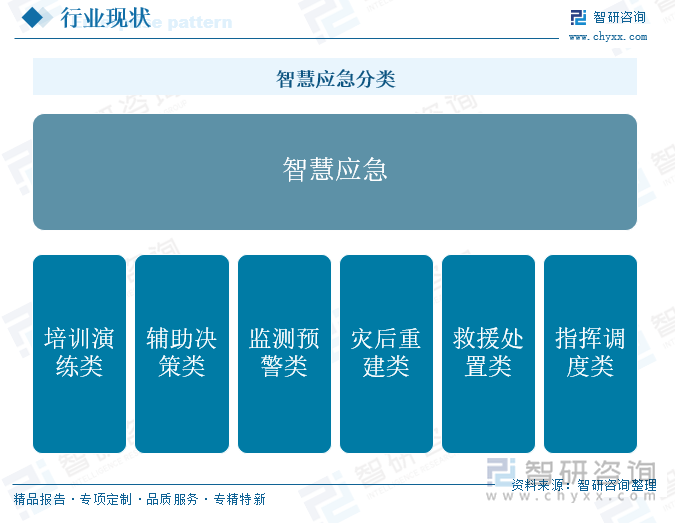
Core Viewpoint - The smart emergency industry in China is experiencing strong growth driven by digital transformation and increasing public safety awareness, with a projected market size of approximately 24.8 billion yuan in 2024, representing a year-on-year growth of 13.76% [1][12]. Industry Overview - Smart emergency refers to the use of modern information technologies (such as IoT, big data, cloud computing, and artificial intelligence) for the comprehensive management of emergency events, emphasizing efficiency and quality through information technology [1]. - The industry encompasses various segments including training, decision support, monitoring and early warning, post-disaster recovery, rescue operations, and command and dispatch [1]. Industry Value Chain - The upstream of the smart emergency industry includes hardware devices such as chips, sensors, electronic components, servers, drones, and robots, as well as software and technologies like operating systems, middleware, databases, cloud computing, big data, artificial intelligence, and digital twins [4]. - The midstream involves system integration and service, while the downstream applications are primarily in government and public services, industrial sectors, and urban communities [4]. Market Size - The smart emergency application industry in China is projected to reach approximately 24.8 billion yuan in 2024, with a year-on-year growth of 13.76%, driven by urbanization and the increasing frequency of natural disasters [12]. Key Companies' Performance - The competitive landscape of the smart emergency industry features a "leading enterprises + small and medium enterprises + cross-industry integration" model, with major players like Unicom Digital, Huawei, and Chen'an Technology holding significant market shares [14]. - Unicom Digital leads the smart emergency platform market, having connected 78% of provincial administrative regions through its national emergency management cloud platform [14]. - Chen'an Technology reported a revenue of 200 million yuan in Q1 2025, a year-on-year increase of 55.76%, while its net profit was -34 million yuan, up 41.32% [15]. - Tai Chi Technology's revenue in Q1 2025 was 1.396 billion yuan, a year-on-year decrease of 15.96%, with a net profit of 16 million yuan, down 0.42% [17]. Industry Development Trends 1. **Integration of Cutting-edge Technologies**: The smart emergency industry will accelerate technology integration, with advancements in virtual reality and quantum computing enhancing emergency management capabilities [19]. 2. **Innovation in Service Models**: New business models such as emergency insurance and social rescue will emerge, expanding the market space for emergency services [20]. 3. **Accelerated Globalization**: The globalization of China's smart emergency industry will enhance its international influence, with initiatives like the "Digital Silk Road" facilitating the export of monitoring and rescue systems [21].