智能变压器

Search documents
“十五五”智能变压器行业深度研究及趋势前景预判报告
Xin Lang Cai Jing· 2026-02-03 12:52
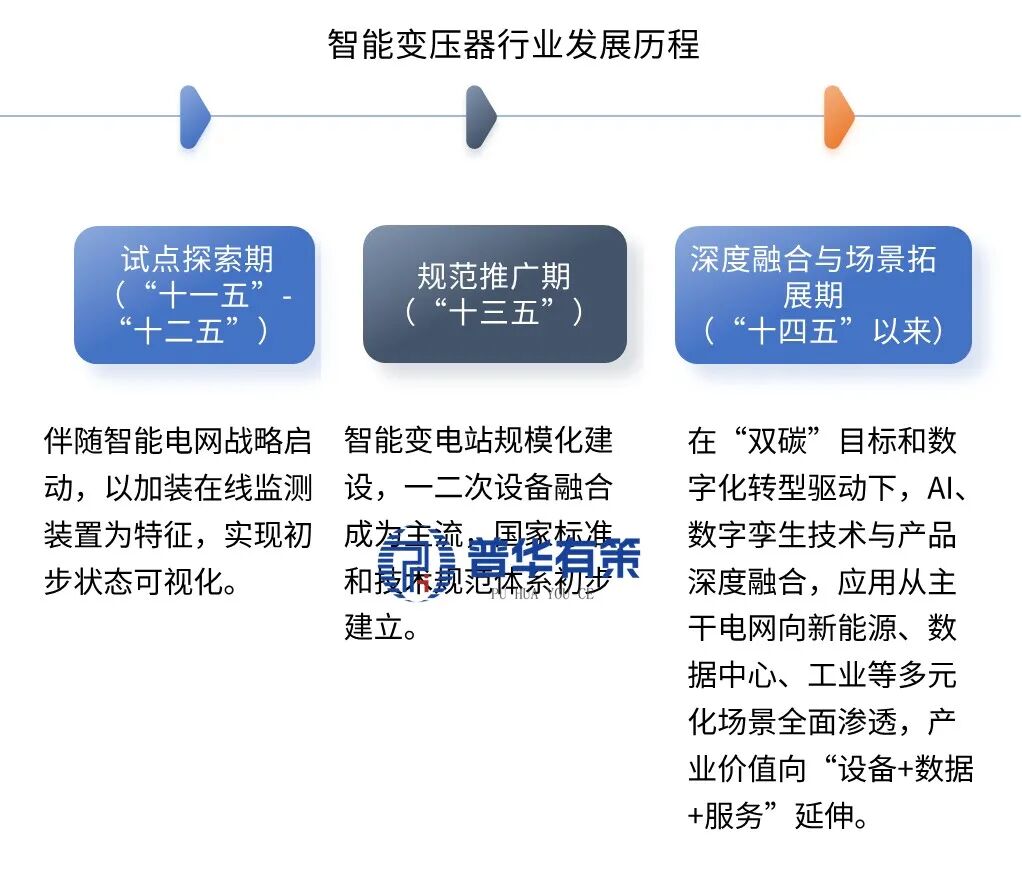
Industry Overview - The smart transformer is defined as an advanced power transformer that integrates sensors, intelligent electronic devices, and communication units, enabling comprehensive state perception, information interconnectivity, and autonomous control [1][24] - It serves as a crucial infrastructure for constructing a new power system, merging energy flow and information flow [1][24] Industry Development and Policy Support - Since the "14th Five-Year Plan," the smart transformer industry has experienced unprecedented policy support, with a focus on achieving "dual carbon" goals and constructing a new power system [4][24] - The 2025 Central Economic Work Conference emphasized the development of "new quality productivity," injecting confidence into the industry [4][24] Technology Level and Characteristics - The current technology level of smart transformers exhibits a "multi-layer iteration and cross-generation coexistence" characteristic, with traditional electromagnetic principle-based products dominating the market [5][24] - Key technological features include the integration of multi-physical quantity sensors, high-speed industrial Ethernet or fiber optic communication, and embedded intelligent terminals for local data analysis and remote interaction [5][24] Industry Chain Summary and Impact - The smart transformer industry chain is clear, with upstream including raw materials and core intelligent components, midstream focusing on design, manufacturing, integration, and testing, and downstream applications rapidly expanding into new energy generation and data centers [9][28] - Upstream technological advancements and supply stability are foundational for industry development, with the cost and performance of raw materials directly impacting product efficiency and market competitiveness [9][28] Core Driving Factors - National strategic policies are the most fundamental and enduring driving force, with the "dual carbon" goal establishing the ultimate direction for energy transformation [11][30] - The application of AI technology is transitioning from the periphery to the core, enhancing predictive maintenance and operational efficiency [12][31] - The recognition of the long-term value of smart transformers in reducing energy consumption and optimizing operational costs is increasingly acknowledged in the market [13][32]