汽车零部件及前件制造

Search documents
汽车电子龙头,比亚迪、蔚来“小伙伴”今日上市
2 1 Shi Ji Jing Ji Bao Dao· 2025-11-05 23:32
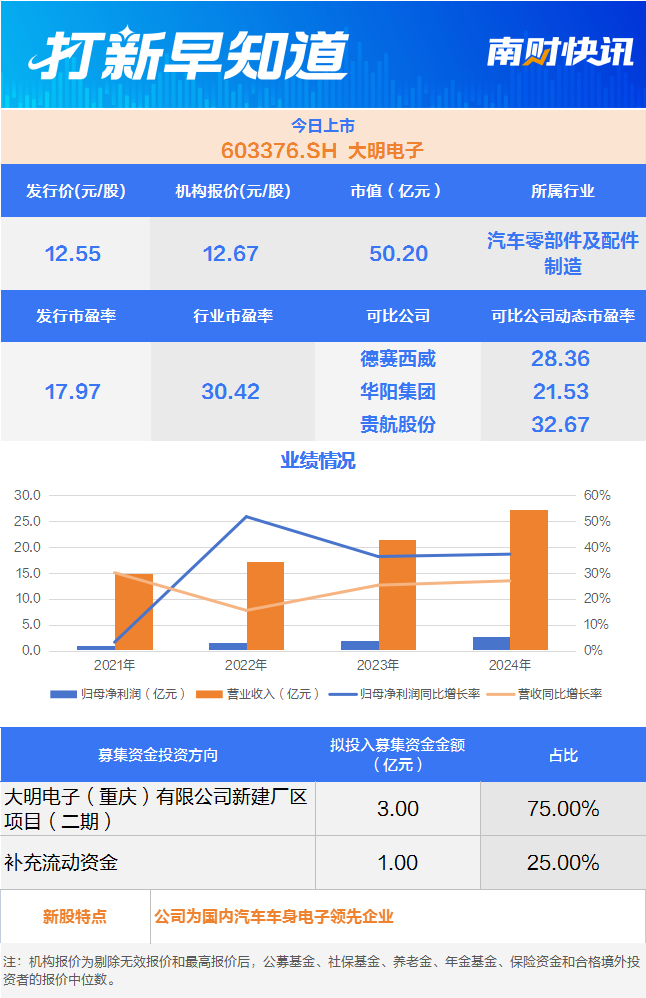
Core Viewpoint - Daming Electronics (603376.SH) has successfully listed on the Shanghai Stock Exchange, focusing on automotive body electronic control systems, and has established itself as a leading player in the domestic automotive electronics industry [1][2]. Company Overview - Daming Electronics was founded in 1989 and entered the automotive electronics field in 1993 with the development of a car audio volume potentiometer [1]. - The company offers comprehensive solutions for the design, development, production, and sales of automotive electronic control systems [1]. Financial Metrics - The initial offering price was 12.55 CNY per share, with an institutional quotation of 12.67 CNY per share, resulting in a market capitalization of 5.02 billion CNY [2]. - The company's earnings per share (EPS) is based on a price-to-earnings (P/E) ratio of 17.97, compared to the industry average P/E ratio of 30.42 [2]. Performance and Growth - Daming Electronics has developed five core product systems: driving assistance systems, cockpit central control systems, intelligent optoelectronic systems, window control systems, and seat adjustment systems [2][3]. - The company has established long-term stable partnerships with major automotive groups such as Changan Automobile, SAIC Group, and BYD, and is expanding its presence in the new energy vehicle sector [3]. Market Position - The company is one of the few in China capable of R&D and large-scale production of complete automotive body electronic control systems [2][3]. - By the first half of 2025, Daming Electronics anticipates achieving a market share of over 10% for key products like the driver window control assembly and front lamp assembly [3]. Challenges and Risks - The automotive parts industry is experiencing price declines due to increased bargaining power of downstream customers and a tradition of annual price reductions [4]. - Daming Electronics has reported fluctuations in its gross profit margin, projected at 20.91%, 20.65%, 21.09%, and 18.13% from 2022 to the first half of 2025, influenced by various cost factors [4].


汽车电子龙头,比亚迪、蔚来“小伙伴”今日上市丨打新早知道
2 1 Shi Ji Jing Ji Bao Dao· 2025-11-05 23:05
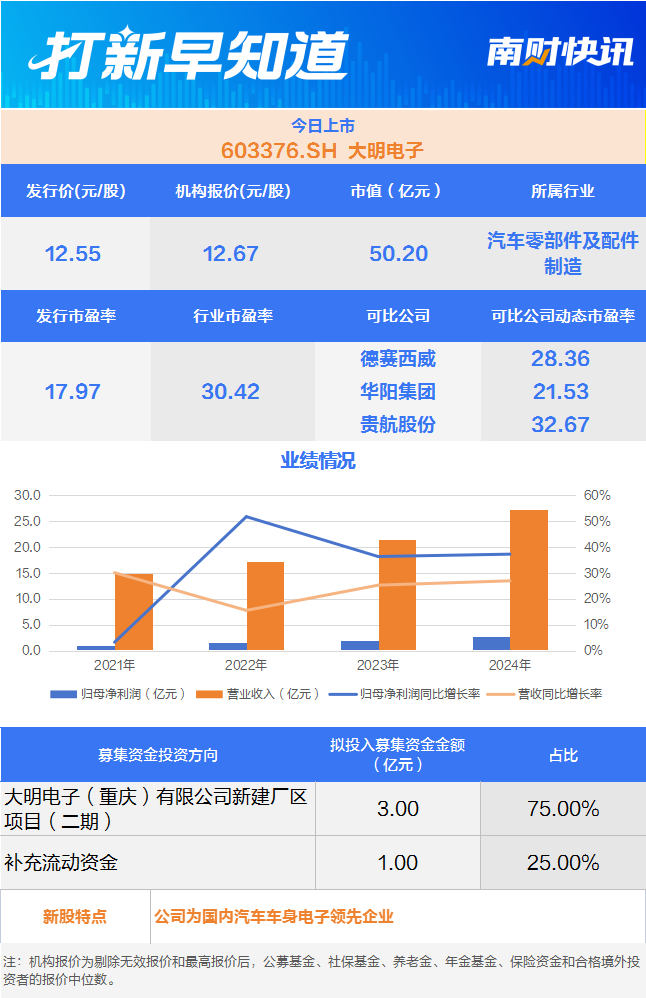
Core Viewpoint - Daming Electronics (603376.SH) has successfully listed on the Shanghai Stock Exchange, focusing on automotive body electronic control systems, with a history dating back to 1989 [1][2]. Company Overview - Daming Electronics provides comprehensive solutions for the design, development, production, and sales of automotive body electronic control systems [1]. - The company has established a core product system consisting of five major areas: driving assistance systems, cockpit central control systems, intelligent optoelectronic systems, window control systems, and seat adjustment systems [2][3]. Financial Metrics - The initial offering price was 12.55 CNY per share, with an institutional quotation of 12.67 CNY per share, resulting in a market capitalization of 5.02 billion CNY [2]. - The company's earnings per share (EPS) is based on a price-to-earnings (P/E) ratio of 17.97, compared to the industry average P/E of 30.42 [2]. - The projected net profit for 2021, 2022, and 2023 is expected to show significant growth, with a focus on increasing revenue [2]. Investment Plans - Daming Electronics plans to invest 3 billion CNY (75%) in the construction of a new factory in Chongqing and 1 billion CNY (25%) to supplement working capital [2]. Client Relationships - The company has established long-term stable partnerships with major domestic automotive groups, including Changan Automobile, SAIC Group, FAW Group, and BYD [3]. - Daming Electronics is expanding its product applications in the new energy vehicle sector, successfully collaborating with several popular brands [3]. Market Position - The company anticipates achieving a domestic market share of over 10% for key products by the first half of 2025 [3]. Risks and Challenges - Daming Electronics faces risks related to product price fluctuations and declining gross margins due to the automotive industry's maturity and increasing bargaining power of downstream customers [4]. - The company has noted potential impacts on gross margins from various factors, including price reduction policies, changes in product sales structure, and rising operational costs [4].