海上风电产业

Search documents
最高法发布《中国海事审判(2022-2024)》报告
Xin Hua She· 2025-12-18 11:05
Core Insights - The Supreme People's Court released the report "China Maritime Trial (2022-2024)", summarizing the role of maritime trials in supporting the construction of a maritime power and high-level opening-up [1][2] Group 1: Case Statistics - From 2022 to 2024, maritime courts across the country accepted 98,726 maritime cases and concluded 97,140 cases [1] - Among these, 71,705 were maritime commercial cases, with 70,759 concluded; 5,477 were maritime administrative cases, with 5,482 concluded; 21,359 were maritime enforcement cases, with 20,706 concluded; and 185 were maritime criminal cases, with 193 concluded [1] - The courts accepted 6,823 foreign-related cases, concluding 6,071, and 1,226 cases related to Hong Kong, Macau, and Taiwan, with 1,134 concluded [1] Group 2: Judicial Functions and Support - Maritime courts actively exercise judicial jurisdiction to maintain national sovereignty and maritime rights, while promoting the stable development of international trade [2] - The courts provide strong judicial services and guarantees for the high-quality development of modern shipping, offshore wind power, shipbuilding, and advanced marine equipment manufacturing [2] - The courts support environmental public interest litigation and promote a comprehensive marine ecological protection framework [2]
“短板”破万亿,沿海大省再踩油门
Mei Ri Jing Ji Xin Wen· 2025-09-16 14:48
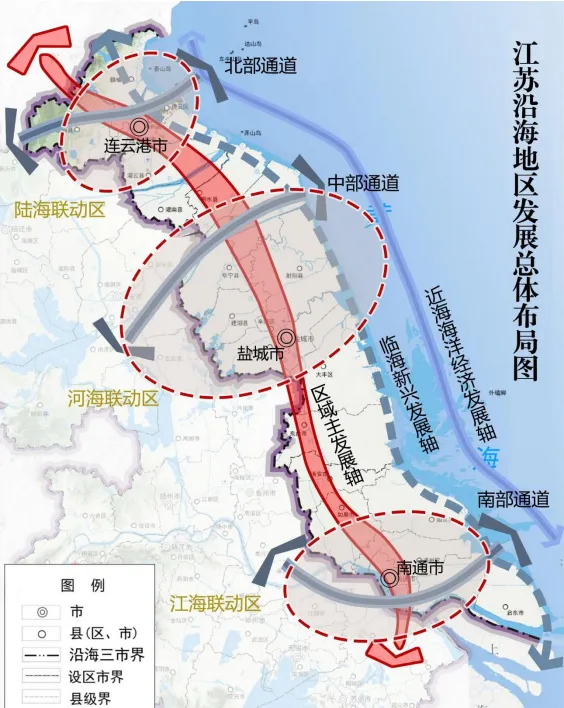
Core Viewpoint - Jiangsu province is focusing on enhancing its coastal economic development to leverage its marine resources and improve its position in the national marine economy landscape, as it has lagged behind other provinces despite its rich marine resources and strategic location [1][3][4]. Economic Overview - The national marine economy is projected to exceed 10 trillion yuan in 2024, accounting for 7.8% of the GDP, with Jiangsu's marine economy recently surpassing the 1 trillion yuan mark, reaching 10046.2 billion yuan [1][4]. - Jiangsu ranks sixth in marine economic output among provinces, trailing behind Guangdong, Shandong, Fujian, Zhejiang, and Shanghai [1][4]. Development Challenges - Jiangsu's coastal cities (Nantong, Yancheng, Lianyungang) account for nearly one-third of the province's land area and about one-quarter of its population, yet their GDP contribution is only 18.1%, falling short of the 20% target set for 2025 [3][4]. - The marine economy's contribution to Jiangsu's GDP is only 7.3%, which is below the national average and significantly lower than Guangdong's marine economic output [9]. Industry Structure - Jiangsu's marine economy is heavily weighted towards secondary industries, with insufficient development in the tertiary sector, particularly in marine services [9][10]. - The province has a strong foundation in traditional marine industries, such as shipbuilding and marine engineering, leading the nation in several key metrics [11]. Transformation and Innovation - The provincial government is emphasizing technological innovation as a key driver for transforming the marine industry, aiming to establish Jiangsu as a hub for marine economic development and technology transfer [10][12]. - The "14th Five-Year Plan" for marine economic development outlines the need for a modern marine industry system, focusing on traditional industry transformation and the enhancement of emerging industries [10]. Regional Collaboration - Jiangsu's coastal cities need to identify and amplify their comparative advantages to enhance their contributions to the marine economy [15][16]. - The recent coastal and marine spatial planning aims to create a cohesive development framework, promoting collaboration among the three coastal cities to optimize resource allocation and enhance overall competitiveness [18][22].