
电子回收

Search documents
深圳市安胜电子回收有限公司成立 注册资本50万人民币
Sou Hu Cai Jing· 2025-12-17 05:41
Group 1 - Shenzhen Ansheng Electronic Recycling Co., Ltd. has been established with a registered capital of 500,000 RMB [1] - The legal representative of the company is Li Zefeng [1] - The company's business scope includes general operations such as recycling of renewable resources (excluding production waste metals), sales of renewable resources, and processing of non-metal waste and scraps [1] Group 2 - The company is authorized to handle specific projects, including the treatment of waste electrical and electronic products, recovery of scrapped vehicles, and dismantling of scrapped vehicles [1] - The company will operate under the principle of conducting business activities independently based on its business license, except for projects that require approval from relevant authorities [1]
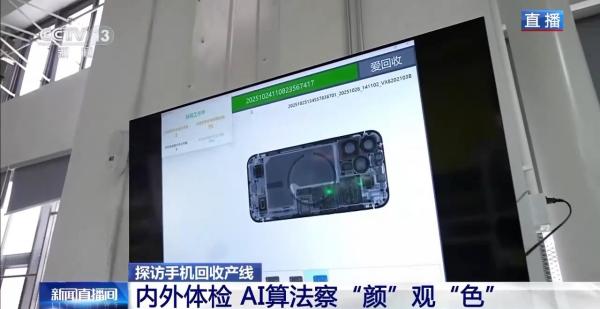
AI算法察“颜”观“色” 来看旧手机的“重生考核”
Yang Shi Xin Wen· 2025-11-03 07:47
Core Insights - The production of mobile phones in China reached 961 million units in the first eight months of the year, with 758 million being smartphones, reflecting a year-on-year growth of 1% [1] Group 1: Mobile Phone Recycling Process - The automated operation center in Dongguan processes old mobile phones through a 100-meter long automated production line, where each phone is assigned a unique QR code for tracking [1] - The phones undergo X-ray inspection to assess internal components without disassembly, completing the process in just 7 seconds [1] - A 360-degree photo capture system evaluates the phone's exterior condition, achieving a precision of 24 microns and a quality inspection accuracy of over 99.5% [1][3] Group 2: Functionality and Health Assessment - The "function diagnosis room" tests over 70 indicators, including camera functionality, microphone performance, battery health, and charging speed, using robotic arms to simulate human interaction [5] - Each phone receives a comprehensive "health record," allowing for accurate grading based on extensive data, which helps match different quality levels to market demands [5] Group 3: Economic and Environmental Impact - The automation in the recycling process has reduced the comprehensive quality inspection cost per phone by 30% and cut labor costs by 80% [7] - China generates over 400 million old mobile phones annually, and effective recycling can recover valuable resources while preventing electronic waste, contributing to a multi-billion dollar second-hand market [9]

美媒:报告称,东南亚成美国电子垃圾倾倒场
Huan Qiu Shi Bao· 2025-10-23 22:45
Core Insights - The report by Basel Action Network (BAN) reveals that millions of tons of electronic waste from the U.S. are exported annually to Southeast Asian developing countries lacking safe disposal capabilities [1] - The phenomenon is termed an "invisible electronic waste tsunami," highlighting the secretive export of U.S. electronic waste under harmful conditions while generating profits for the electronic recycling industry [1] - Approximately 2,000 containers (around 33,000 tons) of electronic waste are shipped from U.S. ports each month [1] Industry Impact - Many containers carrying electronic waste are sent to countries that have banned such imports under the Basel Convention, which aims to prevent the transboundary movement of hazardous waste, especially to developing nations [1] - To evade international regulations, these shipments are often misdeclared as "raw materials" or "recyclables" rather than actual electronic waste [1] - The rapid turnover of electronic products has led to a global increase in electronic waste at a rate five times faster than the capacity for formal recycling [1] Future Projections - In 2022, global electronic waste reached a record of 62 million tons, with projections indicating an increase to 82 million tons by 2030 according to the International Telecommunication Union (ITU) [1]