
电梯制造与维保

Search documents
2024年全国41起电梯事故致27死
Xin Lang Cai Jing· 2026-01-09 11:29
Core Viewpoint - The article highlights the significant safety risks associated with aging elevators in China, particularly those over 15 years old, and emphasizes the need for improved maintenance and regulatory oversight to prevent accidents and ensure public safety [1] Group 1: Elevator Safety Concerns - There are over 1.1 million elevators in China that are over 15 years old, contributing to public safety hazards due to mechanical wear and aging electronic components [1] - In 2024, there were 41 elevator accidents resulting in 27 fatalities, with over 30% of special equipment accidents related to elevators [1] Group 2: Maintenance Challenges - The cost of maintaining older elevators increases significantly, leading to challenges in funding repairs, which often require contributions from homeowners [1] - Issues such as inadequate maintenance practices, including "repair instead of maintenance" and falsified records, exacerbate safety risks [1] Group 3: Regulatory and Technological Responses - The government has included over 160,000 aging residential elevators in a special bond subsidy program, with funding amounting to 24 billion yuan, to address maintenance issues [1] - Innovative solutions, such as assigning unique QR codes to each elevator for tracking maintenance history and implementing smart monitoring systems, are being explored to enhance safety [1]
电梯维保责任不可悬空
Xin Lang Cai Jing· 2025-12-23 23:14
Group 1 - The core point of the article highlights a concerning trend in elevator safety, with 41 elevator accidents reported in 2024, resulting in 27 fatalities, indicating that over 30% of special equipment accidents are related to elevators [1] - The National Market Supervision Administration plans to eliminate the rigid requirement of "maintenance every 15 days," shifting to a "demand-based maintenance" approach, emphasizing that "demand-based" does not equate to "less maintenance" [1] - There is a call to strengthen corporate responsibility, urging elevator manufacturers to enhance quality traceability obligations and maintenance units to strictly adhere to maintenance regulations, utilizing technologies like IoT and facial recognition for traceability and supervision [1]
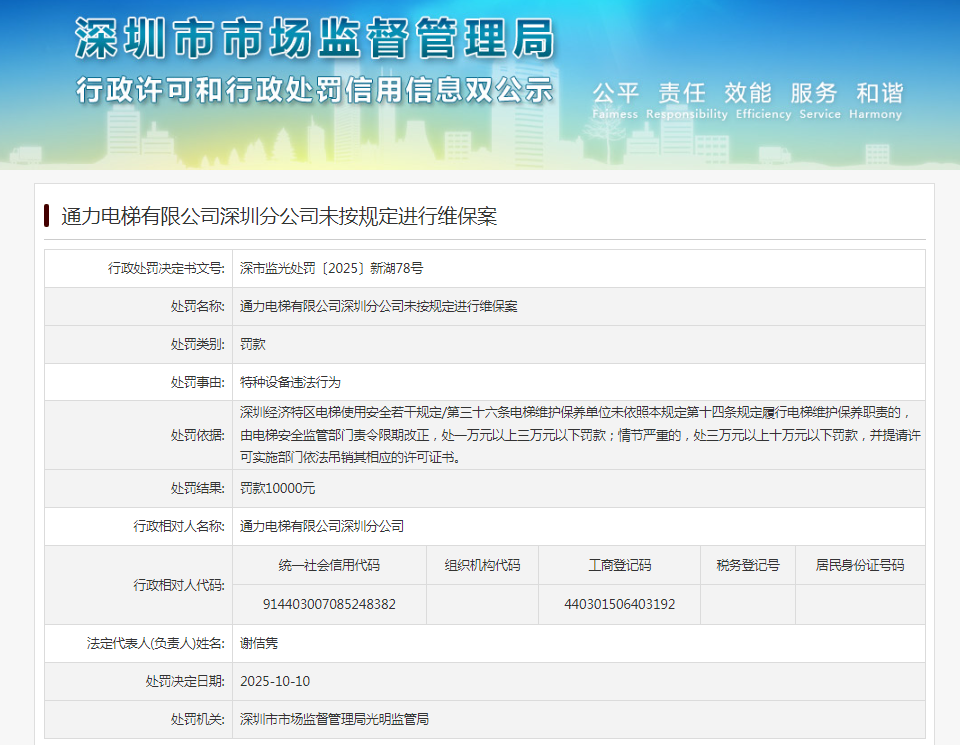
未按规定进行维保,通力电梯深圳分公司被罚
Qi Lu Wan Bao· 2025-10-11 09:07
Core Viewpoint - KONE Elevator Co., Ltd. Shenzhen Branch received a fine for failing to comply with maintenance regulations for special equipment, highlighting regulatory scrutiny in the elevator industry in China [1][3]. Company Overview - KONE Elevator Co., Ltd. was established in 1910 and reported a revenue of €11.1 billion in 2024, with operations in over 60 countries [3]. - The company ships an average of over 750 units daily and maintains over 1.7 million units globally [3]. - The Chinese market is KONE's largest single market, accounting for over 20% of its global sales in the 2024 fiscal year [3]. Regulatory Action - The Shenzhen Market Supervision Administration imposed a fine of 10,000 yuan on KONE Elevator Shenzhen Branch for not adhering to maintenance regulations [2][3]. - The administrative penalty was based on the Shenzhen Special Economic Zone Elevator Safety Regulations, which stipulate fines for non-compliance with maintenance responsibilities [2][3].

市场监管总局发布通知 加强住宅老旧电梯更新安全监管
Zheng Quan Ri Bao· 2025-06-11 13:41
Group 1 - The core viewpoint of the article is the implementation of a notification by the National Market Supervision Administration to enhance the safety and convenience of residential old elevator updates through special government bond funding [1][2]. - The notification emphasizes the responsibility of elevator manufacturers to provide high-quality, reasonably priced, and well-supported elevator products for the updating of old residential elevators [1][2]. - Local market supervision departments are required to collaborate with relevant authorities to guide property owners in determining management and maintenance units before the implementation of elevator update projects [2]. Group 2 - The notification outlines the need for clear management responsibilities, where property owners must designate responsible personnel for elevator safety management when entrusting management to property service units [2]. - It stresses the importance of establishing maintenance service requirements, including the signing of maintenance contracts that specify the frequency of maintenance, emergency response times, and the rights and obligations of both parties [2]. - The notification encourages the use of technological safety measures, such as equipping updated elevators with reliable electric bicycle intelligent blocking systems to mitigate residential safety hazards [2].