肿瘤医院

Search documents
1元甩卖股权!肿瘤医院无人接盘
Xin Lang Cai Jing· 2026-01-02 13:16
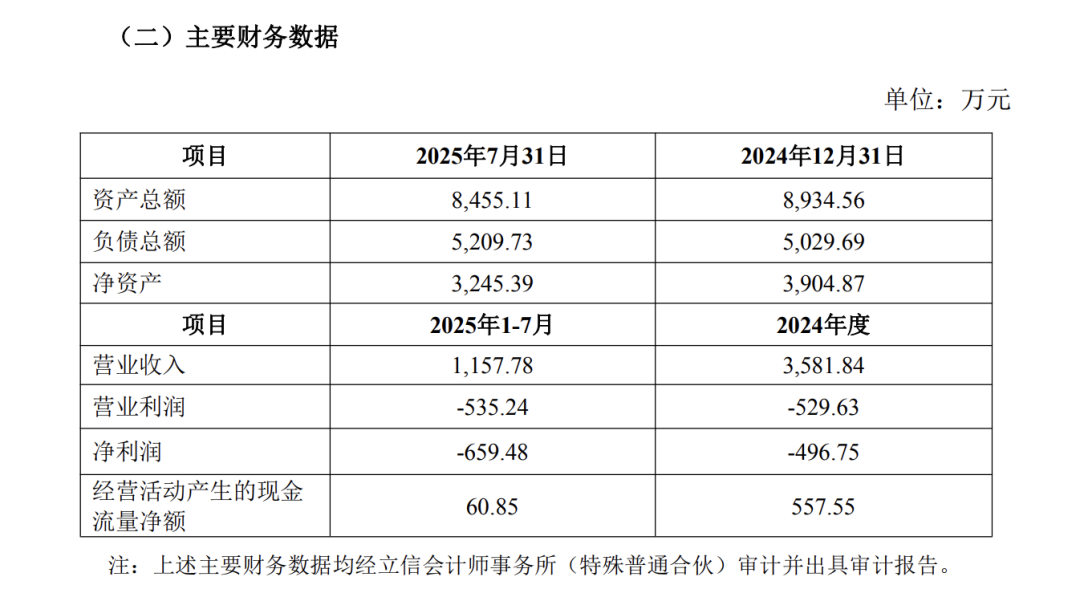
Core Viewpoint - Yonghe Intelligent Control is attempting to publicly transfer 100% equity of Kunming Medical Oncology Hospital for a base price of 17 million yuan, marking the fourth attempt to sell this asset after previous unsuccessful attempts at higher prices [1][2]. Group 1: Financial Performance - Kunming Medical Oncology Hospital has consistently reported losses since its establishment in 2017, with a total loss of 4.97 million yuan in 2024 and an increased loss of 6.59 million yuan from January to July 2025 [1][2][3]. - The hospital's total assets as of July 31, 2025, were 84.55 million yuan, with total liabilities of 52.10 million yuan, resulting in net assets of 32.45 million yuan [2]. - The operating revenue for the first seven months of 2025 was 11.58 million yuan, while the operating profit was -5.35 million yuan, indicating ongoing financial struggles [2]. Group 2: Acquisition and Investment Strategy - Yonghe Intelligent Control acquired Kunming Medical Oncology Hospital in 2020 for 108 million yuan, as part of a broader strategy to expand into the healthcare sector [1][6]. - The company planned to establish a network of 50 oncology specialty hospitals across China, with initial investments estimated between 50 million to 70 million yuan per hospital [6][9]. - The company has also attempted to transfer stakes in other hospitals, with the latest transfer price for 70% of Liangshan High-tech Oncology Hospital set at 1.87 million yuan, and stakes in Dazhou and Xi'an Medical Oncology Hospitals listed for only 1 yuan [1][2]. Group 3: Market Context and Challenges - The oncology hospital sector in China has significant revenue potential, with total income for oncology hospitals reaching 104.99 billion yuan in 2022, averaging 656 million yuan per hospital [3][9]. - Despite the high demand for oncology services, Yonghe Intelligent Control's strategy of relying on equipment rather than clinical expertise has proven ineffective, as the company has faced challenges in patient acquisition and operational management [9][11]. - The competitive landscape for private oncology hospitals is tough, with many struggling to achieve profitability, highlighting the difficulties in the healthcare market [9][11].


2025-2030年中国肿瘤医院行业深度调研及投资战略分析报告
Sou Hu Cai Jing· 2025-06-10 06:17
Overview - The report provides a comprehensive analysis of the cancer hospital industry in China, including its classification, regulatory framework, and current standards [2][3]. Industry Definition - The cancer hospital industry encompasses various services related to cancer diagnosis, treatment, and research [2]. - It is classified under specific codes in the National Economic Industry Classification [2]. Regulatory Framework - The industry is governed by several regulatory bodies and self-regulatory organizations in China [2]. - There is an ongoing effort to establish a standard system for cancer hospitals [3]. Current Status of Healthcare in China - The healthcare industry in China is characterized by a "low-level, broad coverage, and high efficiency" model [3]. - There are significant disparities in healthcare access between urban and rural areas [3]. Supply and Demand Analysis - The report analyzes the development of medical institutions, including the number of facilities and healthcare personnel [3]. - It highlights the increasing demand for cancer treatment services due to rising cancer incidence rates [3]. Market Competition - The competitive landscape of the cancer hospital industry is analyzed, including the entry of new players and resource allocation among existing competitors [4]. - The report employs Porter's Five Forces model to assess the competitive dynamics within the industry [4]. Regional Development - The report examines the development of cancer hospitals in key regions such as Beijing, Shanghai, and Guangdong, focusing on population demographics, income levels, and healthcare spending [8][9][10]. Investment Opportunities - The report identifies potential investment opportunities in the cancer hospital sector, particularly in urban areas with high cancer incidence [12][14]. - It discusses the importance of financing mechanisms, including leasing for medical equipment [14]. Future Trends - The industry is expected to move towards specialized and individualized cancer treatment approaches [14]. - The report emphasizes the need for continuous innovation and adaptation to changing healthcare policies and market demands [14].