视力矫正

Search documents
造富神话来袭!暴涨733%,港股新股炒疯了,逻辑在哪?
Ge Long Hui· 2025-10-01 15:56
Core Viewpoint - The stock of Aodima Automotive has surged significantly, with a rise of 239% to HKD 2, leading to a market capitalization exceeding HKD 1.7 billion, reflecting a more than 730% increase since its listing three days ago [1]. Company Overview - Aodima Automotive is a one-stop automotive after-sales service provider based in Singapore, focusing on inspection, maintenance, and repair services [1]. - According to a Frost & Sullivan report, Aodima ranks first among independent automotive after-sales service providers in Singapore, holding an approximate market share of 8.4% based on revenue generated in 2018 [1]. - The company's revenue for the years 2016 to 2018 was reported as SGD 16.335 million, SGD 18.641 million, and SGD 17.985 million, respectively, with profits of SGD 1.429 million and SGD 1.906 million in 2016 and 2017, but a loss of SGD 0.243 million in 2018 [1]. Market Activity - The public offering of Aodima Automotive was significantly oversubscribed, with a subscription rate of approximately 28.18 times the initial offering [1]. - The recent trend in the Hong Kong stock market has seen a surge in new stocks, with Aodima Automotive's stock price increasing by 733% since its listing [8][9]. - Other new stocks in October have also experienced substantial gains, contributing to a favorable market sentiment for new listings [8]. Investor Sentiment - Some investors expressed regret over not holding onto their shares, indicating a strong emotional response to the stock's rapid increase [2][4]. - There are mixed sentiments among investors, with some anticipating further price increases, while others are cashing out at high prices [5][7].


研判2025!中国视力矫正行业产业链、发展现状、细分市场、竞争格局及发展趋势分析:技术迭代与国产替代加速,行业迈向千亿智能健康管理新时代[图]
Chan Ye Xin Xi Wang· 2025-07-22 01:14
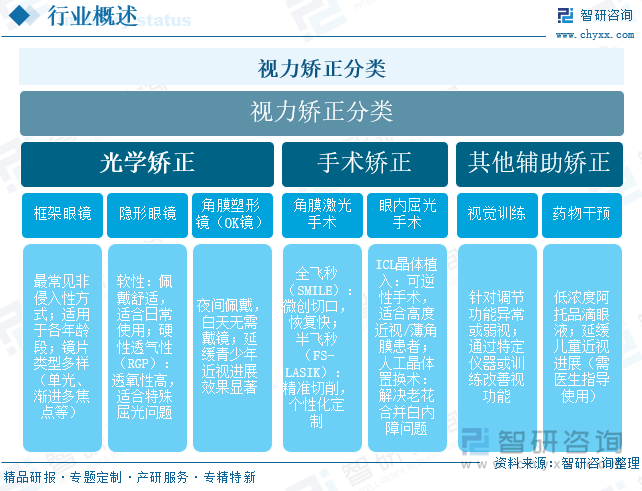
Core Insights - The vision correction industry in China is experiencing rapid growth driven by policy support, market demand, and technological innovation [1][5][22] - The market size is projected to reach 215 billion yuan in 2024, with a year-on-year growth of 11.6% [1][14] - The industry has established a comprehensive treatment system combining surgical and optical correction methods [1][10] Policy Support - The Chinese government has implemented a series of policies to enhance eye health, including the "Comprehensive Prevention and Control of Myopia in Children and Adolescents Implementation Plan" [5][7] - Policies aim to create a management system covering prevention, treatment, and rehabilitation, promoting standardized and high-quality development in the industry [5][22] Market Demand - The number of myopic individuals in China has surpassed 600 million, with a significant increase in myopia rates across all age groups [8][12] - The myopia rate among high school students exceeds 80%, and projections suggest that the rate for the 16-24 age group may reach 94% [8][12] - This growing patient base provides a continuous driving force for the industry's development [1][8] Industry Structure - The vision correction industry has formed a complete industrial chain, with upstream focusing on optical materials and high-end equipment, while midstream includes the production of glasses and surgical devices [10][20] - The downstream market is served by medical institutions, optical centers, and e-commerce platforms, with private eye hospitals contributing over 60% of refractive surgeries [10][12] Competitive Landscape - The industry features a multi-layered competitive structure, with foreign brands dominating high-end markets while domestic brands accelerate their presence [20][21] - Key players include Aier Eye Hospital, Aibo Medical, and Opcon Vision, each with distinct market positions and strategies [21][20] Future Trends - The industry is expected to continue expanding due to policy-driven demand and technological advancements, with a focus on full-cycle management of eye health [22][24] - Innovations such as AI-assisted surgeries and domestic alternatives to imported products are reshaping the competitive landscape [24][25] - The trend towards service accessibility is being driven by private institutions expanding into lower-tier cities and the growth of online sales channels [25][22]