量子材料研究

Search documents
实验揭示赝能隙态潜藏磁性有序结构 为理解高温超导起源提供关键线索
Ke Ji Ri Bao· 2026-01-20 01:39
Core Insights - Physicists at the Max Planck Institute for Quantum Optics have experimentally revealed magnetic ordered structures hidden in pseudogap states, providing crucial insights into the origins of high-temperature superconductivity [1] Group 1: Research Findings - The study indicates that superconductivity is not directly derived from conventional metallic states but first enters a peculiar intermediate state known as the pseudogap state, where electron behavior is abnormal and available energy states are reduced [1] - The research team utilized a cold atom quantum simulator to construct the Fermi-Hubbard model with lithium atoms, simulating electron interactions in a highly controlled environment [2] Group 2: Experimental Techniques - Using a quantum gas microscope, the team captured over 35,000 high-resolution images of atoms and spin states under varying temperatures and doping conditions [2] - Analysis revealed that while long-range antiferromagnetic order disappears with doping, stable short-range magnetic correlations persist at extremely low temperatures [2] Group 3: Implications for Future Research - The findings suggest that the magnetic correlations at different doping levels and temperatures can be unified into a single curve, closely aligning with the characteristic temperature of the pseudogap, indicating a strong relationship between the pseudogap and the weakened but still present magnetic structure [2] - The research also discovered that in the pseudogap state, electrons form complex multiparticle structures, with measurements showing the involvement of five particles in correlation effects, suggesting that even a single dopant can disturb the surrounding magnetic arrangement over a larger spatial range [2] - The cold atom quantum simulation provides a controllable platform for exploring complex quantum materials, with the potential for discovering new quantum ordered states as experimental temperatures decrease and observational techniques improve [2]
新气象 | 打造科技创新“摇篮”探访怀柔科学城
Zhong Yang Ji Wei Guo Jia Jian Wei Wang Zhan· 2025-07-28 00:00
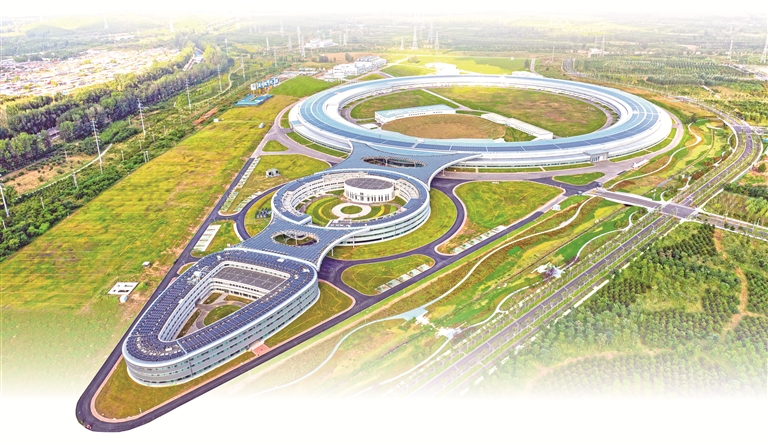
Core Insights - The article highlights the significant advancements and developments in Huairou Science City, which is a major national scientific infrastructure project aimed at fostering innovation and research in China [2][4][22] Group 1: Infrastructure and Facilities - Huairou Science City features 16 scientific facility platforms that are open for global sharing, with over 1.43 million hours of operational time accumulated [2] - The High Energy Synchrotron Radiation Source, a key facility, is set to be the brightest fourth-generation synchrotron radiation source globally, with a brightness one trillion times that of sunlight [3] - By 2050, Huairou Science City aims to become a world-class original innovation hub aligned with national strategic needs [4] Group 2: Research and Development - The city has entered a new operational phase, with 29 facility platforms from the 13th Five-Year Plan now in research status, and 8 new platforms from the 14th Five-Year Plan under construction [4] - Currently, there are 26,000 researchers in Huairou, including 33 Nobel laureates and 86 academicians, indicating a strong scientific community [4] Group 3: Achievements and Innovations - Huairou Science City has achieved breakthroughs in 51 key core technologies and produced 386 major scientific results, along with 465 high-level academic papers [14] - Notable innovations include the development of high-quality superconducting cavities and the first all-season observational laser radar, both of which are at the forefront of international technology [5][14] Group 4: Ecosystem and Collaboration - The city has attracted over 20 national research institutions, enhancing its scientific innovation ecosystem [15] - The integration of various research entities, including the Chinese Academy of Sciences, has strengthened collaborative efforts in addressing national strategic tasks [18]