锑矿开采与冶炼

Search documents
趋势研判!2025年中国金属锑行业政策、SWOT、产业链、供需规模、应用结构、竞争格局及发展趋势分析:市场规模增长,阻燃剂是锑消费最大的应用领域[图]
Chan Ye Xin Xi Wang· 2025-12-07 02:01
Core Viewpoint - The antimony metal industry in China is experiencing a decline in production despite a slight increase in output for 2024, with significant growth in industry value expected, while demand continues to decrease [1][5]. Industry Overview - Antimony is a metallic element with unique physical and chemical properties, widely used across various fields. China has long dominated global antimony reserves and production [2][5]. - The production of antimony is highly dependent on antimony ore resources, which are unevenly distributed globally, primarily concentrated in China, Tajikistan, Russia, Myanmar, and Bolivia [4]. Current Industry Status - In 2024, China's antimony production is projected to be 82,100 tons, a slight increase of 1700 tons from 2023. The industry value is expected to reach 11.034 billion yuan, an increase of 4.314 billion yuan from 2023, while demand is forecasted to decline to 79,000 tons, an increase of 2,900 tons from 2023 [1][5]. - The market size for the antimony industry in China is estimated at 10.279 billion yuan in 2024, with the flame retardant sector accounting for 4.632 billion yuan (45.06%) [5]. Industry Chain - The antimony industry chain consists of upstream mining and initial processing, midstream antimony production, and downstream applications, primarily in flame retardants, lead-acid batteries, glass ceramics, and chemicals [6]. Competitive Landscape - The global antimony industry is shifting from a "China-dominated" model to a more diversified competition. Major companies in the industry include Hunan Gold, Huaxi Nonferrous, and Huayu Mining, which possess quality mining areas and significant production capacity [7][8]. - The market concentration is high, with leading companies having strong advantages in resource acquisition, cost control, and market expansion [7]. Development Trends - Demand for antimony in traditional applications such as flame retardants and lead-acid batteries is expected to decline due to environmental regulations and the emergence of alternative materials [11][12]. - Antimony smelting technology is moving towards greener and low-carbon methods, with a focus on enhancing energy efficiency and reducing emissions [13].


300774,宣布重要收购
中国基金报· 2025-12-05 01:03
Core Viewpoint - The article discusses the strategic acquisition by Beijite (300774) of a controlling stake in Yunnan Wenye Nonferrous Metals Co., aiming to enhance its position in the antimony industry chain from raw material extraction to smelting and recycling [2][3]. Group 1: Acquisition Details - Beijite's subsidiary, Beijite (Beijing) New Materials Technology Co., signed a framework agreement to acquire a controlling stake in Wenye Nonferrous [2]. - This acquisition is part of Beijite's strategy to integrate its operations in the antimony industry, complementing its previous acquisition of a 55% stake in Dahao Mining for 224.8 million yuan [3]. - The goal is to establish a complete industrial chain covering antimony extraction, smelting, and recycling, thereby improving resource utilization and profitability [3]. Group 2: Company and Financial Overview - Wenye Nonferrous, established in June 2001 with a registered capital of 10.68 million yuan, specializes in antimony ore smelting and sales, located in Yunnan province [4]. - The smelting capacity of Wenye Nonferrous is expected to complement the antimony resources from Dahao Mining, addressing upstream raw material processing issues [4]. - Dahao Mining, previously acquired by Beijite, has not yet turned a profit, with projected net losses of 16.5 million yuan and 12.9 million yuan for 2024 and 2025 respectively [5]. Group 3: Industry Insights - Antimony is a critical raw material in the semiconductor and new energy sectors, with increasing market demand [5]. - According to Dongxing Securities, antimony consumption in the global photovoltaic glass sector is expected to grow by 38.6% year-on-year in 2024, with a compound annual growth rate of 22% from 2024 to 2027 [5]. - The global supply-demand gap for antimony is projected to widen over the next three years, supporting a long-term high price range for antimony [5].


研判2025!中国氧化锑行业产量、销售量及进出口分析:中国强化锑资源战略管控,2024年氧化锑产量收缩[图]
Chan Ye Xin Xi Wang· 2025-08-06 01:26
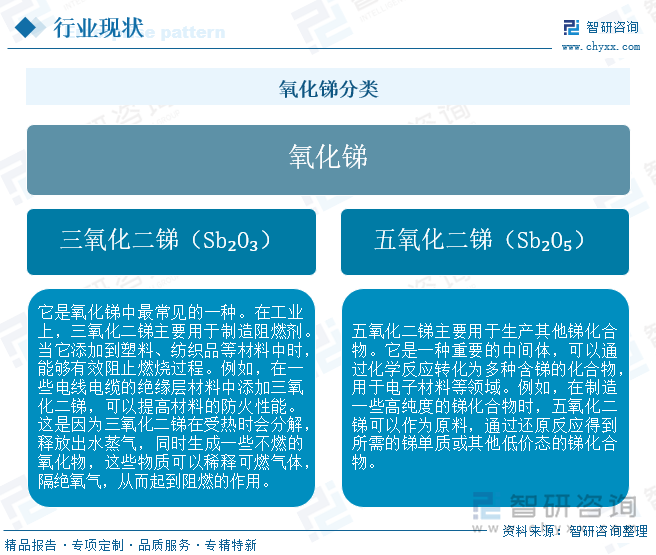
Core Viewpoint - China is the dominant country in global antimony resources and production, but the depletion of high-quality resources and increasing mining difficulties are significant challenges. The National Development and Reform Commission has included antimony in the "National Security Reserve List," aiming to increase the reserve target to 25,000 tons [1][6]. Industry Overview - Antimony oxide, primarily in the forms of antimony trioxide (Sb₂O₃) and antimony pentoxide (Sb₂O₅), is a common antimony oxide. Antimony is a chemical element with the symbol Sb and atomic number 51. Antimony trioxide is a white cubic crystal, soluble in hydrochloric acid and tartaric acid, but insoluble in water and acetic acid. Antimony pentoxide is a pale yellow powder, difficult to dissolve in water, and slightly soluble in alkali, forming antimonates [2][4]. Industry Chain - The upstream of the antimony oxide industry chain includes antimony ore resources, coal, soda ash, and various production equipment. The midstream involves the production and manufacturing of antimony oxide. The downstream applications include flame retardants, bearings, glass clarifiers, lead-acid batteries, electronic materials, and pharmaceuticals [4]. Industry Status - In 2024, China's antimony oxide production is projected to be 105,100 tons, a year-on-year decrease of 6.76%, while consumption is expected to be 74,900 tons, down 2.87% [6]. The average grade of domestic antimony ore has declined from 0.8% in 2010 to 0.6% in 2024, increasing mining costs by 30% [8]. The operating rate of antimony mines in China is expected to remain below 50% due to strict environmental inspections and safety issues [10]. Key Enterprises - The antimony industry in China is highly concentrated, with Hunan Gold Group and Flash Star Antimony Co., Ltd. forming a duopoly. Hunan Gold holds the largest market share, followed by Flash Star Antimony, Huaxi Nonferrous Metals, and Hunan Yutong Mining [14][16]. Hunan Gold has a comprehensive antimony industry chain and produced 29,200 tons of antimony products in 2024, a decrease of 6.15% year-on-year [16]. Development Trends 1. **Policy-Driven Resource Integration and Strategic Reserve Enhancement** - China is constructing a national security system for antimony resources through export controls, environmental inspections, and strategic reserve policies. The export control policy implemented in September 2024 aims to prioritize domestic demand, leading to a surge in antimony prices globally [20]. 2. **Technological Innovation Leading Industry Upgrade and High-End Transformation** - The antimony industry is advancing through technological innovations that enhance resource utilization and extend into high-value-added fields. New smelting processes and product developments are addressing environmental concerns and improving recovery rates [21][22]. 3. **Breaking Resource Constraints and Deepening Global Layout** - Companies are accelerating global expansion to address resource constraints. Hunan Gold plans to increase high-end antimony production capacity and pursue overseas resource acquisitions [23].