防脱洗护

Search documents
深度 | 蔓迪港股递表,引爆防脱“新战局”
FBeauty未来迹· 2025-11-25 14:18
Core Insights - The core viewpoint of the article is that the power dynamics in China's anti-hair loss market have shifted from traditional daily chemical brands to pharmaceutical companies, driven by a growing consumer base and evolving market demands [4][5]. Market Dynamics - The anti-hair loss market in China has seen a significant transformation, with over 300 million people affected by hair loss, particularly among the 26-35 age group, indicating a shift from a minor issue to a widespread concern [4]. - Pharmaceutical companies, particularly those with OTC pipelines and dermatological resources, have emerged as the primary players in the market, leading to a dual oligopoly dominated by Sanofi's Mandi and Zhendong Pharmaceutical's Dafeixin [4][8]. - The market for anti-hair loss products has reached 5.247 billion yuan in sales within the first ten months of 2025, reflecting a year-on-year growth of over 47% [10][13]. Brand Strategies - Pharmaceutical companies are creating a new narrative of "anti-hair loss = medicine + consumer," leveraging high margins and professional barriers while extending their product lines into daily care categories [5][19]. - Brands like Mandi and Dafeixin are combining pharmaceutical and cosmetic products, promoting them through "scientific anti-hair loss salons" to capture consumer interest [6][9]. Competitive Landscape - Traditional daily chemical brands are struggling, with companies like Bawang reporting a significant decline in profits despite a slight revenue increase, highlighting a structural challenge in the market [8]. - The consumer focus has shifted from "shampoo for hair loss" to "medical treatment and scalp management," indicating a demand for more scientifically-backed solutions [9][10]. Emerging Trends - The average price of anti-hair loss products has risen to over 113 yuan, suggesting consumers are willing to invest more in effective scalp care solutions [13]. - New brands such as EHD and Off&Relax are gaining traction, with EHD leading in sales at 371 million yuan, showcasing a trend towards professional and functional care [16][18]. Future Directions - To compete effectively, beauty brands must transition from traditional narratives to scientific and medical language, focusing on the mechanisms behind hair loss and scalp health [19][23]. - The integration of devices with hair care products is emerging as a trend, with brands like Kérastase introducing scalp care devices that enhance treatment efficacy [25][27]. Conclusion - The anti-hair loss market is evolving into a sector characterized by scientific, medical, and long-term management approaches, with pharmaceutical companies redefining the rules and traditional brands being compelled to adapt [19].


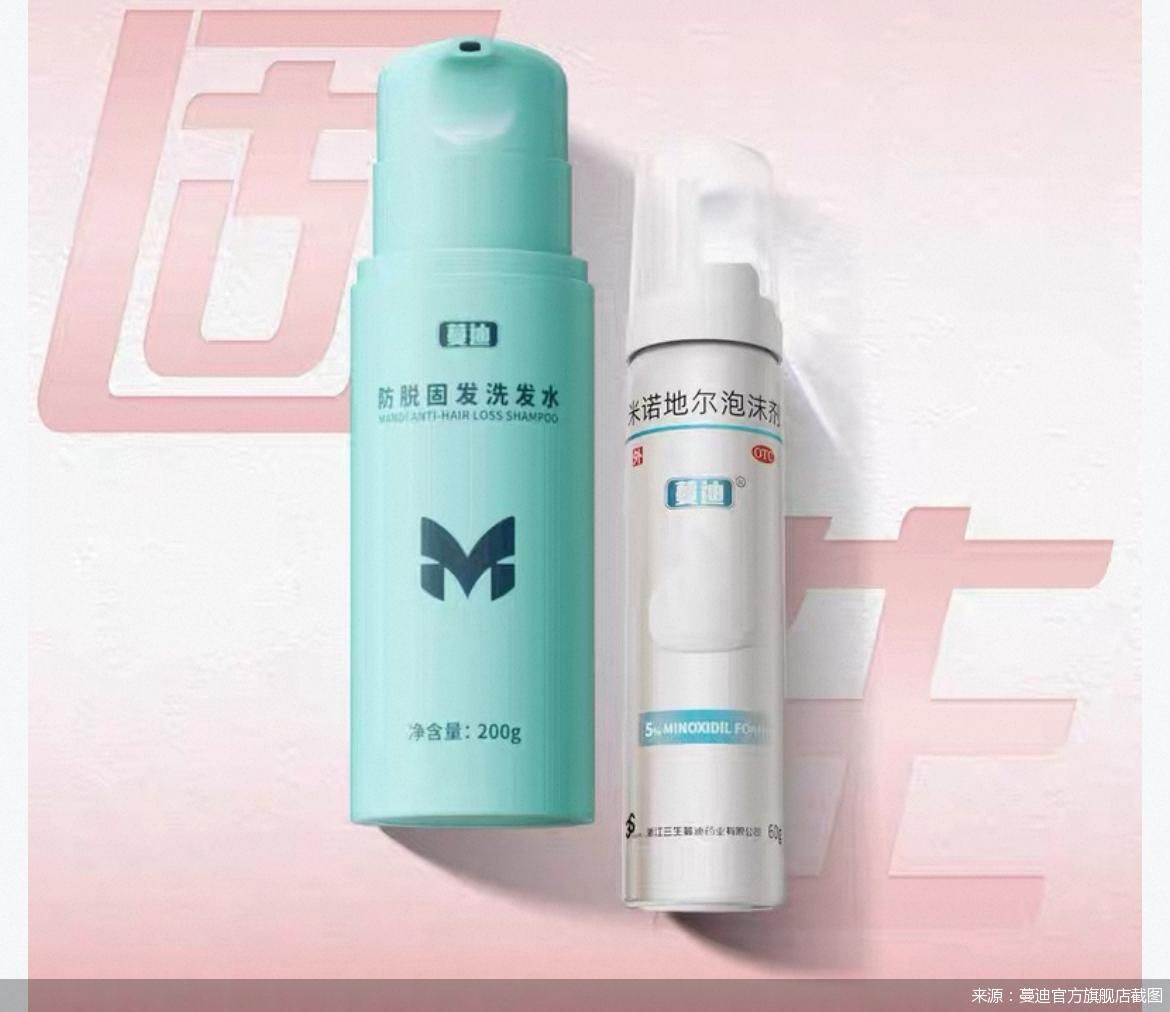
防脱成刚需,蔓迪国际赴港上市
Bei Jing Shang Bao· 2025-11-23 11:07
Core Viewpoint - Mandi International has submitted an IPO application to the Hong Kong Stock Exchange, aiming for an independent listing, following the announcement of its spin-off from 3SBio, which will no longer retain any equity in Mandi International [1][3]. Company Overview - Mandi International focuses on developing comprehensive and long-term solutions for skin health and weight management, launching its first 5% minoxidil product in China in 2001, thus entering the hair loss treatment market early [3]. - The Mandi series, which includes products like Mandi 5% minoxidil solution and foam, constitutes a significant portion of the company's revenue, accounting for 91.7% to 92.3% of total product sales from 2022 to 2024 [3][4]. Financial Performance - Mandi International's revenue from 2022 to 2024 is projected to be CNY 9.82 billion, CNY 12.28 billion, and CNY 14.55 billion, with year-on-year growth rates of 25.05% and 18.49% for 2023 and 2024, respectively [4]. - The net profit for the same period is expected to be CNY 2.02 billion, CNY 3.41 billion, and CNY 3.9 billion, with significant growth rates of 68.81% and 14.37% in 2023 and 2024 [4]. Market Dynamics - The hair loss treatment market in China is projected to grow to CNY 21 billion by 2024, with over 339 million people affected by hair loss, more than 60% of whom are under 35 years old [3][4]. - The market for hair loss products has become highly competitive, with various companies, including traditional hair care brands and new entrants from the beauty and pharmaceutical sectors, vying for market share [5][6]. Future Plans - Mandi International plans to use the net proceeds from the IPO for enhancing R&D capabilities, digital operations, brand building, and working capital [4]. - The company aims to solidify its leading position in the hair health sector and accelerate the launch of new business segments [4].