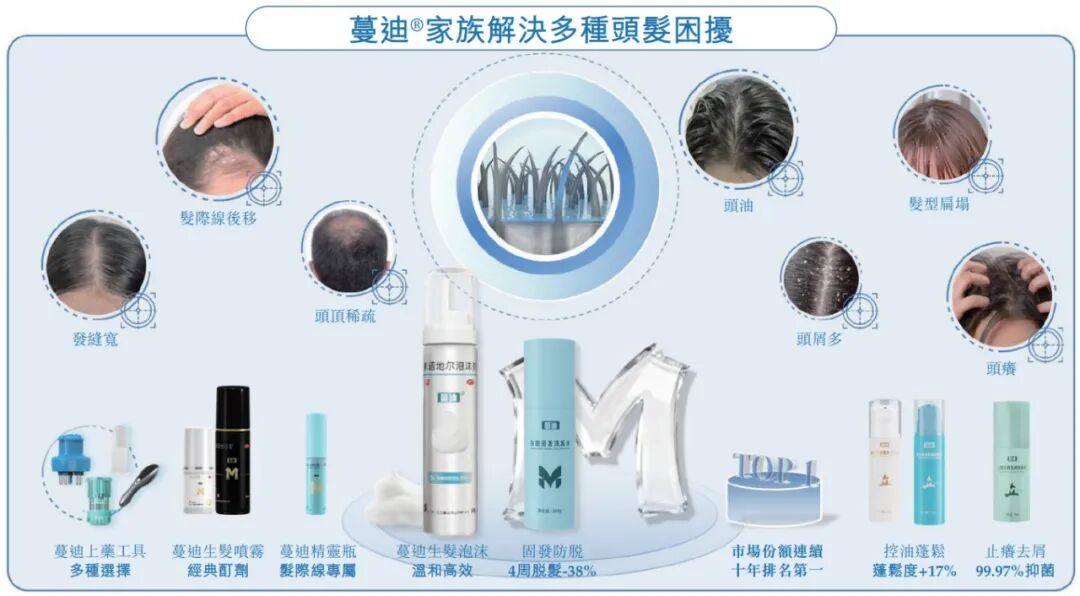
蔓迪防脱固发洗发水

Search documents
深度 | 蔓迪港股递表,引爆防脱“新战局”
FBeauty未来迹· 2025-11-25 14:18
Core Insights - The core viewpoint of the article is that the power dynamics in China's anti-hair loss market have shifted from traditional daily chemical brands to pharmaceutical companies, driven by a growing consumer base and evolving market demands [4][5]. Market Dynamics - The anti-hair loss market in China has seen a significant transformation, with over 300 million people affected by hair loss, particularly among the 26-35 age group, indicating a shift from a minor issue to a widespread concern [4]. - Pharmaceutical companies, particularly those with OTC pipelines and dermatological resources, have emerged as the primary players in the market, leading to a dual oligopoly dominated by Sanofi's Mandi and Zhendong Pharmaceutical's Dafeixin [4][8]. - The market for anti-hair loss products has reached 5.247 billion yuan in sales within the first ten months of 2025, reflecting a year-on-year growth of over 47% [10][13]. Brand Strategies - Pharmaceutical companies are creating a new narrative of "anti-hair loss = medicine + consumer," leveraging high margins and professional barriers while extending their product lines into daily care categories [5][19]. - Brands like Mandi and Dafeixin are combining pharmaceutical and cosmetic products, promoting them through "scientific anti-hair loss salons" to capture consumer interest [6][9]. Competitive Landscape - Traditional daily chemical brands are struggling, with companies like Bawang reporting a significant decline in profits despite a slight revenue increase, highlighting a structural challenge in the market [8]. - The consumer focus has shifted from "shampoo for hair loss" to "medical treatment and scalp management," indicating a demand for more scientifically-backed solutions [9][10]. Emerging Trends - The average price of anti-hair loss products has risen to over 113 yuan, suggesting consumers are willing to invest more in effective scalp care solutions [13]. - New brands such as EHD and Off&Relax are gaining traction, with EHD leading in sales at 371 million yuan, showcasing a trend towards professional and functional care [16][18]. Future Directions - To compete effectively, beauty brands must transition from traditional narratives to scientific and medical language, focusing on the mechanisms behind hair loss and scalp health [19][23]. - The integration of devices with hair care products is emerging as a trend, with brands like Kérastase introducing scalp care devices that enhance treatment efficacy [25][27]. Conclusion - The anti-hair loss market is evolving into a sector characterized by scientific, medical, and long-term management approaches, with pharmaceutical companies redefining the rules and traditional brands being compelled to adapt [19].


150亿沈阳医药家族,冲击第三个IPO
2 1 Shi Ji Jing Ji Bao Dao· 2025-11-24 04:35
Core Viewpoint - Mandis International has submitted an IPO application to the Hong Kong Stock Exchange, with Huatai International as the sole sponsor, indicating a significant move in the hair loss treatment market in China [1][2]. Company Overview - Mandis International's minoxidil-based hair loss treatment products have ranked first in retail sales for ten consecutive years, holding a market share of 57% [2]. - The company reported a revenue of 743 million yuan in the first half of the year, representing a nearly 20% year-on-year growth, with a net profit of 174 million yuan [2]. - Mandis International was spun off from 3SBio, led by the prominent pharmaceutical figure Lou Jing, who is expected to achieve his third IPO [2][24]. Market Potential - The hair loss treatment market is experiencing significant growth, with over 339 million people in China suffering from hair loss issues, and more than 60% of them being under 35 years old [3]. - Approximately one in four individuals in China faces hair loss challenges [3]. Product Development - Mandis has been proactive in the minoxidil product market, launching the first 5% minoxidil solution in China in 2001 and continuously developing various product specifications [5]. - The company introduced the second-generation minoxidil foam product in 2024, which is the first and only domestically approved product of its kind in China [5]. - The foam product is priced at 198 yuan per bottle and has sold over 700,000 units, ranking first in Tmall's hair growth liquid sales [5][9]. Sales Performance - In the first half of the year, Mandis' sales reached approximately 681 million yuan, a 24% year-on-year increase, accounting for 98.8% of 3SBio's sales in the hair loss sector [12]. - The company's products have achieved a compound annual growth rate of 21.9% from 2022 to 2024 [12]. Distribution Channels - Mandis employs a dual-channel strategy, with online sales contributing 74% of its revenue in the first half of the year [10]. - The products are distributed to over 2,000 medical institutions and approximately 190,000 retail pharmacies across various cities in China [11]. Future Expansion - Lou Jing aims to expand Mandis' product line into skin health and weight management, recognizing significant market potential in these areas [20]. - The company is developing a range of early-stage assets, including treatments for acne and obesity-related metabolic syndromes [22]. IPO and Financial Strategy - The IPO is expected to enhance Mandis' research capabilities, digital operations, marketing, and brand development [25]. - Prior to the IPO, Mandis International was 87.16% owned by 3SBio, with Lou Jing and his wife being the controlling shareholders [24].