零食快消

Search documents
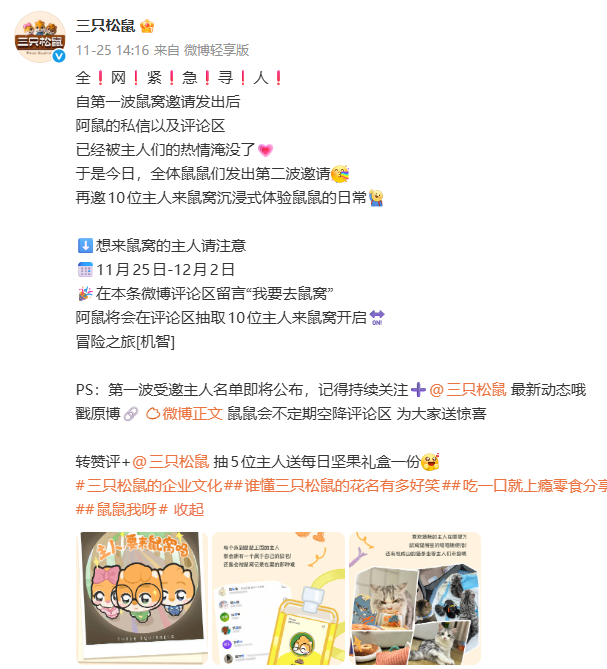
三只松鼠花名引争议,坦诚也是企业“加分项”
2 1 Shi Ji Jing Ji Bao Dao· 2025-11-28 00:14
Core Viewpoint - The article discusses the recent controversy surrounding the internal naming culture at Three Squirrels, highlighting the importance of consumer trust and brand management in response to public opinion events [2][5]. Group 1: Incident Overview - A recent post by a netizen claimed that employees at Three Squirrels are required to adopt a "mouse" themed nickname upon joining, which sparked widespread attention [2]. - Three Squirrels clarified that the "mouse name" is a non-mandatory aspect of their corporate culture, allowing employees to choose their nicknames freely without any negative consequences for opting out [2][6]. Group 2: Company Response - The founder and CEO of Three Squirrels, Zhang Liaoyuan, emphasized that any employee culture that aligns with the company's values and is accepted by employees is beneficial [2][6]. - The company addressed consumer concerns regarding a return process where the return recipient was labeled "Return Mouse," explaining that this is part of their internal culture and not intended to offend [2][5]. Group 3: Public Perception and Management - The incident illustrates how internal corporate culture can attract public scrutiny, leading to questions about employee respect and management style [5]. - Three Squirrels adopted a transparent approach in handling the situation, clarifying the voluntary nature of the nickname system and showcasing that even executives use similar nicknames, which helps mitigate public skepticism [6][7]. Group 4: Consumer Engagement - The company utilized social media to invite consumers to engage with and understand their corporate culture, transforming public criticism into an opportunity for brand explanation [7]. - The humorous and light-hearted nature of the corporate culture resonates well with the target consumer demographic, enhancing brand perception through effective public relations strategies [7].


三只松鼠花名引争议,坦诚也是企业“加分项”|消费舆警指数
2 1 Shi Ji Jing Ji Bao Dao· 2025-11-28 00:05
Core Viewpoint - The article discusses the recent controversy surrounding the employee nickname culture at Three Squirrels, highlighting the importance of consumer trust and brand management in response to public sentiment [1] Group 1: Incident Overview - A recent post by a netizen claimed that employees at Three Squirrels are required to adopt a nickname starting with "Squirrel" upon joining, which sparked widespread attention [1] - Three Squirrels clarified that the use of "Squirrel" nicknames is voluntary and not mandatory, emphasizing that employees can choose whether to adopt such names without facing negative consequences [2] Group 2: Company Response - The company adopted a candid approach in addressing the public's concerns, stating that the nickname culture is not enforced and that it reflects a fun and engaging corporate culture [3] - Three Squirrels' founder and CEO, Zhang Liaoyuan, expressed that any culture that employees enjoy and aligns with the company's values is beneficial [2][3] Group 3: Consumer Interaction - The company faced criticism when a consumer noted that the return label for a product was "Return Squirrel," which was perceived as having a negative connotation [2] - In response, Three Squirrels explained that the nickname is part of their internal culture and is not intended to offend consumers [2] Group 4: Public Relations Strategy - The company effectively communicated its internal culture by showcasing that even executives use similar nicknames, which helped alleviate public skepticism regarding employee consent [3] - By inviting consumers to engage with the brand and understand its culture, Three Squirrels transformed public scrutiny into an opportunity to explain and promote its brand values [4]