非常规天然气

Search documents
山西2025经济答卷亮眼 2026锚定高质量发展再出发
Zhong Guo Fa Zhan Wang· 2026-02-06 04:09
Core Viewpoint - Shanxi Province is focusing on high-quality economic development and resource-based economic transformation, with a positive outlook for 2026 following a stable performance in 2025 [1][6]. Economic Performance - In 2025, Shanxi's GDP reached 25,495.7 billion yuan, growing by 4.0% year-on-year, which is an increase of 1.8 percentage points compared to 2024 [1]. - The growth rates for primary, secondary, and tertiary industries were 4.5%, 3.1%, and 4.5% respectively, indicating sustained economic resilience [1]. Macroeconomic Policies - Shanxi implemented a series of policies to stabilize growth and promote transformation, with fiscal spending exceeding 600 billion yuan, of which 80.1% was allocated to people's livelihoods [2]. - Tax reductions and refunds for technological innovation and manufacturing totaled 231.8 billion yuan, benefiting 440,000 business entities [2]. - The province's loan balance grew by 7.4%, with average interest rates for new corporate loans and inclusive small and micro loans dropping to 3.41% and 4.35% respectively [2]. Domestic Demand and Investment - Shanxi's "old for new" consumption policy led to a significant increase in retail sales, reaching 8,030.9 billion yuan, a growth of 4.7%, which is 1 percentage point higher than the national average [3]. - Fixed asset investment saw a narrowing decline of 0.4%, which is 3.4 percentage points lower than the national average, supported by 120 "two重" projects [3]. Industrial Structure and Innovation - The province's industrial value added grew by 4.9%, with coal production exceeding 1.3 billion tons, an increase of 2.1% [4]. - New industries such as computer manufacturing and renewable energy saw substantial growth, with the former increasing by 121.6% [4]. - The service sector's contribution to GDP rose by 2.3 percentage points, with information technology services growing by 9.8% [4]. Reform and Development - Shanxi is deepening reforms in key areas, enhancing the competitiveness of state-owned enterprises and fostering innovation through the establishment of 27 national-level innovation platforms [5]. - The province's open economy is improving, with 1,000 China-Europe (Asia) freight trains operating, and 2,471 enterprises engaged in import and export activities, marking an 18.6% increase from the previous year [5]. Social Welfare and Employment - In 2025, Shanxi created 473,000 new urban jobs, exceeding annual targets, and continued to narrow the income gap between urban and rural areas [6]. - The high proportion of fiscal spending on social welfare ensures that development benefits are equitably distributed among the population [6].
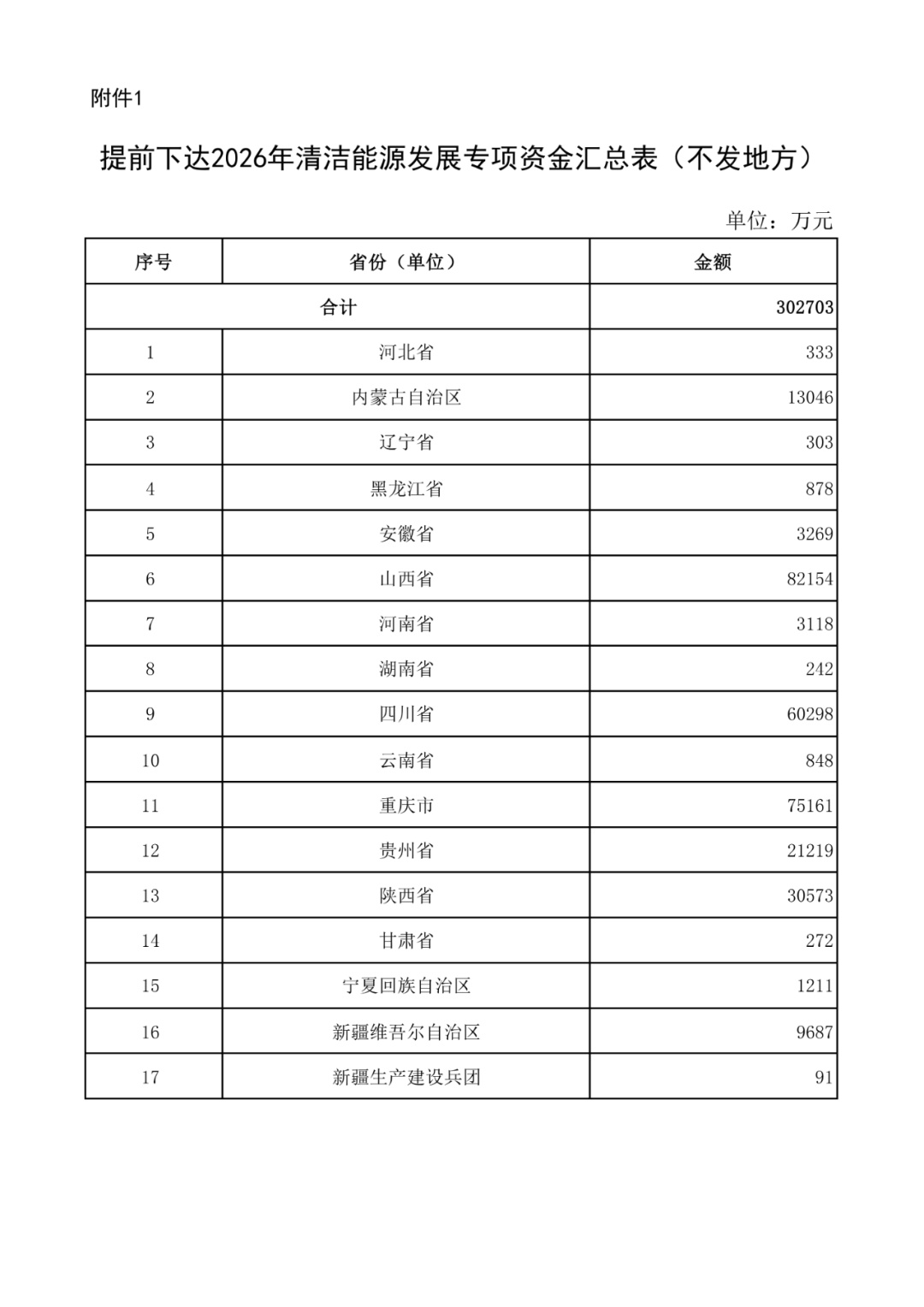
30.27亿!财政部提前下达2026年清洁能源发展专项资金预算
Zhong Guo Dian Li Bao· 2025-11-25 08:56
Core Points - The Ministry of Finance has announced the early allocation of the 2026 budget for the Clean Energy Development Special Fund, aimed at supporting unconventional natural gas extraction and utilization, including coalbed methane, shale gas, and tight gas [1][2] - The total budget for the Clean Energy Development Special Fund for 2026 is set at 302,703 million yuan, which will be allocated to various provinces and regions for specific projects [5][7] - The fund will be monitored under a standardized budget management system to ensure effective and safe usage, with performance management and evaluation requirements in place [2][3] Budget Allocation - The total amount allocated for the Clean Energy Development Special Fund is 302,703 million yuan [5][7] - Specific allocations include: - Shanxi Province: 82,154 million yuan - Sichuan Province: 60,298 million yuan - Chongqing City: 75,161 million yuan - Other provinces also receive varying amounts, contributing to the overall total [5] Performance Goals - The performance targets for the fund include: - Coalbed gas extraction utilization of at least 9.3 billion cubic meters - Shale gas extraction utilization of at least 17 billion cubic meters - Tight gas extraction utilization of at least 14.5 billion cubic meters - Ensuring that the quality of unconventional natural gas meets national standards [7][8] - Additional goals include increasing energy supply, enhancing energy security, and promoting a green and low-carbon energy structure [7]