AI PCB

Search documents
大族激光-AI PCB 与 IT 设备驱动的上行周期仅过半,上调目标价至 89 元人民币
2026-03-03 03:13
Summary of Han's Laser Technology (002008.SZ) Conference Call Company Overview - **Company**: Han's Laser Technology - **Industry**: Laser processing equipment manufacturing - **Main Products**: Laser marking, welding, cutting equipment, PCB equipment, photovoltaic devices, and LED packing equipment [doc id='23'][doc id='24'] Key Points Earnings Forecast and Target Price - **Earnings Revisions**: 2025/26/27 earnings forecasts revised up by 19%/30%/50% respectively [doc id='1'] - **Target Price Increase**: Target price raised by approximately 65% to Rmb89, reflecting stronger earnings outlook driven by AI PCB and IT equipment [doc id='1'][doc id='25'] IT Equipment Insights - **Revenue Growth**: IT revenue expected to grow by 40% and 29% YoY in 2026 and 2027, reaching Rmb4.5 billion in 2027, surpassing the previous high of Rmb4.0 billion in 2017 [doc id='1'] - **3D Printing Expansion**: Apple may extend the use of 3D printing equipment to produce middle frames, increasing the total addressable market (TAM) to approximately Rmb7.0 billion from current revenue of Rmb200 million [doc id='2'][doc id='18'] PCB Equipment Insights - **Revenue Growth**: PCB equipment revenue forecasted to grow by 56% YoY in 2026, with potential upside due to AI PCB technology migration [doc id='3'] - **Nvidia's Influence**: Anticipated demand from Nvidia's new products could drive incremental demand for mechanical PCB drilling equipment [doc id='3'][doc id='18'] Financial Performance - **Earnings Summary**: - 2023 Net Profit: Rmb820 million, EPS: Rmb0.780 - 2024 Net Profit: Rmb1,694 million, EPS: Rmb1.620 - 2025E Net Profit: Rmb1,132 million, EPS: Rmb1.088 - 2026E Net Profit: Rmb1,875 million, EPS: Rmb1.821 - 2027E Net Profit: Rmb2,519 million, EPS: Rmb2.447 [doc id='5'][doc id='9'] Valuation Metrics - **P/E Ratio**: New target price based on a P/E of 49x for 2026E, increased from 39x, reflecting bullish sentiment on multi-year earnings up-cycle [doc id='4'][doc id='25] - **Market Capitalization**: Approximately Rmb76.83 billion [doc id='6'] Risks - **Downside Risks**: - Fewer-than-expected Apple orders - Increased competition affecting margins - Weakening auto sales impacting high-power laser equipment demand - Potential failure of new investment projects - Emergence of substitute technologies [doc id='26'] Investment Strategy - **Recommendation**: Rated as a "Buy" due to strong demand for PCB drilling and testing equipment, driven by AI server/datacenter needs and Apple orders [doc id='24'] Conclusion - Han's Laser Technology is positioned for significant growth driven by advancements in AI PCB and IT equipment, with a favorable outlook for revenue and earnings in the coming years. The company faces risks primarily related to market demand and competition, but the overall sentiment remains positive with a strong investment recommendation.

A股指数家族“新陈代谢”:被调入的样本股会涨吗?
第一财经· 2025-12-16 08:47
Core Viewpoint - The article discusses the periodic adjustments of sample stocks in major A-share indices, emphasizing the importance of these adjustments in reflecting market trends and economic development [3][5]. Group 1: Index Adjustment Mechanism - The adjustment of indices can be categorized into periodic and temporary adjustments, with periodic adjustments typically occurring semi-annually in June and December [5]. - The recent adjustments affected multiple core indices, including the Shanghai Stock Exchange 50, 180, 380, and others, with changes implemented on December 12 and 15, 2025 [3][6]. - The adjustments aim to ensure indices accurately reflect market conditions and to eliminate underperforming stocks, thereby maintaining the indices' integrity [5][6]. Group 2: Sample Stock Changes - The adjustments involved significant changes in sample stocks across various indices, with the Shanghai Stock Exchange 50 changing 4 stocks, the Shanghai and Shenzhen 300 changing 11 stocks, and the CSI 500 changing 50 stocks [6][8]. - The adjustments also included the addition of companies with strong performance and growth potential, particularly in sectors like information technology and high-end manufacturing [6][12]. Group 3: Industry Structure Optimization - The recent adjustments have led to an optimization of the industry structure within the indices, increasing the representation of new quality productivity sectors such as information technology and renewable energy [12]. - For instance, the Shenzhen Component Index saw a shift with 10 companies removed and 10 new companies added, enhancing its focus on innovative sectors [12][13]. Group 4: Financial Performance and Investor Returns - The adjusted indices show strong financial performance, with the Shenzhen Component Index's manufacturing companies representing 76% of its sample, and over 30% being industry leaders [12][14]. - The new sample companies in the indices have demonstrated significant growth, with the Shenzhen Component Index's companies reporting a 16% increase in revenue and a 24% increase in net profit year-on-year [12][14]. Group 5: Market Reactions to Adjustments - The article notes that adjustments to index components can influence stock prices, with stocks added to indices often experiencing price increases prior to the adjustment date [16][17]. - Historical data suggests that stocks added to indices tend to achieve excess returns, although the impact may be limited due to pre-adjustment speculation by investors [17].


A股指数家族“新陈代谢”:创新的成色更足
Di Yi Cai Jing· 2025-12-15 13:44
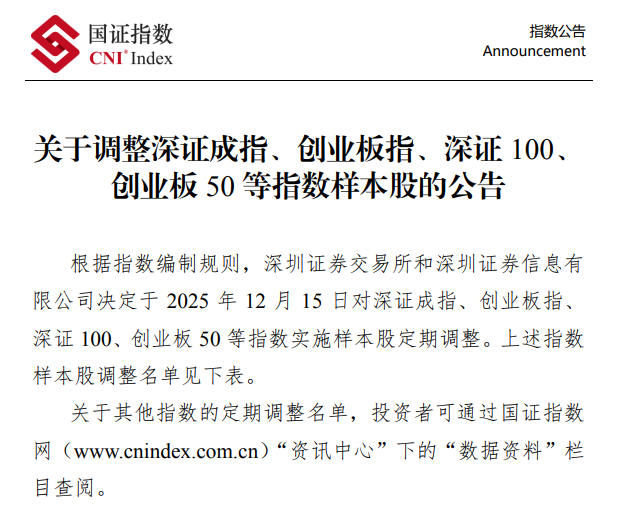
Core Viewpoint - The recent index sample adjustment at the end of the year encompasses most of the core indices in the A-share market, aimed at accurately reflecting market trends and economic development directions [1][2]. Group 1: Index Adjustments - The adjustments for the Shanghai Stock Exchange and China Securities Index took effect after the market closed on December 12, 2025, while those for the Shenzhen Stock Exchange were implemented on December 15, 2025 [2]. - The periodic adjustment mechanism is crucial for maintaining the vitality of indices, allowing them to reflect the evolving market and economic conditions [2][3]. - The adjustments include a variety of indices such as the SSE 50, SSE 180, SSE 380, STAR 50, CSI 300, CSI 500, CSI 1000, CSI A50, CSI A100, CSI A500, SZSE Component Index, ChiNext Index, SZSE 100, and ChiNext 50 [1][4]. Group 2: Sample Changes - The number of sample changes for various indices includes: SSE 50 (4 stocks), SSE 180 (7 stocks), SSE 380 (38 stocks), STAR 50 (2 stocks), CSI 300 (11 stocks), CSI 500 (50 stocks), CSI 1000 (100 stocks), CSI A50 (4 stocks), CSI A100 (6 stocks), CSI A500 (20 stocks), SZSE Component Index (17 stocks), ChiNext Index (8 stocks), SZSE 100 (7 stocks), and ChiNext 50 (5 stocks) [4][6]. - The adjustments aim to remove underperforming companies and include those with stable growth and promising industry prospects, particularly in new productivity sectors [4][9]. Group 3: Industry Impact - The adjustment enhances the representation of new productivity sectors such as information technology, high-end equipment manufacturing, biomedicine, and new energy [9]. - The weight of sample stocks from the STAR Market and ChiNext has increased, reinforcing the innovation attributes of the indices [9]. - The manufacturing sector's representation in the SZSE Component Index reached 76%, the highest among Chinese capital market indices, with over 30% being industry-leading companies [11]. Group 4: Financial Performance - The new sample companies in the ChiNext Index reported a 16% increase in revenue and a 24% increase in net profit year-on-year for the first three quarters [11]. - The strategic emerging industries' weight in the ChiNext Index reached 93%, with R&D expenses growing by 13% year-on-year [10][11]. - The SZSE 100 Index has over 80% of its sample companies expanding their business internationally, with a compound annual growth rate of 17% in overseas revenue over the past three years [11].
2026年AI算力硬件出海逻辑及重大边际变化梳理
傅里叶的猫· 2025-12-07 13:13
Group 1: Optical Modules - The optical module industry is experiencing the highest growth and performance realization among AI hardware this year, driven by high verification barriers for North American CSP tech giants and increasing demand due to the acceleration of supernode technology [2][4] - The average ratio of optical modules to GPUs is continuously increasing, with demand for 800G and 1.6T optical modules being revised upwards, indicating a strong upward resonance in demand [2][4] - By 2026, the demand for 1.6T optical modules is expected to exceed 30 million units, with an average price of $900-1000 per unit, while high-end EML optical chips are projected to face a 25-30% supply shortage [4][5] Group 2: Liquid Cooling - The liquid cooling industry has seen fluctuating trends this year, with initial enthusiasm dampened by low penetration rates, followed by a resurgence in August and significant breakthroughs in November [5][9] - The demand for liquid cooling in North America is expected to expand rapidly by 2026, with penetration rates in the NVIDIA ecosystem projected to rise from 20-30% to over 80-90% [7][9] - A leading domestic manufacturer is anticipated to capture a market share of 13-17% in North America by 2026, with Google expected to implement liquid cooling solutions for over 200,000 TPU V7 chips, creating a market space exceeding $24-28 billion [9][10] Group 3: AI PCB - The AI PCB industry is thriving, with companies like Shenghong, Huidian, and Shengyi achieving performance realization in North America, despite some quarterly fluctuations [10][12] - The supply side is seeing an increase in product value and manufacturing difficulty due to upgrades in customer chips and cabinet solutions, leading to a marginal differentiation in the supply landscape [10][12] - By 2026, the introduction of orthogonal backplanes is expected to significantly increase unit value, with M9 material processing anticipated to break through, although mass production is expected to ramp up in 2027 [12][13] Group 4: Server Power Supply - The server power supply market has shown similar trends to liquid cooling, with initial excitement followed by a divergence in performance among manufacturers [13][14] - The supply side is dominated by Taiwanese manufacturers, with a high concentration of market share, while domestic manufacturers are expected to make significant breakthroughs in North America by 2026 [14][15] - The adoption of HVDC technology is projected to replace traditional UPS solutions, with an expected market scale exceeding $20-30 billion by 2026 [15]