Artificial Intelligence(人工智能)

Search documents
机器人抢上春晚,出场费1亿;DeepSeek招兵买马,布局AI搜索与智能体;15万Clawdbot智能体发帖吐槽人类 | AI周报
AI前线· 2026-02-01 05:32
Group 1 - Major tech companies like Tencent, Baidu, and Alibaba are competing for the national-level AI application market by distributing billions in cash red envelopes during the 2026 Spring Festival [3][4] - Tencent announced a cash distribution of 1 billion yuan through its Yuanbao app, aiming to replicate the success of WeChat red envelopes [3] - Baidu is also participating by offering 500 million yuan in cash red envelopes through its Wenxin assistant, with plans to collaborate with major events like the 2026 Spring Festival Gala [3][4] Group 2 - A record number of robotics companies are set to participate in the 2026 Spring Festival Gala, with each company reportedly investing 100 million yuan [5] - Companies like Magic Atom and Galaxy General are among those making their debut at the gala, showcasing a significant increase in robotic presence compared to previous years [5] Group 3 - DeepSeek is actively recruiting talent to develop a multilingual AI search engine and enhance its capabilities in intelligent agents, indicating a strategic push to compete with OpenAI and Alphabet [6][7] - The company aims to create a search engine that can process various input forms, including text, images, and audio, to meet diverse user needs [6] Group 4 - Tencent has confirmed the hiring of a Tsinghua University PhD to strengthen its AI research capabilities, particularly in reinforcement learning algorithms [8][9] - The company has undergone significant restructuring to enhance its AI model development framework, attracting more native AI talent [9] Group 5 - Nvidia's CEO Jensen Huang has denied any dissatisfaction with OpenAI and announced plans for a substantial investment, potentially the largest in the company's history [10][12] - Reports suggest that Nvidia's investment in OpenAI could be part of a larger funding round, with OpenAI seeking to raise over 100 billion yuan [12][14] Group 6 - Alibaba is integrating its AI capabilities across cloud computing and chip development, launching its "Cloud + AI + Chip" strategy, with significant production of its self-developed PPU chips [22][23] - The company plans to invest significantly in AI infrastructure and cloud computing, potentially increasing its budget from 380 billion yuan to 480 billion yuan over the next three years [24] Group 7 - ByteDance has implemented new social media guidelines to prevent employees from profiting from company resources, which is expected to reduce the number of commercial accounts operated by employees [19] - The company has previously taken strong actions against external violations, indicating a commitment to maintaining its brand integrity [19] Group 8 - OpenAI is preparing for a potential IPO in the fourth quarter of 2026, engaging with Wall Street banks for informal discussions regarding the listing [14] - The company is also expanding its internal financial team in anticipation of this move, indicating a strategic focus on growth and investor relations [14]




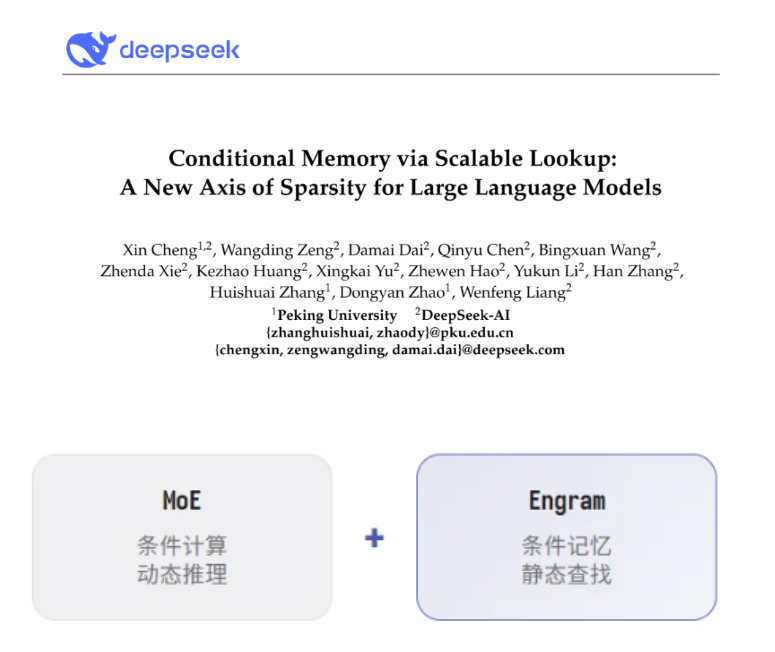
大摩眼中的DeepSeek:以存代算、以少胜多!
Hua Er Jie Jian Wen· 2026-01-22 02:48
Core Insights - DeepSeek is revolutionizing AI scalability by utilizing a hybrid architecture that replaces scarce HBM resources with more cost-effective DRAM, focusing on smarter design rather than merely increasing GPU clusters [1][5] Group 1: Technological Innovation - DeepSeek's innovative module, "Engram," separates storage from computation, significantly reducing the need for expensive HBM by employing a "Conditional Memory" mechanism [1][3] - The Engram architecture allows for efficient retrieval of static knowledge stored in DRAM, freeing up HBM for more complex reasoning tasks, thus enhancing overall efficiency [3][5] Group 2: Cost Structure and Economic Impact - The shift from reliance on HBM to DRAM is expected to reshape the hardware cost structure, making AI infrastructure more affordable [5][7] - A 100 billion parameter Engram model requires approximately 200GB of system DRAM, indicating a 13% increase in the use of commercial DRAM per system compared to existing setups [5][7] Group 3: Competitive Landscape - Despite hardware limitations, Chinese AI models have rapidly closed the performance gap with leading global models, demonstrating strong competitive capabilities [6][8] - DeepSeek V3.2 achieved an MMLU score of approximately 88.5% and coding capability of around 72%, showcasing its efficiency in reasoning and performance [6][8] Group 4: Future Outlook - The upcoming DeepSeek V4 model is anticipated to leverage the Engram architecture for significant advancements in coding and reasoning, potentially running on consumer-grade hardware [8] - This development could lower the marginal costs of high-level AI inference, facilitating broader deployment of AI applications without reliance on expensive data center GPUs [8]

通义大模型发布新一代端到端语音交互模型
Bei Jing Shang Bao· 2025-12-23 13:02
Core Viewpoint - The official release of the Fun-Audio-Chat model by Tongyi Model represents a significant advancement in AI voice interaction, emphasizing its ability to understand speech, perceive emotions, and perform tasks effectively [1] Technical Performance - The new model utilizes an end-to-end S2S architecture that generates voice output directly from voice input, eliminating the need for multiple modules such as ASR, LLM, and TTS, resulting in higher efficiency and lower latency [1] - The Shared LLM layer operates at a frame rate of 5Hz for efficient processing, while the SRH generates high-quality speech at a frame rate of 25Hz, reducing GPU computational costs by nearly 50% [1] - Training content encompasses audio understanding, voice Q&A, emotion recognition, and tool invocation, making the model more practical and applicable to real-world scenarios [1]
$826 Billion AI Market: The Only ETF You Need for Explosive Growth.
The Motley Fool· 2025-11-30 14:05
Core Viewpoint - The article emphasizes the potential of investing in the AI industry through ETFs, particularly the Vanguard Information Technology ETF, which provides diversified exposure to leading technology companies involved in AI [1][3]. Industry Overview - The global AI market is projected to exceed $826 billion by 2030, indicating significant growth potential despite its unpredictability [1]. - Advancements in AI could lead to developments such as humanoid robotics, transitioning from science fiction to reality [2]. ETF Analysis - The Vanguard Information Technology ETF (VGT) is highlighted as a suitable investment for those seeking growth without the complexities of selecting individual AI stocks [3]. - Although not a dedicated AI ETF, VGT includes many leading AI companies among its top holdings, such as Nvidia, Apple, and Microsoft, which are integral to the AI ecosystem [4][5]. - The ETF's top 10 holdings include major players in the technology sector, reinforcing its relevance to the AI market [6]. Performance Metrics - VGT has a long-standing track record of outperforming the broader stock market, attributed to the increasing importance of technology in the economy [9]. - The ETF charges a low expense ratio of 0.09%, which is significantly lower than many dedicated AI ETFs, potentially enhancing long-term investment returns [8]. Market Dynamics - The technology sector, including AI, is becoming increasingly vital across various industries, with traditional sectors adopting technology for efficiency and optimization [10]. - Despite the potential for explosive growth, the ETF and technology stocks are subject to volatility, with historical declines noted during market downturns [12][13].





彭博:人工智能竞赛:美国还是中国领先?
彭博· 2025-08-07 05:18
Investment Rating - The report does not explicitly provide an investment rating for the AI industry or specific companies within it. Core Insights - The competition between the US and China in the AI sector is intensifying, with both countries making significant strides in technology and investment to secure leadership in AI development [2][4][12] - Chinese companies are rapidly advancing in AI capabilities, with models that are approaching those of leading US firms, driven by government support and a focus on open-source technologies [3][8][9] - The outcome of the AI race may determine the technological superpower of the 21st century, with both nations prioritizing AI for economic, political, and national defense purposes [4][12][13] Summary by Sections The Technology - The US has led key breakthroughs in AI, with companies like OpenAI and Alphabet pioneering advanced computing chips and large language models [6][7] - Chinese firms are quickly following suit, developing AI models that require less computational power and embracing open-source standards to enhance global adoption [8][9] The State - AI is a national priority for both the US and China, with the US aiming to maintain a technological edge and China promoting AI as a public good [12][13] - The US government has initiated plans to reduce regulatory barriers for AI development, while China emphasizes the need for international cooperation in AI governance [12][13] The Money - In the first half of 2025, US AI startups raised over $100 billion, while major tech firms are projected to spend more than $344 billion on AI infrastructure [26][27] - China's AI capital expenditure is expected to reach $98 billion in 2025, a 48% increase from 2024, with significant government backing [27][28] The Talent - The US has historically attracted top AI talent from around the world, but tightening visa policies pose risks to this talent pipeline [29][31] - China is actively working to reverse brain drain by attracting scientists and entrepreneurs educated abroad back to the country [32][33] The Infrastructure - China has built a robust AI ecosystem supported by vast data pools and renewable energy-powered data centers [34][41] - The US faces challenges with aging power grids, while China has significantly increased its energy capacity to support AI development [41][42]
Qwen紧追OpenAI开源4B端侧大模型,AIME25得分超越Claude 4 Opus
量子位· 2025-08-07 00:56
Core Insights - The Qwen team has released two new models, Qwen3-4B-Instruct-2507 and Qwen3-4B-Thinking-2507, which are designed to enhance performance on various tasks, particularly in reasoning and general capabilities [2][3][5]. Model Performance - Qwen3-4B-Thinking-2507 achieved a score of 81.3 in the AIME25 assessment, outperforming competitors like Gemini 2.5 Pro and Claude 4 Opus [4][5][23]. - The new models support a context length of 256k, significantly improving context awareness and understanding [3][17]. Model Specifications - Qwen3-4B-Instruct-2507 is a non-reasoning model that enhances general capabilities and multi-language support, while Qwen3-4B-Thinking-2507 is a reasoning model tailored for expert-level tasks [7][16]. - The 4B parameter size is particularly friendly for edge devices, allowing for deployment on small hardware like Raspberry Pi [2][8][26]. Comparative Analysis - In various tests, Qwen3-4B-Instruct-2507 outperformed smaller closed-source models like GPT-4.1-nano and showed comparable performance to larger models like Qwen3-30B-A3B [13][15]. - The models exhibit significant improvements in areas such as instruction following, logical reasoning, and text generation, with enhanced alignment to user preferences [17][24]. Deployment Recommendations - The Qwen team has provided deployment suggestions for local use, including applications like Ollama and MLX-LM, and recommended using a quantized version for very small devices [27][28]. - For optimal performance, especially in reasoning tasks, it is advised to use a context length greater than 131,072 tokens [29]. Community Engagement - The Qwen team has encouraged community feedback and interaction, with links provided for accessing the new models on platforms like Hugging Face and ModelScope [26][36].