Housing Security

Search documents
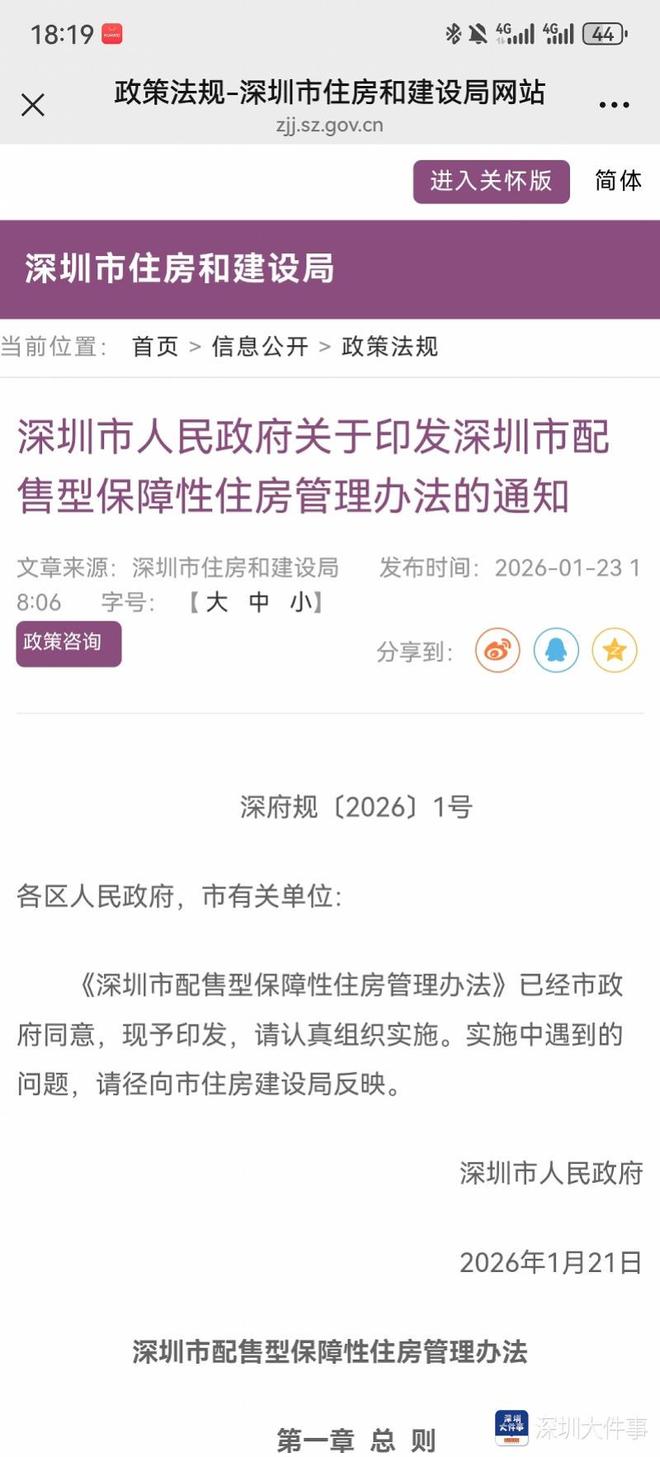
深圳配售型保障房新政:设回购机制,满3年可按折旧价返售
Nan Fang Du Shi Bao· 2026-01-23 12:24
Core Viewpoint - Shenzhen has released the "Shenzhen Management Measures for Allocated Affordable Housing," which will take effect on March 1, 2026, aiming to provide housing support for low-income groups [1]. Group 1: Overview of the Measures - The measures consist of 5 chapters and 37 articles, detailing application conditions, allocation methods, management, and supervision of allocated affordable housing [4]. - Allocated affordable housing is a type of housing support where the government provides policy support, limiting unit size, sale price, and rights of use and disposal, aimed at eligible low-income groups [4]. Group 2: Pricing and Allocation - The pricing for allocated affordable housing will consider land costs, construction costs, reasonable profits, and relevant taxes, while also factoring in housing supply and demand and the payment capacity of low-income groups [4]. - The specific sale price for each project will be stated in the project allocation announcement [4]. Group 3: Application Conditions - To apply for allocated affordable housing, applicants must be registered residents of Shenzhen, have no self-owned housing in the city, and have not transferred or divided self-owned housing in the past three years [4]. - Applicants must have paid social insurance in Shenzhen for at least 5 years, or 3 years if they meet specific talent introduction criteria [4]. Group 4: Management and Transfer Regulations - Allocated affordable housing will be strictly managed and cannot be converted to commercial housing [5]. - After signing the purchase contract for three years, buyers can apply for a closed transfer on the information platform, with transfer prices negotiated between parties [5]. - In case of repurchase, the repurchase price will be calculated as the original purchase price multiplied by (1 - annual depreciation coefficient × years of use), with a depreciation coefficient of 1% [5].

成都创新推出“住保一码通”
Xin Lang Cai Jing· 2026-01-08 19:02
Core Viewpoint - The launch of "Chengdu Housing Guarantee One-Code Pass" aims to simplify the housing guarantee process for citizens, addressing key concerns regarding eligibility, policy access, and application procedures [1][2]. Group 1: Service Features - The "One-Code Pass" service offers three main functions: eligibility calculation, policy inquiry, and application guidance, creating a seamless online service experience [2][4]. - Users can easily input basic information such as age, household registration, and housing status, allowing the system to quickly determine applicable housing guarantee types [2]. - The platform provides a clear list of required application materials and guides users through both online and offline processes, facilitating a smooth transition from eligibility calculation to application and housing search [2][3]. Group 2: Housing Guarantee System - Chengdu has developed a multi-tiered housing guarantee system that includes public rental housing, rental subsidies, and talent apartments, catering to various income groups and housing needs [3][4]. - By the end of 2025, Chengdu plans to have built 107,000 public rental housing units, benefiting over 800,000 people, and has already secured 223,800 units of guaranteed rental housing, with 71,000 units operational [3]. - The "Colorful Collar Home" initiative specifically targets new employment forms, providing 2,659 beds for workers such as couriers and sanitation workers, while rental subsidies totaling 690 million yuan have been distributed to 65,000 households [3]. Group 3: Future Developments - Chengdu intends to continuously enhance the functionality of the "One-Code Pass" and improve the housing guarantee system, aiming to provide more citizens with convenient services and quality housing options [5].
西安公租房、保租房、配售保障房、共有产权房有啥区别?
Sou Hu Cai Jing· 2025-07-14 21:36
Group 1: Core Concepts - The article discusses different types of affordable housing in Xi'an, including public rental housing, guaranteed rental housing, allocated affordable housing, and shared ownership housing [2][3][10] - Each type of housing targets different groups based on income and employment status, with specific eligibility criteria outlined for each category [2][3][11] Group 2: Types of Affordable Housing - Public rental housing is aimed at urban residents with low to moderate income, including new employees and migrant workers with stable jobs [2][4] - Guaranteed rental housing primarily serves new citizens and young people, focusing on small units with a maximum area of 70 square meters, without income restrictions [2][10] - Allocated affordable housing is designed for civil servants, urban talent, and eligible wage-earning groups [2][11] - Shared ownership housing targets residents without their own homes and those with no housing registration or transaction records in the past five years [3][16] Group 3: Application Conditions - Public rental housing applicants must have local residency, not benefit from other housing policies, and meet income and asset criteria [4][5][6] - Guaranteed rental housing applicants must have full civil capacity and no ownership of housing in the application area [8][10] - Allocated affordable housing applicants must be employed in the local area, have low per capita housing area, and meet additional government conditions [11][14] - Shared ownership housing applicants must be local residents or recognized talents, with no housing ownership and specific age requirements [16][17] Group 4: Application Process - The application process for public rental housing involves applying for rental qualifications, participating in a lottery or waiting list, and selecting a unit [21] - For guaranteed rental housing, applicants must apply online, undergo qualification review, and select a unit based on availability [21] - The process for allocated affordable housing includes registration, lottery sorting, and unit selection based on the lottery results [21]