
保障性租赁住房

Search documents
部分城市保障房租金开始打折了
第一财经· 2026-03-10 09:22AI Processing
2026.03. 10 本文字数:2120,阅读时长大约4分钟 作者 | 第一财 经 马一凡 从房租年年涨,到"房东"主动降价,租房市场正在经历巨变。 "刚来到上海工作不久,我就住进了位于徐汇区的一个保租房项目中,在享受了区级和公司两项补贴之后,我实际支付的房租仅为市场价的50%。"近 期,一名在上海工作的"00后"青年对第一财经表示。 随着保障性租赁住房集中入市以及地方政府加大存量房源收储力度,国内多个核心城市租金水平开始出现松动。近期西安宣布外来务工人员租住保租房 的租金最高可下调50%,珠海等地保租房项目租金也宣布较市场价低30%。 与此同时,市场化长租公寓在当下的复工租房季正密集推出折扣、免一个月租金等促销活动。 在供应持续放量背景下,保障性租赁住房正逐步成为稳定租赁市场的"压舱石",年轻租客也开始享受到房租下降带来的居住成本红利。 西安外来务工者房租最高降50% 近期,有不少租房者发现,很多城市的保障房租金也开始打折了,比如西安近期就宣布外来务工人员租金最高直降50%。 西安市住房和城乡建设局于3月3日正式发布《关于做好外来务工人员租赁保障性租赁住房有关事项的通知》,明确在西安市工作的外来务工人员可 ...

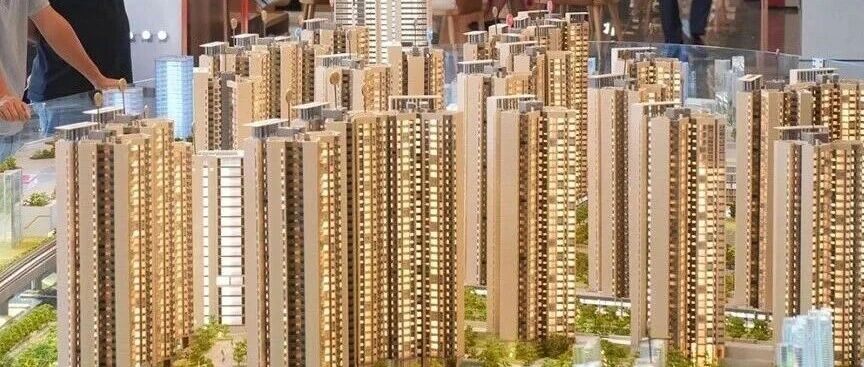
政策性收购二手房全面铺开 “老破小”或迎“暖春”
Xin Lang Cai Jing· 2026-02-27 19:29
Core Viewpoint - The recent initiatives in Shanghai to acquire second-hand housing for affordable rental housing projects signal a significant shift in the real estate market, emphasizing the importance of the second-hand housing market and addressing the "sell old, buy new" bottleneck for citizens [1][2]. Group 1: Policy Initiatives - Shanghai has officially launched the first batch of second-hand housing acquisitions, focusing on "old, broken, small" properties in core districts like Pudong, Jing'an, and Xuhui, with financial support from China Construction Bank [2]. - The acquisition criteria prioritize small units, specifically those built before 2000, with a maximum price of 4 million yuan and a size of 70 square meters or less [2][3]. - Other regions, such as Fujian and Jinan, are also implementing similar policies to encourage the acquisition of second-hand housing for affordable housing projects, indicating a nationwide trend [3][4]. Group 2: Market Dynamics - The acquisition of low-priced second-hand properties is expected to alleviate the pressure on homeowners to lower prices, stabilize price expectations, and break the negative cycle of price reductions and market hesitation [5][7]. - The shift from "incremental development" to "stock operation" in the real estate sector reflects a profound change in supply-demand dynamics, with government intervention in the circulation of existing assets [8][9]. - The role of local governments is evolving from "land suppliers" to "housing resource operators," directly influencing market demand and supply relationships [8][9]. Group 3: Long-term Implications - If the official acquisition of second-hand housing expands, it could reshape the real estate landscape by converting inefficient assets into affordable rental housing, optimizing resource allocation in core areas [9]. - Government intervention as a market stabilizer is expected to guide housing prices back to reasonable levels, promoting a shift from speculative trading to a focus on residential attributes, thus fostering long-term stability in the real estate market [9].
一文看懂“北上深”三城「商改保」最新推进情况
Sou Hu Cai Jing· 2026-02-27 04:50
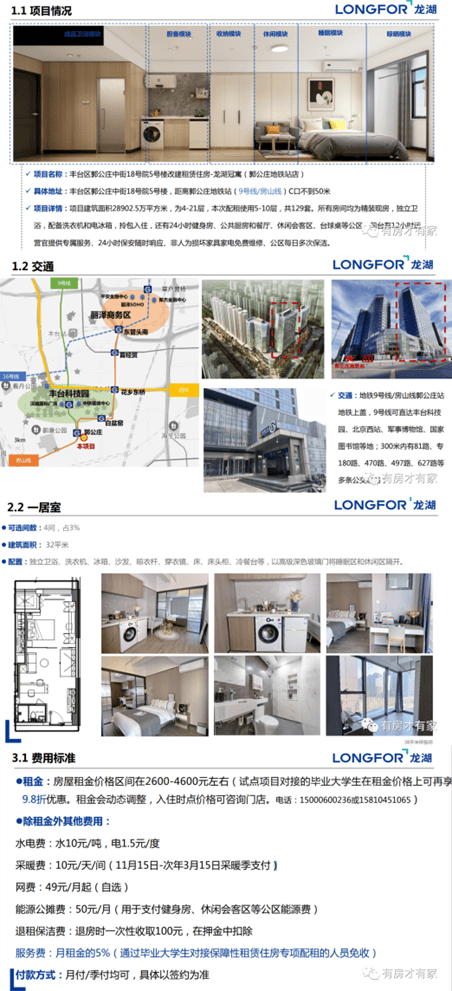
Core Insights - The "commercial-to-rental" initiative aims to convert idle non-residential properties into affordable rental housing, addressing the dual challenges of asset underutilization and housing shortages in major cities [1][3][31] Group 1: Policy Framework - The State Council's 2021 guidelines allowed the conversion of idle commercial properties into affordable rental housing without changing land use or paying additional land fees, providing tax incentives and utility price reductions [1][2] - Beijing has established a comprehensive policy framework for "commercial-to-rental," including top-level regulations and operational details, serving as a national benchmark [5][14] - Shanghai has developed a complete policy framework with a three-year action plan and implementation guidelines, focusing on the conversion of commercial properties into rental housing [14][15] Group 2: Market Conditions - Major cities like Beijing, Shanghai, and Shenzhen face high vacancy rates in commercial properties, with Beijing's Grade A office rental prices dropping to 246 RMB/sqm/month and vacancy rates reaching 17.9% [1][2] - The demand for affordable rental housing remains significant, with Beijing aiming for 400,000 new units and Shenzhen targeting at least 740,000 units during the 14th Five-Year Plan [2][3] Group 3: Project Implementation - Beijing's first "commercial-to-rental" project, the Longfor Guanyuyuan in Fengtai District, converted an idle office building into 728 rental units, showcasing a successful model [7][12] - Shanghai's Suhe Meixin Apartment, converted from an old office building, exemplifies the market-oriented approach to "commercial-to-rental," offering 230 high-quality rental units [16][20] - Shenzhen's first operational project, the Huan Shui | Boyu Ecological Software Park, quickly reached full occupancy, demonstrating the effectiveness of the initiative [25][29] Group 4: Financial and Operational Support - Financial institutions are providing low-interest loans and tax incentives for "commercial-to-rental" projects, facilitating funding and operational efficiency [6][15] - The approval process for these projects has been significantly streamlined, with some projects receiving approvals in as little as two months [6][15] Group 5: Broader Implications - The "commercial-to-rental" initiative addresses structural contradictions in urban development, optimizing resource allocation and enhancing living conditions [31] - It shifts urban renewal from extensive redevelopment to organic updates, preserving historical urban fabric while activating spatial value [31] - The integration of REITs into the "commercial-to-rental" model transforms it into a sustainable market-driven business, paving the way for new development models in the real estate sector [31]
1.6万户家庭住上公租房 泰安健全住房保障体系,让安居梦照进现实
Da Zhong Ri Bao· 2026-02-27 02:47
Core Viewpoint - The recent revision of the housing security policy in Tai'an aims to enhance the public rental housing system, addressing the urgent housing needs of residents and improving their living conditions [1][2]. Group 1: Policy Revision and Objectives - The revised implementation opinion focuses on optimizing the scope of public rental housing, improving the management mechanism for affordable rental housing, and enhancing the supply system for affordable housing [1][2]. - The policy revision is a response to the changing demands of urban development and aims to improve the efficiency of public rental housing resources and management processes [2][3]. Group 2: Key Measures and Changes - The new policy includes measures to relax entry requirements for public rental housing, increasing the per capita housing area standard from 12 square meters to 15 square meters and raising the income ceiling for low- to middle-income families [2][3]. - The policy eliminates asset restrictions for applicants, allowing more individuals facing housing difficulties to apply without the burden of financial asset limitations [2][3]. Group 3: Market Activation and Management - The policy aims to activate the affordable rental housing market by removing the construction area cap for new dormitory-style rental housing, thereby increasing market supply potential [3]. - A comprehensive management approach is established, ensuring strict oversight throughout the project lifecycle, from approval to construction and operation, to ensure efficient use of rental housing resources [3]. Group 4: Future Implementation and Goals - The city plans to enhance public awareness of the new policy, refine supporting measures, and strengthen oversight to ensure that the benefits reach the grassroots level and improve residents' lives [4]. - The initiative is part of a broader effort to promote the rule of law in housing security, aiming for high-quality economic and social development while ensuring a solid housing guarantee for residents [4].
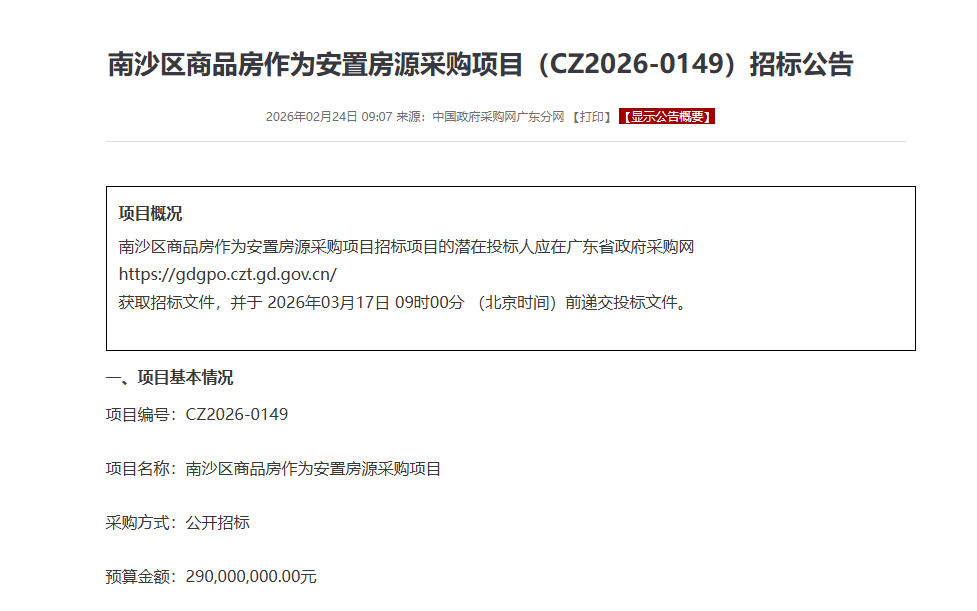
2.9亿元!广州南沙下场“收房”
Shang Hai Zheng Quan Bao· 2026-02-26 15:23
Group 1 - The core announcement is that Guangzhou's Nansha District plans to invest 290 million yuan to purchase 20,000 square meters of commercial housing to be used as resettlement housing [1] - The procurement requires that the commercial housing must be newly built, fully decorated, and completed but unsold, with a price not exceeding 14,500 yuan per square meter [4][3] - The housing must have clear ownership, no disputes, and be suitable for residential or mixed-use purposes, with specific requirements for unit types and sizes [4] Group 2 - Last year, Nansha District initiated a large-scale pilot program for "stock commercial housing resettlement," successfully providing around 2,100 units as resettlement housing [4] - The Guangzhou Anju Group has announced the first batch of 785 units of affordable housing for sale this year, with the "Wanglu Garden" project offering units at a base price of 22,800 yuan per square meter [5] - The city is also focusing on converting idle commercial office properties into affordable rental housing, with 664 units already transformed [7] Group 3 - The Guangzhou Housing and Urban-Rural Development Bureau aims to broaden channels for constructing affordable housing, emphasizing the conversion of existing stock [8] - Other cities like Shenzhen, Shanghai, and Jinan are also engaging in similar initiatives to revitalize stock housing resources [8] - Industry experts suggest that these initiatives can alleviate inventory pressure and enhance the housing security system, with state-owned enterprises expected to renovate acquired properties for rental purposes [9]
专项债收储存量房卡点在哪丨公共经济与管理
Di Yi Cai Jing· 2026-02-24 12:04
Core Viewpoint - The strategy of utilizing local government special bond funds to acquire existing commercial housing and convert it into affordable housing is a key choice for Shanghai to address the dual challenges of excess commercial housing inventory and insufficient affordable housing supply [1] Group 1: Current Initiatives - In early 2026, Shanghai's Jing'an, Xuhui, and Pudong districts will launch a government-led pilot program for the acquisition of second-hand housing, aiming to convert eligible existing housing into affordable rental units [1] - The initiative represents a significant attempt by local government to intervene in the existing housing market, focusing on optimizing resource allocation and revitalizing existing properties [1] Group 2: Challenges Faced - There is a need for improved inter-departmental coordination, as the acquisition process involves multiple departments with differing priorities, leading to delays in project advancement [2] - The priority of existing housing acquisition projects is low in the allocation of special bond quotas, as these projects compete with infrastructure and other areas that offer quicker returns [2] - There is a significant price gap between local government cost control and developers' need for profit, complicating acquisition pricing [2] - Achieving a balance between project revenue and financing is difficult due to the inherent low pricing of affordable housing [2] Group 3: Recommendations for Improvement - Shanghai should establish standardized operational guidelines and a "green channel" for project approval to expedite processes in areas with high inventory pressure and urgent affordable housing needs [3] - The management mechanism for special bonds should be optimized by relaxing funding usage restrictions and introducing differentiated revenue evaluation standards for affordable housing projects [3] - A market-oriented pricing system should be developed, including a unified data platform for price assessment and a "shared revenue, shared risk" model to align interests between government and developers [4] Group 4: Innovative Financing Solutions - Innovative revenue models should be explored to reconcile the conflict between public welfare and profitability, such as combining rental income with commercial operations to enhance overall returns [5] - The introduction of a financing tool combination, such as "special bonds + re-loans + REITs," could facilitate project acquisition and operational funding [5] - A cross-regional revenue balancing mechanism could be established to package high-yield affordable housing projects with those in less profitable areas, ensuring overall compliance with special bond repayment requirements [5]
马年开工首日 上海多个重大工程马力全开
Xin Lang Cai Jing· 2026-02-24 11:03
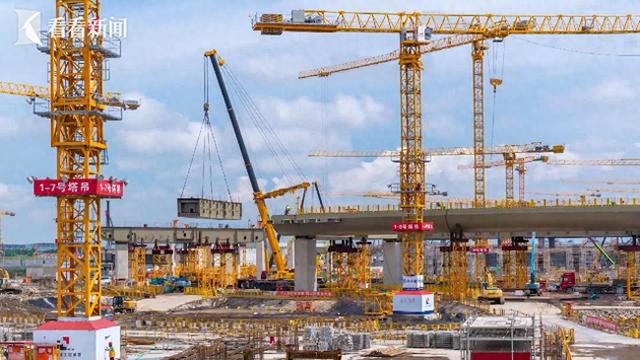
Group 1 - Shanghai's major construction sites are fully operational on the first day of the Year of the Horse, aiming for a strong start to the year and a good beginning for the 14th Five-Year Plan [1] - The Pudong Hospital Lingang District project is a significant functional project in the Lingang New Area, with over 200 workers on-site for inspections and ensuring smooth progress, expected to be completed in the first half of this year [3] - The affordable rental housing project on Tingxi Road has completed the structural work of four residential buildings, with over 830 rental units planned to be available by next year’s Spring Festival [5] Group 2 - A major construction ceremony was held in Huangpu District, focusing on education, public welfare, and affordable housing projects, while also developing waterfront public spaces [6] - Shanghai has scheduled 184 major projects for this year, with a planned investment of 255 billion yuan, aiming to achieve a historical high [8]
国资下场了!老破小等到最大的买家
Sou Hu Cai Jing· 2026-02-15 18:19
Core Viewpoint - The real estate market is experiencing stagnation, and state-owned enterprises (SOEs) are emerging as key players to revitalize the second-hand housing market by targeting neglected "old and dilapidated" properties, providing much-needed liquidity [1][3]. Group 1: Market Dynamics - The second-hand housing market is facing challenges with low sales and high prices for new homes, leading to a broken replacement chain for many families [1]. - In February 2026, the first batch of second-hand housing acquisitions for affordable rental housing projects in Shanghai was signed, signaling a significant shift in the market [3]. - SOEs are entering the market with a direct "acquisition model," contrasting with traditional real estate agency practices, injecting liquidity into the market [5]. Group 2: Acquisition Criteria and Impact - SOEs have specific acquisition criteria, such as targeting properties built before 2000, under 70 square meters, and priced below 4 million yuan, focusing on "old and dilapidated" homes in prime locations [5]. - The demand for small rental units is high, with 78.2% of the rental market in Shanghai in 2025 being for one- and two-bedroom apartments, indicating a strong need for affordable housing [5]. - Different regions are adopting varied acquisition strategies, such as Shanghai's "housing ticket" system and cash purchases in other districts, enhancing flexibility in the market [6]. Group 3: Long-term Mechanisms and Challenges - The SOE acquisition strategy addresses the "work-life balance" issue for young professionals by converting central city "old and dilapidated" homes into affordable rental units [8]. - This approach is expected to activate the replacement chain in the housing market, reducing risks associated with upgrading homes and alleviating the pressure of increasing listings [8]. - However, challenges remain, including pricing difficulties that could lead to losses for SOEs or dissatisfaction among homeowners, as well as regional restrictions that may limit the effectiveness of the acquisition strategy [11]. Group 4: Future Outlook - The central government's 2025 economic meeting emphasized encouraging the acquisition of existing homes for affordable housing, setting a policy direction for this model [13]. - If successful in Shanghai, this model could lead to a transformation in the role of local governments and investment platforms from land suppliers to market stabilizers and housing resource operators [13]. - The real estate industry is shifting from "incremental development" to "stock operation," with the ability to revitalize existing assets becoming crucial for success in the upcoming market reshuffle [13].
2026第一波大招落地,多地官方下场收二手房。重庆……
Sou Hu Cai Jing· 2026-02-15 12:47
Core Viewpoint - The article discusses a significant shift in the housing market, where government-led initiatives to purchase second-hand homes are emerging as a crucial trend for 2026, indicating a deep restructuring of the housing system rather than a temporary market rescue [2][25]. Group 1: Government Initiatives - Multiple cities, including Shanghai, Nanjing, Hangzhou, and Haikou, are initiating a "stock housing acquisition wave" led by the government [2]. - In Shanghai, pilot programs are being launched in key districts such as Pudong, Jing'an, and Xuhui, with specific requirements for the properties being acquired [3][5]. - The acquisition conditions include properties built before 2000, with a maximum area of 70 square meters and a total price cap of 4 million yuan, with financial support from China Construction Bank [5]. Group 2: Housing Supply and Demand Dynamics - The acquired properties will be converted into affordable rental housing to support new citizens and young people [5][10]. - The acquisition model aims to address liquidity issues in the stock housing market while simultaneously creating affordable housing options [10][11]. - The policy is designed to stimulate the new housing market by releasing funds and housing vouchers, thereby facilitating a smoother transition for homeowners [9][15]. Group 3: Broader Implications - The current initiatives are seen as a way to build confidence in the housing market and provide a predictable exit mechanism during times of slow market liquidity [13][14]. - The approach benefits multiple stakeholders, including homeowners looking to upgrade and renters seeking affordable housing, ultimately improving overall market liquidity [16]. - The article highlights that while the scope may be limited initially, the signal sent by these policies is clear: the government is actively working to revitalize the housing market [15][26]. Group 4: Case Study - Chongqing - Chongqing has not officially announced the purchase of individual second-hand homes but is exploring beneficial strategies within the broader framework of stock revitalization [18]. - In early 2024, state-owned enterprises in Chongqing acquired seven stock housing projects, totaling 4,207 units, demonstrating a proactive approach to housing supply [20]. - The city has implemented various measures to stabilize the real estate market, including a recent announcement of 22 policies aimed at revitalizing stock housing [23][24].
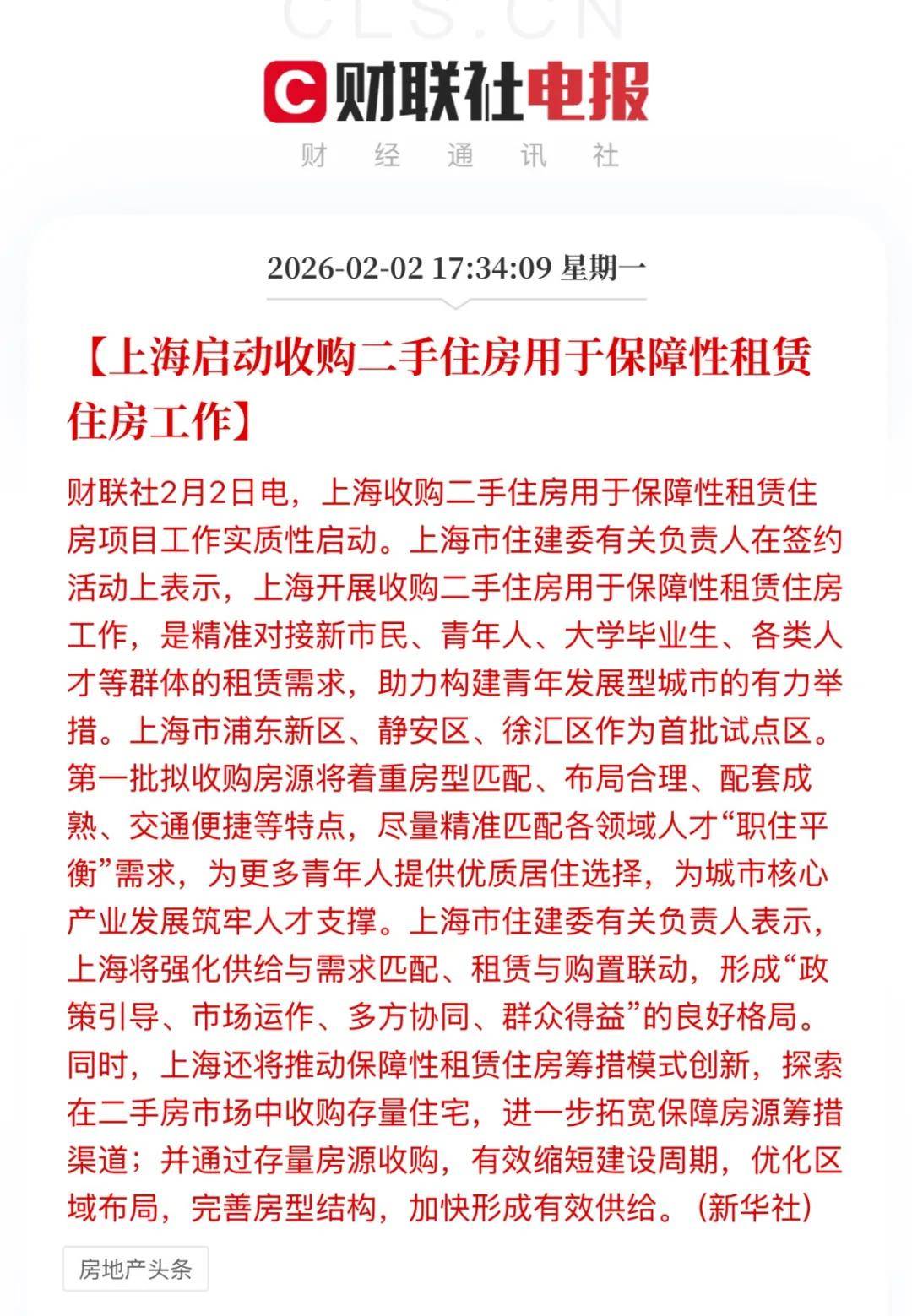
房地产行业点评:关于上海收购二手房用于保租房试点工作启动的点评
Bank of China Securities· 2026-02-14 05:39
Investment Rating - The industry investment rating is "Outperform the Market," indicating that the industry index is expected to perform better than the benchmark index over the next 6-12 months [24]. Core Insights - The pilot program in Shanghai for acquiring second-hand housing for rental housing is expected to have advantages compared to lower-tier cities and may serve as a guiding model for other key urban projects [2][4]. - If the implementation is orderly, it could positively impact market expectations and confidence [2]. - The acquisition of second-hand homes is part of a new model called "monetization of affordable housing construction," allowing for the conversion of physical affordable housing into monetary funds for purchasing suitable existing homes [1][4]. Summary by Sections Event Overview - On February 2, 2026, the first batch of second-hand housing acquisitions for rental housing projects in Shanghai was officially signed, supported by China Construction Bank [1]. - The pilot will take place in the districts of Pudong, Xuhui, and Jing'an, focusing on acquiring 96 second-hand homes to be included in the affordable housing supply system [1]. Acquisition Mechanism - The acquisition will prioritize small-sized units built before 2000, with a total price not exceeding 4 million yuan, targeting properties with clear ownership and no disputes [4][5]. - The program aims to address the housing supply-demand imbalance in key areas with high rental demand [4][6]. Market Conditions - As of the end of 2025, there were approximately 4,825 second-hand homes in the three districts that met the acquisition criteria, with a total listing value of 14.2 billion yuan [4][11]. - The rental demand for one and two-bedroom units in these districts is notably high, with demand ratios reaching 85.4% in Xuhui, 80.2% in Pudong, and 78.2% in Jing'an [6][8]. Financial Support and Sustainability - The funding for the acquisitions will come from district-level financial resources, supplemented by bank loans, with rental income from the acquired properties expected to support ongoing operations [4][5]. - China Construction Bank is expected to provide financial support for the acquisition process, including customized financing solutions [4][5]. Comparative Analysis - The report compares Shanghai's approach to similar initiatives in Zhengzhou, noting that while Zhengzhou's program has not significantly boosted market demand, Shanghai's pilot is positioned to better meet existing rental needs [4][5]. - The price decline of second-hand homes in Shanghai has been significant, with prices in the three districts dropping by over 20% compared to their peak [4][15].