Hydropower

Search documents
X @Bloomberg
Bloomberg· 2026-02-14 03:08
First Gen will buy a 40% stake in Prime Infrastructure Capital’s hydropower portfolio in a deal worth $1.3 billion, the Philippine companies said. https://t.co/M8lS44SOf8 ...
China-backed power plant, Astra gold mine lose permits in Indonesian environmental crackdown
Reuters· 2026-01-21 06:03
Group 1 - A China-backed hydropower plant and a gold mining unit operated by Astra International had their permits revoked by the Jakarta government [1] - The revocation of permits affected a total of 28 firms [1] - This action reflects the Jakarta government's regulatory stance towards foreign investments in the region [1] Group 2 - The specific reasons for the permit revocations were not detailed in the report [1] - The impact on the operations and financial performance of the affected companies remains to be seen [1] - The move may signal increased scrutiny of foreign investments in Indonesia's natural resources sector [1]


2025年1-11月中国水力发电量产量为12285.5亿千瓦时 累计增长2.7%
Chan Ye Xin Xi Wang· 2026-01-13 02:57
Core Viewpoint - The report highlights the growth of China's hydropower generation, indicating a significant increase in production and a positive outlook for the industry from 2026 to 2032 [1] Group 1: Industry Overview - In November 2025, China's hydropower generation reached 96.7 billion kilowatt-hours, marking a year-on-year increase of 17.1% [1] - From January to November 2025, the cumulative hydropower generation in China was 1,228.55 billion kilowatt-hours, reflecting a cumulative growth of 2.7% [1] Group 2: Companies Involved - Listed companies in the hydropower sector include: - Changjiang Electric Power (600900) - Huaneng Hydropower (600025) - Guotou Power (600886) - Chuan Investment Energy (600674) - Guiguan Electric Power (600236) - Qianyuan Electric Power (002039) - Hubei Energy (000883) - Mindong Electric Power (000993) - Leshan Electric Power (600644) - Chaozhou International Electric (600969) [1]

突破!抽水蓄能电站支撑电力运行“稳定器”“调节器”作用凸显 筑牢电力安全防线
Yang Shi Wang· 2025-12-25 05:02
Core Viewpoint - The Zhejiang Tiantai Pumped Storage Power Station, the largest single-unit pumped storage power station in China, has successfully connected its first unit to the grid, marking a significant breakthrough in the field of hydropower equipment and engineering construction in the country [1][3]. Group 1: Project Overview - The total investment for the Zhejiang Tiantai pumped storage project exceeds 10 billion yuan, consisting of an upper reservoir, lower reservoir, water conveyance system, and underground powerhouse, with a total installed capacity of 1.7 million kilowatts from four units, each with a capacity of 425,000 kilowatts [6][9]. - The project is recognized as the largest pumped storage power station initiated during China's 14th Five-Year Plan, achieving power generation during its construction phase [9]. Group 2: Technical Achievements - The construction process has led to multiple technological breakthroughs in areas such as ultra-high head large-capacity units, advanced materials, and intelligent construction [9]. - The power station is expected to provide approximately 1.7 billion kilowatt-hours of clean electricity annually, sufficient to meet the annual electricity needs of a city with a population of 1.6 million [9]. Group 3: Operational Role - The power station will play a crucial role in peak shaving, valley filling, frequency regulation, phase adjustment, energy storage, and emergency backup for the Zhejiang power grid, enhancing the flexible dispatch capability of the East China power grid and ensuring stable operation of the power system [11]. - Pumped storage is considered the most mature and economically viable "giant battery" for the power grid, effectively managing energy supply and demand fluctuations [12][21]. Group 4: Functionality of Pumped Storage - The basic framework of a pumped storage power station involves constructing reservoirs at different elevations, allowing for the conversion of electrical energy into potential energy and vice versa [14]. - During periods of excess electricity generation, such as during peak solar output, the power station utilizes surplus energy to pump water to the upper reservoir, preventing energy waste [16]. - When renewable energy generation decreases, the station switches to power generation mode, releasing stored water to generate electricity, thus ensuring stable electricity supply for residential and industrial use [18][21].

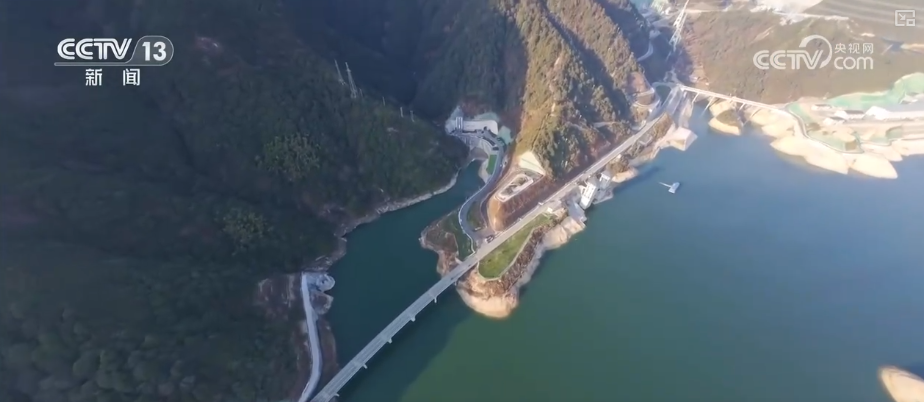
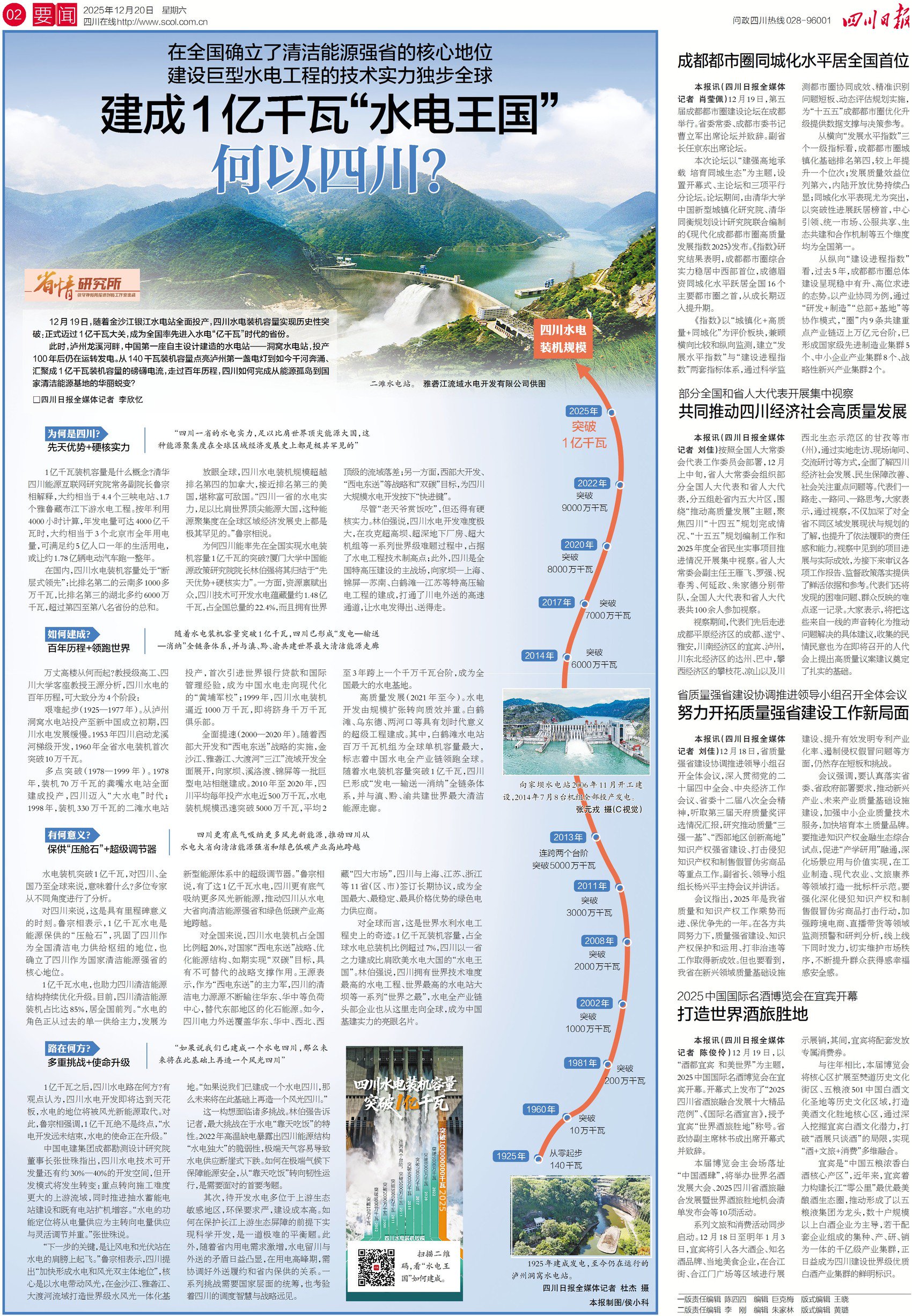
“水电王国”四川 率先迈进“亿千瓦”时代丨川报早读
Xin Lang Cai Jing· 2025-12-19 22:31
Core Insights - Sichuan province has officially surpassed 100 million kilowatts in hydropower installed capacity, becoming the first province in China to enter the "100 million kilowatt" era in hydropower generation [1][4] - This capacity is equivalent to 4.4 Three Gorges dams, with an annual generation potential of 400 billion kilowatt-hours, sufficient to meet the electricity needs of 500 million people for a year or power 178 million electric vehicles for a year [1] - Sichuan's hydropower development has grown over 700,000 times since the first hydropower station was established, showcasing its significant advancements in hydropower engineering technology [1][8] Resource Endowment and Historical Development - Sichuan has the largest technically exploitable hydropower resources in China, estimated at approximately 148 million kilowatts [1] - The province's hydropower development began slowly in the early years of the People's Republic of China, with significant milestones achieved from 1978 to 1999, marking the transition to a "large hydropower" era [4] - Major hydropower stations, such as Gongzui and Ertan, were completed during this period, contributing to the rapid increase in installed capacity [4] Strategic Importance and Future Directions - The achievement of 100 million kilowatts is seen as a milestone for Sichuan, reinforcing its position as a clean energy hub in China and supporting the national "West-East Power Transmission" strategy [6] - Sichuan's clean energy structure is currently 85% hydropower, and the province aims to further integrate wind and solar energy into its energy mix, creating a "Wind and Solar Sichuan" [5][6] - Experts suggest that while hydropower development may face limitations, there remains 30-40% of exploitable capacity, with a shift towards more challenging upstream projects and energy storage solutions [4][5] Challenges and Considerations - The reliance on hydropower poses risks, particularly in extreme weather conditions, which can lead to significant fluctuations in energy supply [6][7] - Environmental concerns and high construction costs in ecologically sensitive areas present challenges for future hydropower development [7] - Balancing local electricity demand with the need to export power during peak periods is becoming increasingly complex, necessitating strategic planning and coordination at the national level [7]
Inside China’s Controversial $167 Billion Mega-Dam | Exclusive Preview
Bloomberg Originals· 2025-12-17 17:01
Project Overview - China is planning to build the Yaxia Hydropower Project (Lower Yarlung Hydropower Project) at The Great Bend of the Yarlung Tsangpo River, a project considered even more ambitious than the Three Gorges Dam [1][5] - The project aims to dominate hydropower generation, potentially becoming the world's largest individual source of energy [7][8] - Analysts are using social media, state television, and satellite images to understand the project's design due to limited official information [9] Engineering and Design - The project is envisioned as a diversion project, potentially consisting of a series of hydropower stations along the river, including upstream and downstream dams with underground tunnels [9][10] - The scale of the project is considered novel, with engineers potentially doubting the feasibility of building it in such a remote location [12] - The volume of water diverted will be similar to the discharge of a medium-sized river like the Rhine in Europe [11] Power Generation and Capacity - The project is expected to have an installed capacity of 60 gigawatts [8] - The Chinese government estimates the project will generate approximately 300 billion kilowatt hours per year, exceeding the UK's annual usage and about three times more than the Three Gorges Dam generates [8] Environmental and Geopolitical Considerations - The project is located in an earthquake-prone area, requiring tunneling through rising mountains [2] - The project could affect hundreds of millions of lives downstream in neighboring India and Bangladesh, potentially creating tensions over water resources [2] - The Great Bend is characterized by a significant elevation drop of about 2,000 meters (6,562 feet) over a 50 kilometer (31 miles) distance, making it the world's steepest and deepest canyon [5][6][7]

长江电力 - 线上会议要点-稳中求进;维持增持评级
2025-12-10 12:16
Summary of Yangtze Power Conference Call Company Overview - **Company**: Yangtze Power Co., Ltd. (YZP) - **Industry**: Hydropower and Renewable Energy - **Ticker**: 600900 CH Key Points Hydropower Generation Targets - Management reaffirmed confidence in meeting the 2025 hydropower generation target of **300 billion kWh** despite lower water inflows in the first nine months of 2025 [3][12] - Water inflow at Wudongde and Three Gorges was down in 9M25 compared to 9M24, but six cascade hydropower stations maintained stable power generation year-over-year [3][12] Financial Performance and Cost Management - Significant improvements in financing costs through debt restructuring, with overall financing costs expected to be lower than **Rmb 10 billion** in 2025, down approximately **Rmb 2 billion** compared to 2023/2024 [4][12] - Management highlighted the reduction of financial costs due to low-interest loan replacements and early repayments [4][12] Power Pricing and Market Impact - Limited impact from recent power price fluctuations due to a high proportion of fixed-price contracts; about **37%** of power is sold at market prices, with **20%** linked to long-term contracts [5][12] - Management anticipates further weakness in overall power prices in China due to ample power supply and weak coal prices, but expects recognition of YZP's hydropower for its green value in the long run [5][12] Dividend Policy - YZP maintains a commitment to a minimum **70%** dividend payout, with potential increases subject to future investment and shareholder needs [8][12] Capacity Upgrades and Future Investments - Ongoing capacity upgrades at Gezhouba and Xiangjiaba stations, with high returns and strong margins expected [9][12] - Future investments will focus on new hydropower resources, pumped storage stations, and clean energy innovation, with plans to add **6.8 GW** of pumped storage capacity by the end of 2030 [9][12] Analyst Recommendations - J.P. Morgan maintains an Overweight (OW) rating on Yangtze Power, with a price target of **Rmb 34.30** by June 2026, indicating an attractive yield spread against government bonds [10][12][13] Risks - Downside risks to the rating and price target include lower-than-expected utilization and hydropower tariffs [15][12] Conclusion Yangtze Power remains a strong player in the hydropower sector with solid financial management, a commitment to dividends, and strategic investments in capacity upgrades and renewable energy innovation. The company is well-positioned to meet its generation targets despite current market challenges.
Norsk Hydro: Hydro invests NOK 1.2 billion to build Illvatn pumped storage power plant
Globenewswire· 2025-11-14 06:00
Core Insights - Hydro has made a significant investment decision for its largest hydropower project in over 20 years, the Illvatn pumped storage power plant, with construction starting in November and operations expected by 2030 [1][2]. Investment Details - The gross investment for the Illvatn project is NOK 2.5 billion, with a net investment after tax estimated at NOK 1.2 billion due to Norway's cash flow tax scheme for hydropower investments [1]. - The new plant will generate 107 GWh of annual renewable power, specifically for Hydro's aluminium production [1]. Project Features - The pumped storage plant will enhance energy production and reservoir capacity by pumping water from Fivlemyrane to the Illvatn reservoir, increasing total production during high-demand winter months [3]. - A new 13-kilometer power line will be constructed from Fivlemyr to Sveinsøystølen, utilizing aluminium for the power towers to promote sustainable grid development [4]. Industrial Impact - The Illvatn project is crucial for Norway's industrial development, providing renewable energy necessary for reducing emissions and supporting new industries [5][6]. - Hydro aims to ensure competitive power prices for its aluminium plants through increased and flexible hydropower production [6]. Environmental Goals - Hydro's current aluminium production has a carbon footprint approximately 75% lower than the global average, with a goal to achieve zero carbon aluminium by 2050 [7].


Mass Megawatts Announces a New Hydroelectric Cost Cutting Technology Paying for Itself in Less than Two Years at the Best Locations
Globenewswire· 2025-11-06 11:00
Core Viewpoint - Mass Megawatts has developed a new hydroelectric technology that promises a quick financial payback, potentially transforming the energy marketplace with fewer barriers to entry compared to previous products [1][2]. Group 1: New Technology Overview - The new low-cost Hydroelectric Power System can achieve payback in less than two years at optimal locations, utilizing significantly less than 50% of the materials and initial engineering requirements compared to traditional hydropower plants [2]. - The Hydro Multiaxis Turbosystem, or Hydromat, features a tower structure with multiple smaller blades connected to various shafts, leveraging water's density to enhance power generation efficiency [3][4]. Group 2: Design and Engineering Advantages - The design of the Hydromat simplifies blade construction by using smaller blades, which reduces costs and engineering complexities associated with larger blades [4][5]. - Smaller blades lead to lower material usage and reduced weight, as the weight of a blade increases with the cube of its length, while power output increases only with the square of its length [5]. - The new system reduces vibrations and mechanical stress, enhancing the longevity of components like bearings and allowing for the use of standard off-the-shelf parts, which mitigates supply chain issues [6]. Group 3: Efficiency and Performance - The Hydromat technology allows for a higher aspect ratio, improving efficiency by maintaining a large swept area with a low rotor diameter, thus reducing inertia and energy expenditure [9]. - The use of multiple smaller blades per shaft overcomes imbalance issues associated with traditional single-blade designs, resulting in a more durable and efficient turbine [9].

Statkraft divests assets for NOK 13.5 billion in the third quarter
Globenewswire· 2025-10-30 07:00
Core Insights - Statkraft's third quarter results in 2025 showed a decrease despite higher production, primarily due to low prices in Northern Norway, reduced contributions from Markets, and negative hedging effects [1][6][11] Financial Performance - Power generation in Q3 2025 was 15.8 TWh, an increase from 13.3 TWh in Q3 2024, with record-high generation of 52.7 TWh in the first nine months of 2025 [7][10] - Net operating revenues for the quarter were NOK 8.0 billion, down from NOK 9.8 billion, while underlying EBITDA decreased to NOK 3.1 billion from NOK 4.9 billion [7][11] - Net profit for the quarter was NOK -0.7 billion, compared to NOK -0.2 billion in the previous year [7][14] Strategic Developments - Statkraft executed a refocused strategy by signing agreements to divest assets worth approximately NOK 13.5 billion, including district heating, transmission lines in Peru, and renewable energy assets in multiple countries [1][3][7] - The company aims to reduce complexity and costs while freeing up capital for growth in prioritized technologies and markets [2][3] Market Operations - The average system price in the Nordic region was 36 EUR/MWh, an increase of 16.2 EUR/MWh from Q3 2024 [9] - Market activities experienced lower levels compared to a strong previous year, with underlying EBITDA from Markets dropping to NOK 20 million from NOK 1.4 billion [12][8] Future Investments - Statkraft plans for a long-term investment capacity of NOK 16-20 billion per year, focusing on solar, wind, battery storage, and grid services in Europe and South America [4][5] - Significant investments will also be allocated to hydropower refurbishments and new onshore wind developments in Norway and Sweden [5]