Pharmaceutical Retail

Search documents
Market Open: Aussie earnings roll on toward Feb finish line; US tech rally keeps WK9 very green | Feb 26
The Market Online· 2026-02-25 21:55
Group 1: Market Overview - The ASX is experiencing an upswing, influenced by Wall Street's continued advance, with ASX 200 futures indicating a potential +0.9% increase [1][3] - European markets reached record highs, with the FTSE up by +1.2% [2] Group 2: Company Earnings - Qantas (ASX:QAN) reported a profit increase of $71 million, totaling $1.46 billion, and announced a $150 million share buyback along with a dividend of 19.8 cents [4] - Sigma Healthcare (ASX:SIG) saw a 23% rise in half-year net profits, reaching $379 million, and will pay a 2-cent dividend [5] - Super Retail (ASX:SUL) experienced a rise in sales but reported a 20% drop in profits due to discounting in the auto and sports sectors [4] Group 3: Other Company News - BlueScope Steel (ASX:BSL) rejected a fifth bid from SGH Limited and Steel Dynamics, valuing the offer at $14.2 billion as too low compared to its fundamental value [5] - Corporate Travel (ASX:CTD) plans to resume trading in Q2 following a forensic accounting review expected to conclude in March [5] Group 4: Commodity Prices - Iron Ore prices increased by +2.1%, now selling at $98.80 per tonne [6] - Brent Crude oil gained +0.3%, priced at $70.98 per barrel [6] - Gold is currently selling at $5,191 per ounce, while US natural gas futures rose by +3% to $2.88 per gigajoule [7]



省内首台自助售药机将在沈上岗
Xin Lang Cai Jing· 2026-02-21 22:20
Core Viewpoint - The strategic cooperation between Shenyang's Market Supervision Administration and JD Health aims to address the "last mile" challenges in healthcare access by introducing self-service medicine and medical device vending machines, enhancing convenience for residents [1][2]. Group 1: Project Overview - The self-service vending machines will integrate the sale and retrieval of medicines and medical devices, with the first pilot located in the Tiexi District of Shenyang, marking a significant breakthrough in the region [2]. - Shenyang becomes the third city in China, after Beijing and Shanghai, to collaborate with JD Health on this initiative, indicating a growing trend in the integration of technology in healthcare [2]. Group 2: Regulatory Framework - The local market supervision department is developing regulations based on experiences from other cities to ensure that the new business model operates within a legal framework, addressing the lack of local guidelines in this area [2]. - The approval process for the vending machines has been expedited, with a reduction in approval time by over 80%, demonstrating a commitment to facilitating innovation while maintaining regulatory compliance [3]. Group 3: Safety and Quality Assurance - Quality and safety are prioritized, with all medicines sold through the vending machines sourced from licensed pharmaceutical wholesalers, and a real-time monitoring system in place to track sales data [4]. - The vending machines will only dispense Class B non-prescription drugs and personal medical devices, ensuring that prescription medications require valid prescriptions for purchase, thus maintaining safety standards [4]. Group 4: Complementary Role of Traditional Pharmacies - The initiative is not intended to replace traditional pharmacies but to complement them, filling service gaps and time constraints, with physical stores providing inventory and professional services [4].
中国医药零售板块:政策支持恰逢行业拐点_ China Pharmaceutical Retail Sector _ Policy support came at the sector‘s inflection point
2026-01-26 15:54
Summary of the Conference Call Transcript Industry Overview - **Industry**: China Pharmaceutical Retail Sector - **Key Development**: Nine ministries, including the Ministry of Commerce and the National Health Commission, issued policies to support the high-quality development of the pharmaceutical retail sector on January 22, 2026, aiming for professional, sustainable, digital, and compliant growth [2][5]. Core Insights - **Market Dynamics**: Despite ongoing store closures, industry leaders like Yifeng and Dashenlin are poised for expansion after completing internal adjustments. The sector has significant consolidation potential, with market shares of leading pharmacies in provinces often below 20% [3][5]. - **Sales Growth Potential**: The increasing outflow of prescriptions and pharmacies' efforts to diversify products could enhance same-store sales growth (SSSG). Currently, pharmacies account for approximately 30% of China's drug market [3][5]. - **Company Guidance**: Yifeng and Dashenlin provided optimistic guidance for 2026, with expansion plans and earnings outlook surpassing market expectations. Their valuations are considered attractive, estimated at around 14-15x 2026E PE [3][5]. Regulatory Environment - **Consolidation Encouragement**: The government is promoting horizontal mergers and acquisitions (M&As) and restructuring among drug retailers [5]. - **Regulatory Adjustments**: Policies include optimizing inspection frequencies for compliant drug retailers and addressing violations related to internet hospitals and physician licenses [5]. - **Prescription Mechanism Improvements**: Enhancements to the prescription outflow mechanism and e-prescription platforms are being implemented, along with equal reimbursement standards for pharmacies and primary-level hospitals [5]. Risks Identified - **Policy Risks**: Changes in state medical insurance policies could impact drugstore traffic and margins. Regulatory requirements may also affect expansion plans and operational costs [7]. - **Operational Risks**: Non-compliance with regulations could lead to severe consequences, including disqualification from state insurance payments and revocation of operating licenses [7]. - **Competitive Landscape**: Accelerating consolidation may lead to the emergence of regional leaders, which could hinder the expansion of cross-regional chains and intensify competition among leading chains [7]. - **Shift to E-commerce**: The rise of pharmaceutical e-commerce, often offering lower prices, may divert traffic from offline drugstores as consumer purchasing habits evolve [7]. Company Valuation - **Valuation Methodology**: Price targets for Yifeng and Dashenlin are derived using Discounted Cash Flow (DCF) methodology [6]. Company Ratings - **Dashenlin Pharmaceutical**: Rated "Buy" with a price of Rmb19.90 as of January 22, 2026 [19]. - **Yifeng Pharmacy Chain**: Rated "Buy" with a price of Rmb22.55 as of January 22, 2026 [19]. This summary encapsulates the key points from the conference call, highlighting the current state and future outlook of the China pharmaceutical retail sector, along with specific insights into leading companies and associated risks.

A股早评:三大指数集体高开,黄金白银股再度活跃
Ge Long Hui· 2026-01-23 01:33
Core Viewpoint - The A-share market opened with all three major indices rising, indicating a positive market sentiment at the start of trading [1] Group 1: Market Indices Performance - The Shanghai Composite Index opened up by 0.18%, reaching 4130.11 points [1] - The Shenzhen Component Index opened up by 0.15% [1] - The ChiNext Index opened up by 0.16% [1] Group 2: Sector Performance - Gold and silver prices reached new highs, leading to increased activity in gold and silver stocks [1] - The silver and non-ferrous metals sectors saw stocks hitting the daily limit [1] - The pharmaceutical retail and photovoltaic equipment sectors opened higher, while the oil and gas extraction and service sectors experienced a decline at the beginning of trading [1]

商务部等9部门关于促进药品零售行业高质量发展的意见
Yang Shi Wang· 2026-01-22 09:09
Core Viewpoint - The Chinese government aims to enhance the pharmaceutical retail industry by implementing policies that promote professional services, health promotion, and emergency supply capabilities, ultimately creating a "health station" to better meet the public's healthcare needs [1] Group 1: Overall Requirements - The initiative is guided by Xi Jinping's thoughts and aims for a combination of government guidance and market leadership, focusing on innovation and standardized development to foster a high-quality pharmaceutical retail sector [1] Group 2: Improving Pharmaceutical Services - Retail pharmacies are encouraged to enhance their pharmaceutical service capabilities by equipping teams with licensed pharmacists and health consultants, and providing training to improve professional service quality [2] - The reform of the medical and health system will continue, promoting the flow of external prescriptions and improving the efficiency of electronic prescription platforms [2] - The payment and reimbursement mechanisms for insured patients purchasing medications at designated retail pharmacies will be optimized to enhance efficiency [3] Group 3: Innovation in Health Services - Retail pharmacies are encouraged to expand health management services, including medication guidance and health consultations, and to collaborate with community organizations for health care services [5] - The development of digital and intelligent health service policies is promoted to enhance the health service experience [5] Group 4: Strengthening Emergency Services - Large retail pharmacy chains are encouraged to establish dynamic demand forecasting and low inventory warning systems to enhance their emergency supply capabilities [7] - Retail pharmacies are urged to participate in monitoring key drug markets and provide services during emergencies, such as 24-hour operations and free delivery [7] Group 5: Optimizing Industry Structure - The initiative supports mergers and acquisitions among retail pharmacies to optimize the industry structure and improve operational efficiency [8] - Integration of wholesale and retail operations is encouraged to enhance supply chain efficiency and reduce operational costs [8] Group 6: Regulating Industry Order - The development of smart regulation is emphasized, with a focus on accurate tracking and verification of drug traceability codes [9] - Continuous efforts will be made to ensure fair competition in the industry, particularly in online and offline markets [9]
Jim Cramer Reveals How CVS Health Corporation (CVS) is “Saving a Lot of Money”
Yahoo Finance· 2026-01-09 17:04
Core Insights - CVS Health Corporation (NYSE:CVS) is recognized as one of the largest pharmaceutical chains in America, with its shares increasing by 73% over the past year [2] - JPMorgan has named CVS as a Top Pick, raising its share price target to $101 from $93, citing impressive earnings growth projections through 2028 [2] - Bernstein has also expressed optimism, increasing its price target for CVS to $87 from $86 while maintaining a Market Perform rating, influenced by the firm's strong management and market leadership [2] Operational Insights - CVS has implemented Salesforce technology, which has significantly improved operational efficiency and cost savings [3] - The company is focused on enhancing customer service, moving away from traditional hold times in business communications [3]

老百姓(603883):药品零售业务承压 区域深耕与新零售布局成效显著
Xin Lang Cai Jing· 2025-08-27 10:32
Summary of Key Points Core Viewpoint - The company reported a decline in revenue and net profit for the first half of 2025, with a focus on expanding its store network and enhancing online sales capabilities to drive future growth [1][2]. Group 1: Financial Performance - In H1 2025, the company achieved revenue of 10.77 billion yuan, a year-over-year decrease of 1.5%, and a net profit attributable to shareholders of 400 million yuan, down 20.9% year-over-year [1]. - The gross margin for H1 2025 was 33.1%, a decline of 1.2 percentage points, attributed to the increased sales proportion of new retail business [1]. - The company’s Q2 2025 revenue was 5.34 billion yuan, with a net profit of 150 million yuan, reflecting a year-over-year decrease of 18.9% [1]. Group 2: Store Expansion and Online Sales - As of H1 2025, the company had a total of 15,385 stores nationwide, with a net increase of 108 stores, primarily driven by a net increase of 305 franchise stores [2]. - Online sales reached approximately 1.49 billion yuan in H1 2025, representing a year-over-year growth of 32% [2]. - The company’s O2O and B2C sales ranked fourth and third in the market, respectively, showcasing its competitive strength in the new retail sector [2]. Group 3: Brand Innovation and Product Strategy - The company continues to innovate its private label brands, focusing on optimizing product categories and enhancing cost-performance [3]. - In H1 2025, sales from self-owned brand stores (excluding DTP) amounted to 1.76 billion yuan, accounting for approximately 23% of total sales, an increase of 1.5 percentage points [3]. Group 4: Investment Outlook - Revenue projections for 2025-2027 are estimated at 22.43 billion, 23.71 billion, and 25.17 billion yuan, with corresponding growth rates of 0.3%, 5.7%, and 6.2% [4]. - The expected net profit for the same period is 690 million, 750 million, and 850 million yuan, with growth rates of 33.3%, 9.0%, and 12.5% [4].

老百姓大药房连锁股份有限公司控股股东提前终止减持计划暨减持股份结果公告
Shang Hai Zheng Quan Bao· 2025-08-18 19:09
Group 1 - The controlling shareholder, Yao Baixing Pharmaceutical Group Co., Ltd., held 198,564,175 shares before the reduction plan, accounting for 26.12% of the total share capital of the company [2] - The reduction plan announced on May 7, 2025, allowed for a maximum reduction of 22,802,868 shares, which is 3% of the total share capital, with a maximum of 1% through centralized bidding and 2% through block trading [3] - As of the announcement date, the controlling shareholder had reduced its holdings by 18,110,700 shares, representing 2.38% of the total share capital, bringing its total holdings to 180,453,475 shares, or 23.74% of the total share capital [3][4] Group 2 - The reduction plan was terminated early, with the actual reduction meeting the planned minimum reduction quantity [4] - The shareholding ratio of the controlling shareholder and its concerted parties decreased from 27.91% to 25.53% following the reduction [3][4]
老百姓大药房联合腾讯健康推出“老百姓小丸子AI”
Chang Sha Wan Bao· 2025-08-06 08:19
Core Viewpoint - The collaboration between Lao Bai Xing Pharmacy and Tencent Health aims to enhance operational efficiency and precision in service through the launch of an AI-powered enterprise-level question-and-answer system named "Lao Bai Xing Xiao Wan Zi AI" [1][2]. Group 1: AI Development and Strategy - Lao Bai Xing Pharmacy has prioritized AI development as a key initiative, focusing on strategic implementation, application scenarios, and organizational capability enhancement [1]. - The company has accumulated substantial data assets and self-developed capabilities through previous digital transformations, which serve as a foundation for the new AI initiative [1]. Group 2: AI System Features and Applications - The "Lao Bai Xing Xiao Wan Zi AI" 1.0 version integrates two main knowledge bases: industry policies and company regulations, covering core business scenarios such as medical insurance policies and store operations [2]. - The AI system can provide real-time, precise answers to complex queries related to rapidly changing industry policies and operational issues, thereby improving internal collaboration and employee satisfaction [2]. Group 3: Technical Infrastructure and Future Plans - The AI system leverages Tencent Cloud's intelligent agent development platform and high-performance computing clusters to enhance computational efficiency and reduce inference costs [3]. - Future collaboration between Lao Bai Xing Pharmacy and Tencent Health aims to evolve the AI system from knowledge-based responses to comprehensive business decision-making and customer service, establishing a benchmark for intelligent transformation in retail pharmacies [3].

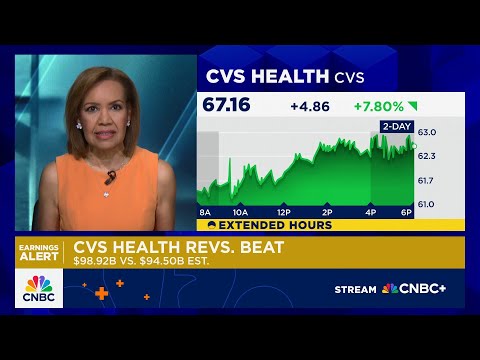
CVS beats estimates, hikes adjusted profit outlook on retail pharmacy and insurance unit strength
CNBC Television· 2025-07-31 10:56
Financial Performance - CVS Health's second quarter earnings exceeded expectations, with shares surging 7% [1][3] - Earnings per share (EPS) came in at A$181, approximately 19% above estimates [1] - Revenues reached 9892 billion, surpassing expectations across all three business segments [1] - The company is raising its 2025 guidance [1] Business Segment Performance - Pharmacy and consumer wellness segments were standouts [2] - CVS stores experienced a 154% increase in same-store sales, driven by gains in old Wraid customers and positive front-end comps [2] - Front-end comps were up 34%, marking the first positive result in 10 quarters [2] Healthcare Benefits (Aetna) - Aetna membership stood at 267 million, lower across Medicare, Medicaid, and exchange plans [2] - Employer enrollment increased [2] - The medical benefit ratio, slightly below 90%, was better than anticipated [2] - Aetna is facing higher costs, particularly in group Medicare Advantage plans, leading to reserve allocation [2] - Approximately half of these plans are slated for repricing in 2026 [2] Future Outlook - CVS feels confident about its pricing for the upcoming year [3] - Turnaround efforts at Aetna over the past 18-24 months have helped the company navigate Medicare reimbursement headwinds [3]